This motor yacht LiFePO4 house battery project shows how a marine battery bank can be configured for refrigeration, lighting, pumps, navigation equipment, onboard electronics and inverter-powered appliances.
The system review covers battery voltage and capacity, continuous and peak current, inverter load, shore-power charging, solar input, alternator charging, circuit protection and installation space.
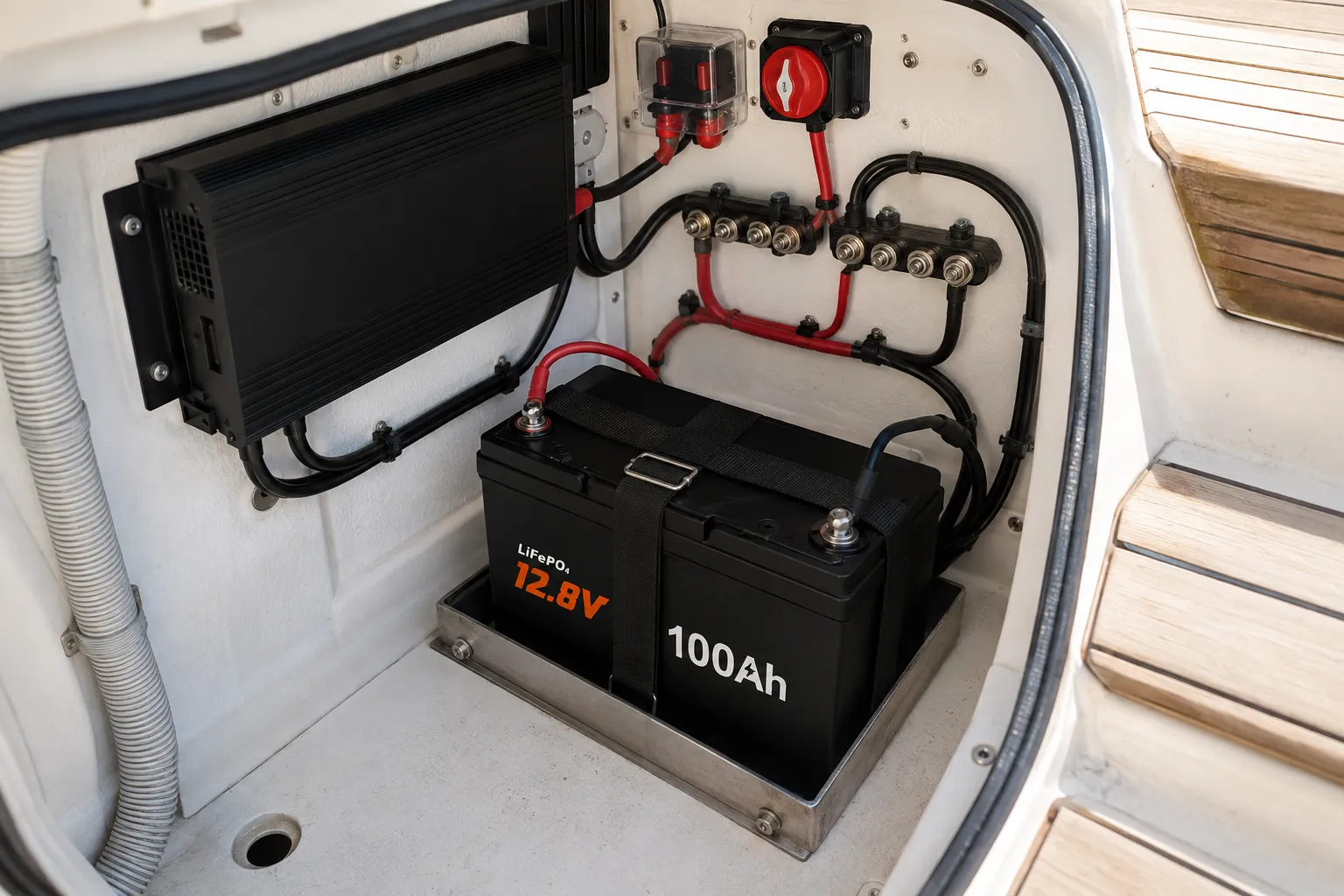
A yacht house battery must supply the normal DC loads and the current demanded by the inverter without exceeding the battery, BMS, cable or circuit-protection limits.
Before selecting the battery, confirm:
The following specification is an engineering reference for a medium-size 24V motor yacht house-power system. It is not presented as measured data from the installation shown in the photographs.
| Battery Bank Voltage | 25.6V nominal |
|---|---|
| Battery Capacity | 230Ah |
| Nominal Energy | 5888Wh |
| Continuous Discharge Current | 200A |
| Continuous Battery Output | 5120W at 25.6V |
| Peak Discharge Current | Confirm from the approved battery and BMS datasheet |
| Reference Battery Dimensions | Approximately 20.47 × 10.59 × 8.66 in |
| Reference Inverter | 24V 3000W pure sine wave inverter |
| Estimated Inverter Current | Approximately 130A at 3000W and 90% efficiency |
| Shore Charger | 29.2V 40A LiFePO4 charger |
| Reference Solar Array | Up to 800W, subject to available deck space and energy demand |
| Solar Charge Controller | 40A MPPT controller with approved LiFePO4 settings |
| Alternator Charging | 24V-output DC-DC charger or approved external alternator regulator |
| Battery Monitoring | Bluetooth monitoring available on selected configurations |
Important: Final specifications must be confirmed against the yacht’s actual loads, inverter surge current, original battery arrangement, cable lengths, compartment dimensions and charging equipment.
The reference battery provides 5888Wh of nominal energy from a 25.6V 230Ah configuration. Whether this capacity is suitable depends on the vessel’s daily energy use and the required reserve.
Battery runtime can be estimated using:
Estimated Runtime = Usable Battery Energy ÷ Average Connected Load
For planning purposes, using 80% of the nominal 5888Wh provides approximately 4710Wh of usable reference energy. At an average load of 500W, the calculated runtime is about 9.4 hours before allowing for inverter losses, changing loads and the selected battery reserve.
This is a design calculation, not a measured result from the pictured yacht.
A 3000W inverter places a substantial DC load on a 24V battery system. The approximate battery current can be calculated as follows:
Battery Current = Inverter Output ÷ Battery Voltage ÷ Inverter Efficiency
At 3000W, 25.6V and 90% inverter efficiency, the calculated battery current is approximately 130A. This is below the 200A continuous discharge rating of the reference battery.
Peak current must be checked separately. Motors, pumps, compressors and other inductive loads can draw significantly more power during startup. The inverter surge duration must be compared with the battery’s permitted peak current and the BMS protection settings.
The battery, BMS, main fuse, disconnect switch, busbars and cables must all be rated for the approved continuous and peak loads.
The reference system uses a 29.2V 40A LiFePO4 charger for shore-power charging. The charger must use a charging profile approved for the selected battery.
At an ideal constant output of 40A, charging 230Ah from empty would take approximately 5.75 hours. Actual charging time will be longer because of connected loads, charge tapering, system losses and the battery’s starting state of charge.
Before retaining an existing marine charger, confirm:
An 800W reference solar array can support refrigeration, lighting, electronics and other daytime loads while returning energy to the battery bank.
At a 29.2V charging voltage, 800W represents a theoretical current of approximately 27.4A before controller and environmental losses:
800W ÷ 29.2V = approximately 27.4A
A 40A MPPT controller provides suitable current headroom for this reference array. The controller’s maximum solar input voltage, power rating and charging parameters must be checked against the panel arrangement and battery specification.
Actual solar production depends on sunlight, panel angle, shading, temperature, wiring losses and controller efficiency.
Alternator charging must be controlled so that the LiFePO4 battery does not place an excessive or uncontrolled load on the alternator.
A 24V-output DC-DC charger or an approved external alternator regulator can be used to manage charging voltage and current. The correct solution depends on the engine alternator, vessel voltage, cable length and required charging rate.
Before approving the alternator-charging system, confirm:
Replacing a yacht lead-acid battery bank requires more than matching the nominal system voltage. The original batteries, charging equipment and complete DC power system must be documented before conversion.
The compatibility review should cover:
A correctly configured LiFePO4 house bank can provide more usable energy, lower weight and more stable voltage under load than a conventional lead-acid bank. The actual improvement depends on the batteries being replaced and the final system design.
View Lead-Acid Replacement Batteries →
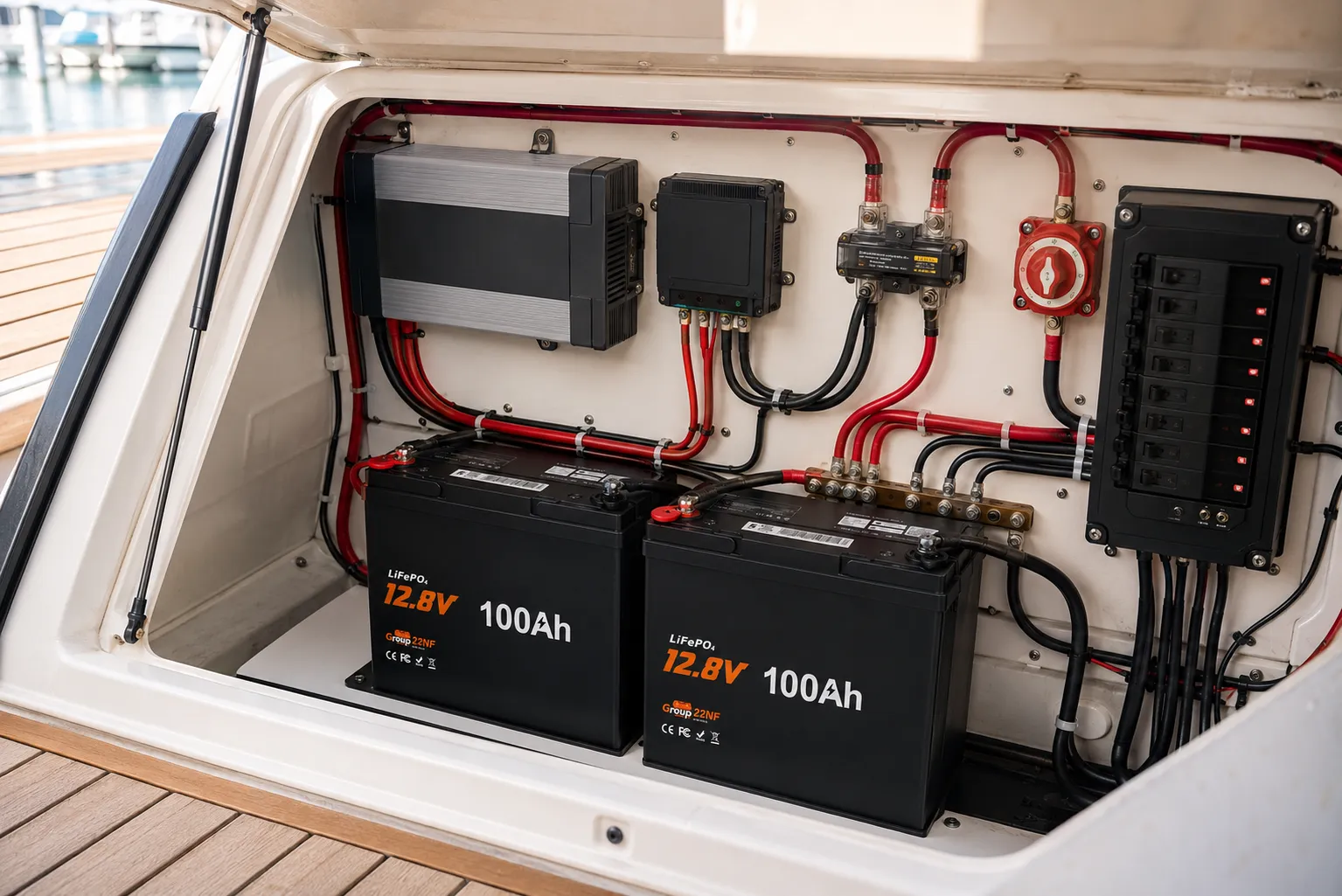
The battery must be secured against vessel movement and installed with appropriately rated circuit protection, supported cable routes and protected terminals.
The installation should include:
Cable and fuse selection must follow the approved inverter, charger, battery and vessel electrical requirements.
The BMS must support the battery’s cell configuration, charging limits, continuous current, inverter demand and permitted peak load.
Available options for selected marine battery configurations may include:
Bluetooth, CAN, RS485 and self-heating are configuration options and should not be treated as standard features on every battery.
The completed system should be tested under representative charging and discharging conditions before being placed into service.
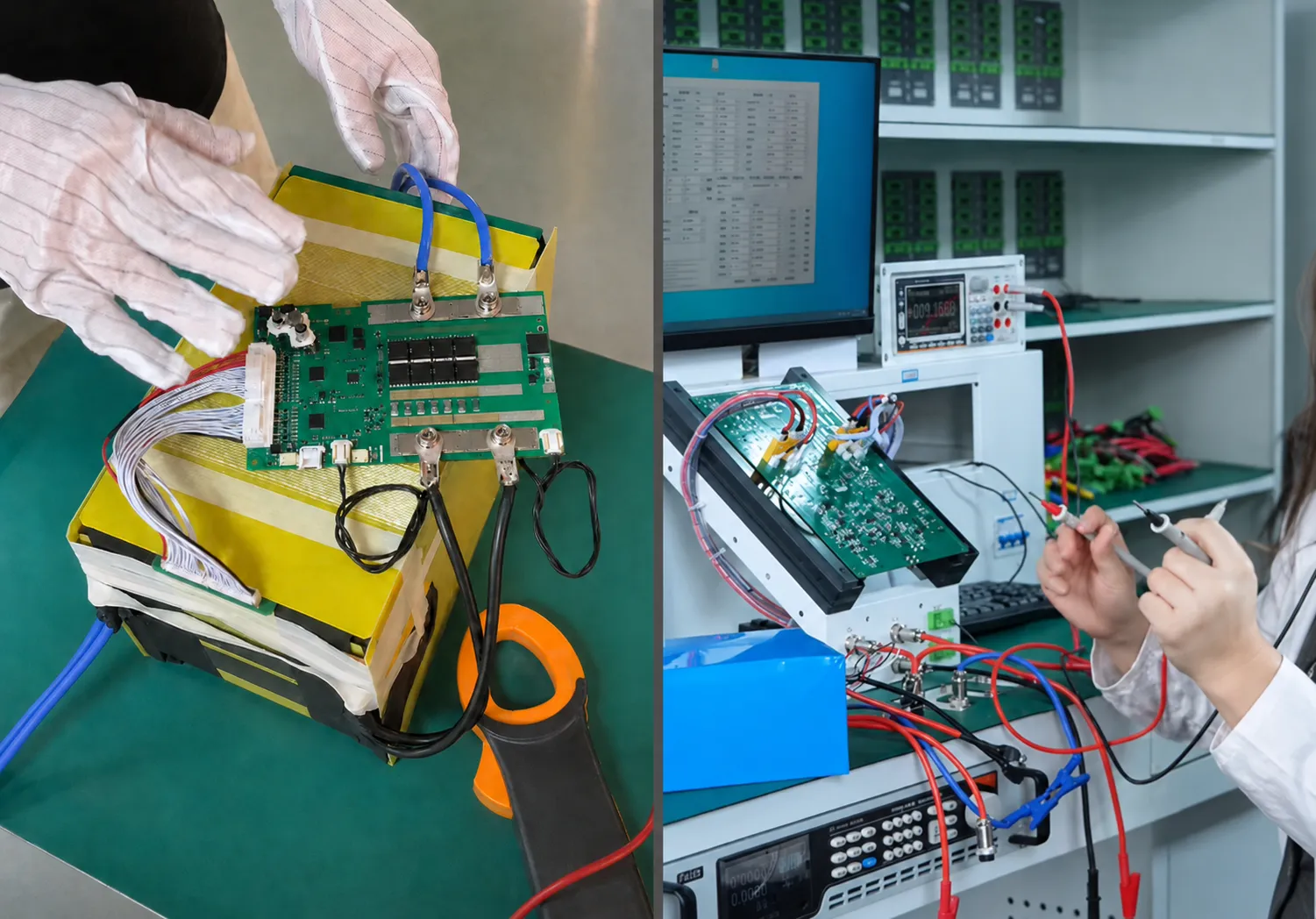
We support boat builders, marine equipment suppliers, battery brands and system integrators with custom marine LiFePO4 battery development and production.
OEM and ODM options include:
View OEM & ODM Battery Services →
Battery size depends on the vessel voltage, daily energy use, inverter load, required runtime, charging capacity, reserve setting and available installation space.
Yes, in many systems. The shore charger, alternator charging circuit, solar controller, inverter, cables, fuses, battery isolation and installation space must be checked before conversion.
At 3000W, 25.6V and 90% inverter efficiency, the calculated battery current is approximately 130A. Startup loads and inverter surge current must still be compared with the battery’s permitted peak-current rating.
It may be retained if its charging voltage, current, charging stages and control functions are compatible with the approved LiFePO4 battery specification.
Usually, yes. A DC-DC charger or approved alternator regulator helps control charging current and protect the alternator and battery system.
Yes. The solar charge controller must be correctly sized and configured with charging parameters suitable for the battery.
Send us the vessel voltage, original battery-bank details, required capacity, continuous and peak current, inverter power, battery-compartment dimensions, shore charger, solar controller, alternator information, communication requirements and estimated order quantity.
Our engineering team will review the system and recommend a suitable marine LiFePO4 battery configuration.