
LiFePO4 Technical Knowledge
Charging, Smart BMS, CAN/RS485, parallel batteries, SOC behavior and system troubleshooting.
LiFePO4 Battery Technical Knowledge Center →RV lithium battery troubleshooting for common LiFePO4 charging, BMS, inverter, shore power, alternator and DC-DC charger problems.
When an RV lithium battery stops charging, shuts down under load or shows incorrect state of charge, the battery itself is not always the cause. The problem may be in the converter, charger, DC-DC charger, alternator, inverter, wiring, fuse, disconnect switch or battery management system.
Start with the symptom and test the complete electrical system before replacing components.
View RV LiFePO4 Battery Solutions →
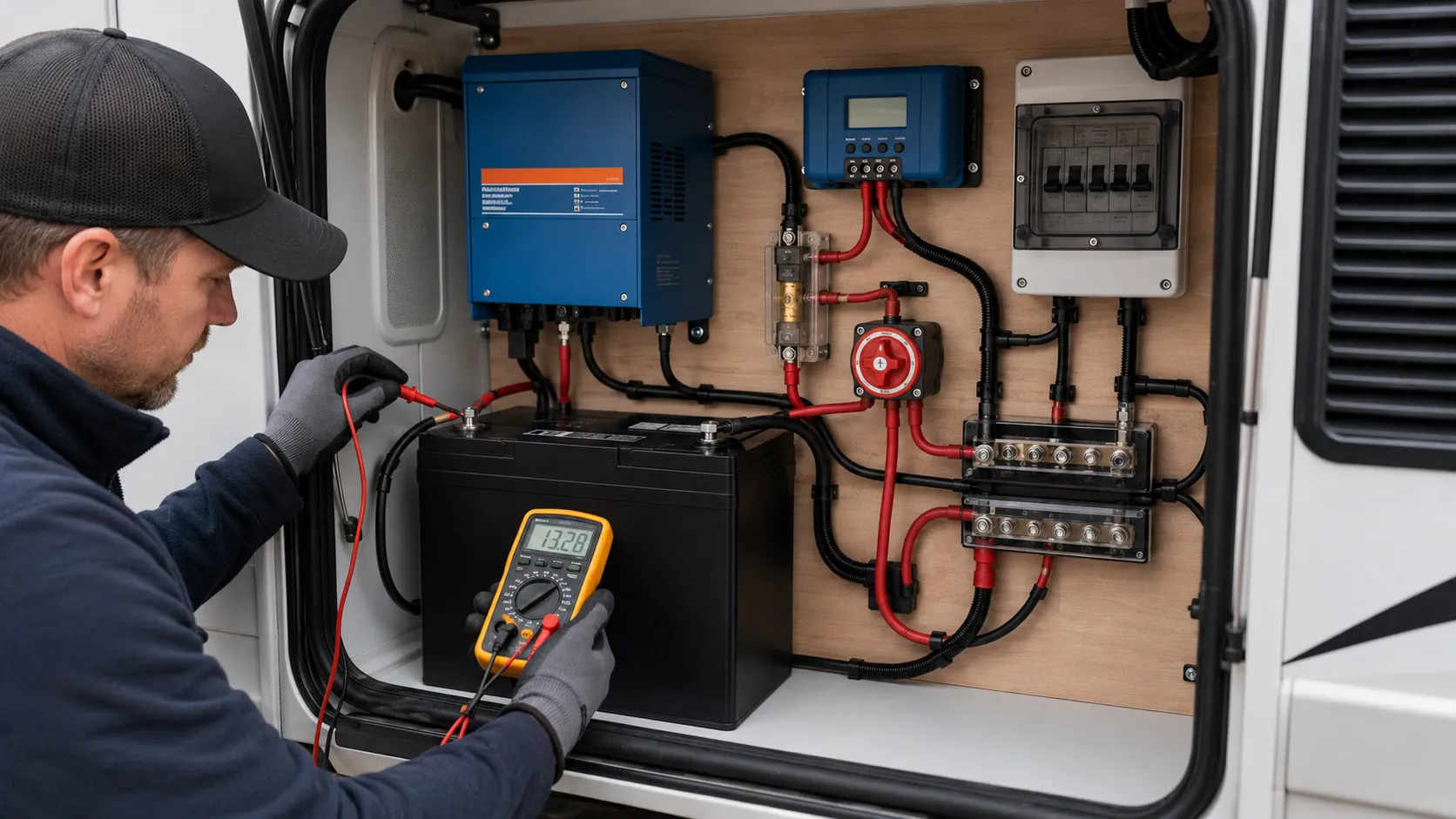
A clear symptom usually points to a smaller group of possible causes. Before disconnecting equipment, record battery voltage, state of charge, charger output and what was operating when the problem occurred.
| Symptom | Check First | Possible Cause |
|---|---|---|
| Battery does not charge on shore power | Charger output at battery terminals | Converter, fuse, disconnect switch, wiring or BMS protection |
| Battery does not charge while driving | DC-DC charger input and output | Alternator signal, wiring, fuse or charger settings |
| Battery shuts down under heavy load | Current demand and voltage under load | BMS current limit, voltage sag, loose cable or weak connection |
| Inverter reports low battery voltage | Voltage at battery and inverter terminals | Cable voltage drop, undersized cable or low state of charge |
| Battery will not charge in cold weather | Battery and cell temperature | Low-temperature BMS charging protection |
| State of charge looks incorrect | Battery monitor settings and full-charge synchronization | Incorrect monitor configuration or incomplete charge cycle |
If the RV is connected to shore power and AC appliances are working but the house battery is not charging, do not assume immediately that the lithium battery has failed.
Measure the charger or converter output first, then measure voltage directly at the battery terminals.
Check:
Replacing the converter without measuring voltage at the battery can leave the original fault unchanged if the real problem is a fuse, cable, disconnect switch or BMS protection condition.
RV Battery Not Charging on Shore Power: Full Troubleshooting Guide →
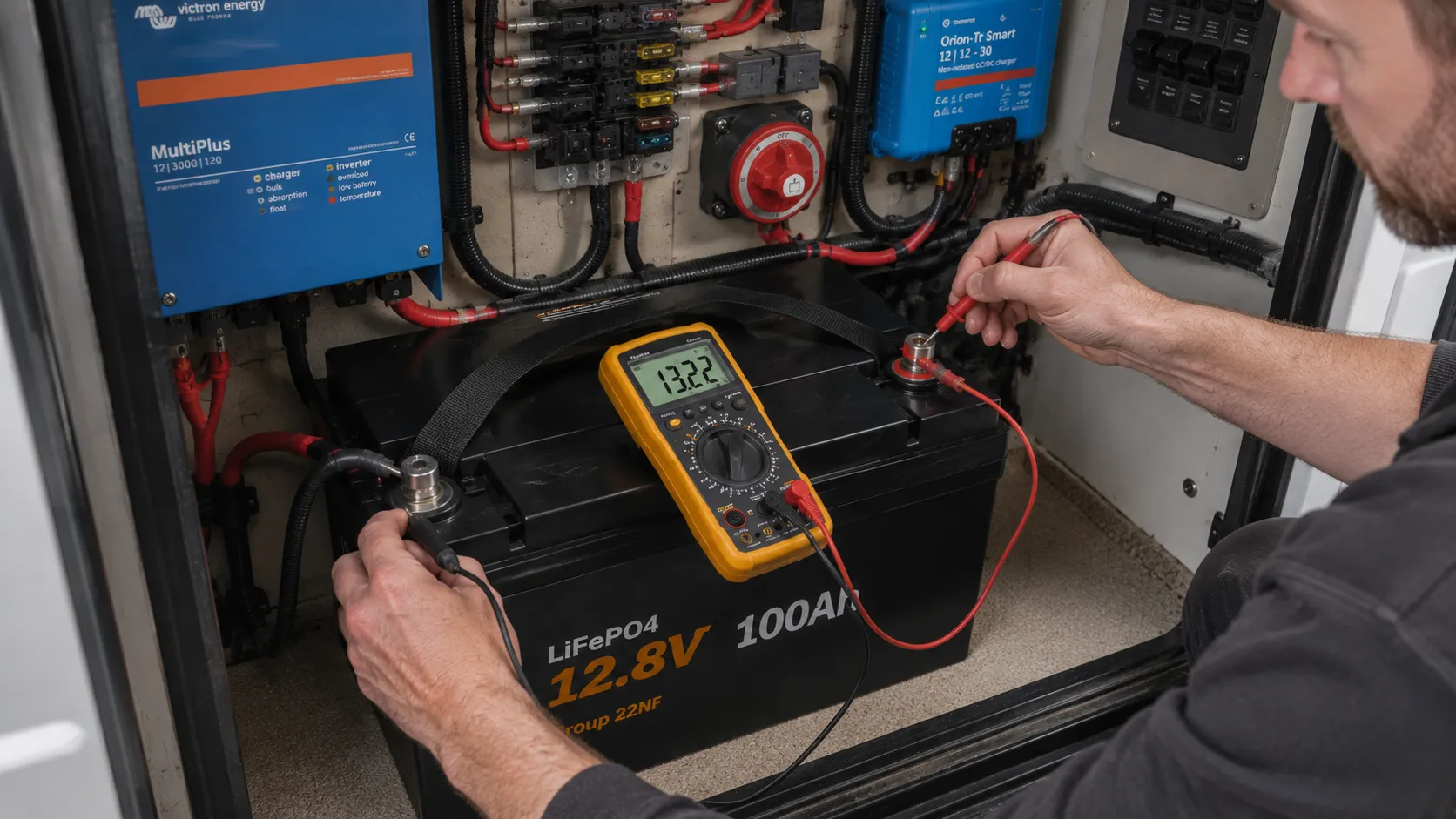
An older RV converter designed for flooded lead-acid, AGM or gel batteries may not provide an ideal charging profile for a LiFePO4 house battery.
Charger compatibility should be checked against the selected battery specification rather than assuming that any 12V charger will work.
Review:
If the existing RV converter cannot be configured for the battery's approved charging requirements, a compatible lithium charger or converter should be used.
Alternator charging problems are common after an RV lead-acid to lithium battery conversion.
A LiFePO4 battery can accept high charging current, but connecting it directly to an alternator is not always the correct system design. The alternator, cable size and charging architecture must all be considered.
Check:
If the battery charges correctly from shore power but not while driving, the DC-DC charging circuit should be tested separately.
Confirm voltage at the DC-DC charger input while the engine is running, then check output voltage at the charger and finally at the battery terminals.
A charger may appear to be powered but still provide no battery charging current because of an incorrect trigger signal, low input voltage, configuration setting or protection condition.
Common causes include:
RV Lithium Battery DC-DC Charger Compatibility →
The Battery Management System protects the LiFePO4 cells from operating outside approved voltage, current and temperature limits.
A BMS shutdown does not automatically mean the BMS is defective. It may be responding correctly to an electrical condition elsewhere in the RV.
Possible BMS protection events include:
Check battery voltage, cell data where available, connected load and charger behavior before resetting or replacing the battery.
An RV battery that works normally with lights and small electronics but shuts down when the inverter powers a large appliance may have a current, voltage-drop or connection problem.
Battery Ah tells you how much energy is stored. It does not tell you how much current the battery can safely deliver at one time.
Check:
An inverter may report low battery voltage even when the battery's resting voltage appears normal.
The important measurement is voltage while the inverter is under load. Measure voltage at both the battery terminals and the inverter DC input.
A significant difference between the two measurements normally indicates voltage drop in the cables, connectors, fuse, breaker or isolation switch.
High-current RV systems are sensitive to resistance. A connection that looks acceptable at low current may create a large voltage drop when an inverter, air conditioner or other heavy load starts.
Inspect:
Measure voltage drop under load instead of relying only on continuity tests.
Many LiFePO4 batteries use low-temperature charging protection to prevent charging the cells below the permitted temperature range.
When this protection is active, the battery may continue supplying loads but refuse charging current.
Check:
Do not bypass low-temperature charging protection without confirming the battery manufacturer's approved operating limits.
LiFePO4 batteries maintain relatively stable voltage through much of their discharge cycle, so estimating state of charge from voltage alone is less reliable than with many lead-acid batteries.
If a battery monitor shows an incorrect percentage, check:
Replacing an RV lead-acid battery with lithium is not simply a matter of installing the same voltage with more Ah.
The battery, converter, solar controller, alternator charging, inverter, cables and protection devices must work together as one system.
Before completing an RV lithium conversion, verify:
View Lead-Acid Replacement LiFePO4 Batteries →
For most RV lithium battery problems, use the same diagnostic sequence:
Changing one component at a time without measurements can make an RV electrical fault harder and more expensive to diagnose.
For RV manufacturers, conversion companies, installers and system integrators, battery troubleshooting often needs to include the complete electrical system rather than the battery alone.
Technical review can include battery sizing, BMS current requirements, inverter compatibility, charger settings, DC-DC charging, alternator integration, cable sizing and protection requirements.
Explore more guidance on LiFePO4 charging, Smart BMS protection, CAN communication and complete battery system integration.
Charging, Smart BMS, CAN/RS485, parallel batteries, SOC behavior and system troubleshooting.
LiFePO4 Battery Technical Knowledge Center →Review BMS current limits, chargers, inverters, CAN/RS485 protocol and complete system requirements.
LiFePO4 Battery System Compatibility →Explore LiFePO4 battery solutions for RV, camper van and motorhome electrical systems.
RV LiFePO4 Battery Solutions →Check converter or charger output, battery-side fuses, disconnect switches, cable continuity, ground connections and BMS charge protection. Working AC appliances do not confirm that charging voltage is reaching the battery.
Check the alternator charging circuit and DC-DC charger. Confirm charger input voltage, ignition signal, fuse condition, output voltage and lithium charging settings.
The inverter may be demanding more current than the battery or BMS can supply, or high resistance in the cables and connections may be causing excessive voltage drop during startup.
Measure voltage while the inverter is under load. Cable resistance, loose terminals, an undersized cable or a high-resistance fuse or disconnect switch can cause the inverter voltage to drop below its shutdown threshold.
Only when its charging voltage, current and charging profile are compatible with the selected battery. Equalization or incompatible desulfation modes should not be used with LiFePO4 batteries.
Many alternator-charged RV lithium systems use a DC-DC charger to regulate charging voltage and current. The correct requirement depends on the alternator, battery, cable size and charging architecture.
Low-temperature BMS protection may be preventing charging. Check battery temperature and the approved charging-temperature range before assuming the battery or charger has failed.
Not necessarily. Measure battery voltage, charging voltage, current and voltage drop first. Many battery complaints are caused by charging, wiring or system-integration problems.
Send us the battery voltage and capacity, inverter power, charger or converter model, DC-DC charger, alternator charging setup, cable size and a description of the problem. For commercial and OEM projects, our team can review the battery and surrounding RV electrical system together.
Request Technical Support →