Explore golf cart LiFePO4 battery projects covering 36V and 48V lead-acid replacement, high-current Smart BMS selection, motor-controller matching, charger compatibility, regenerative braking, custom battery-compartment fitment and OEM vehicle integration.
A reliable golf cart lithium conversion requires more than matching voltage and Ah. Battery current capability, controller demand, charger profile, regenerative current, cables, connectors, mounting space and state-of-charge monitoring should be reviewed as one vehicle system before sample development or production.
For battery selection and OEM system design, see Golf Cart Lithium Battery Solutions. For fault diagnosis, see Golf Cart Lithium Battery Troubleshooting.
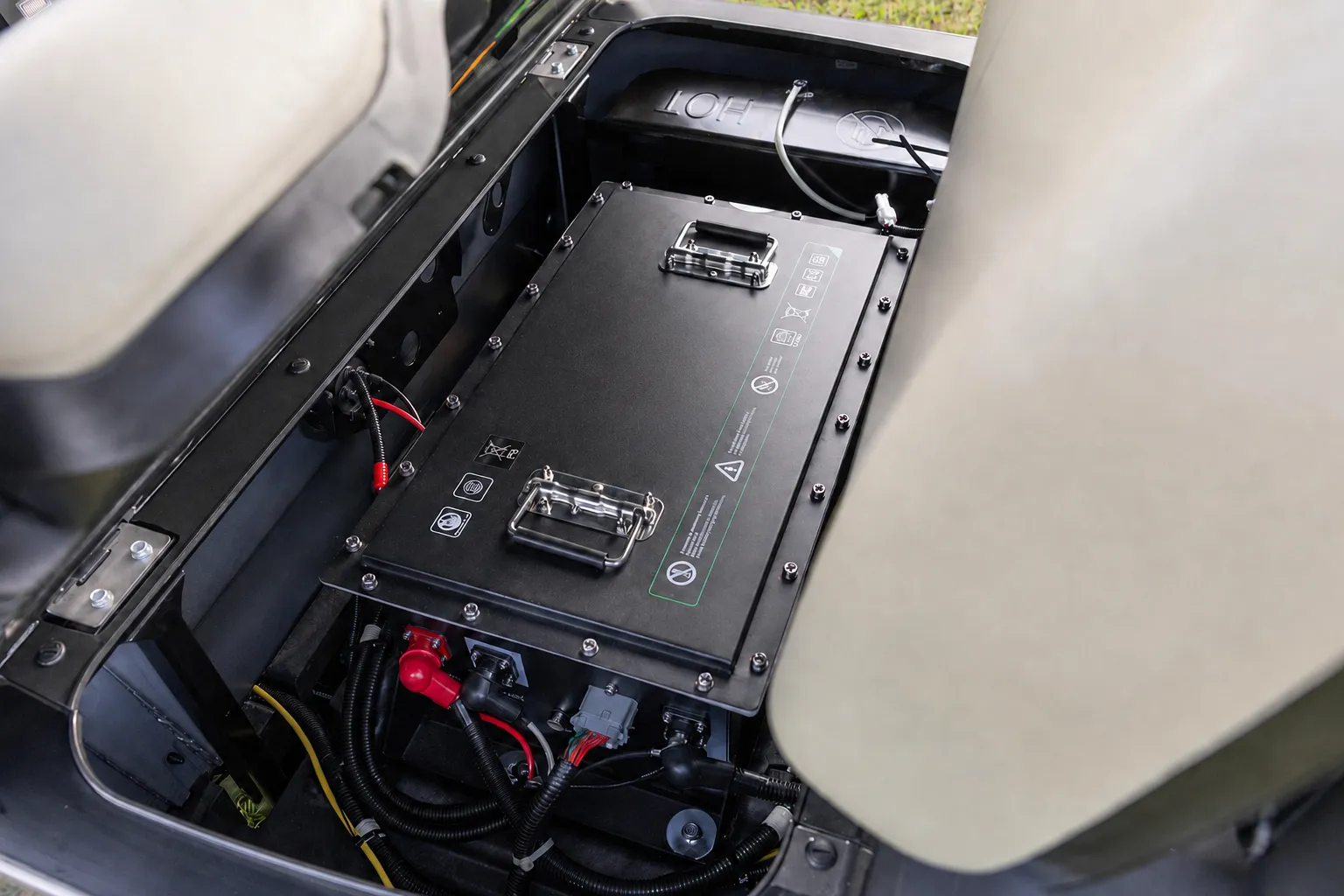
Start with the real retrofit case study or the engineering pathway closest to your vehicle. Reference sections below are clearly separated from measured project data.
A golf cart lithium conversion requires more than matching the original battery-bank voltage. The motor, controller, charger, cables, connectors, mounting structure and state-of-charge display must also work with the replacement battery.
The conversion review should include:
The original lead-acid charger should only be retained when its charging voltage, current and control profile are confirmed as compatible with the approved LiFePO4 battery.
Read the LiFePO4 Lead-Acid Replacement Guide →
The following specification is an engineering reference for a standard 36V golf cart conversion. It should not be presented as measured data from the installation shown in the photographs.
| Nominal Battery Voltage | 38.4V |
|---|---|
| Rated Capacity | 100Ah |
| Nominal Energy | 3840Wh |
| BMS Rating | 100A |
| Continuous Discharge Current | 100A |
| Peak Discharge Current | Up to 600A for 1 second |
| Reference Motor Power | Up to approximately 3000W, subject to controller and startup current |
| Controller Requirement | Continuous and peak current must remain within the approved BMS limits |
| Matched Charger | 43.8V 25A LiFePO4 charger |
| Reference Charging Time | Approximately 4 hours from empty under ideal conditions |
| Reference Driving Range | Up to approximately 35 miles under suitable operating conditions |
This 36V configuration can replace a conventional bank of six 6V lead-acid batteries when the vehicle voltage, controller, charger and installation dimensions are compatible.
A single integrated battery reduces inter-battery cables and connection points. The existing battery tray may still require a mounting frame or hold-down brackets.
A 38.4V battery supplying 100A can provide a theoretical electrical output of 3840W. For vehicle applications, the reference continuous motor load is limited to approximately 3000W to allow for controller losses, acceleration and operating margin.
The motor controller must be checked for:
A controller displaying a high peak-current rating is not automatically compatible. The duration of the current must also remain within the battery and BMS limits.
The following reference configuration is intended for 48V golf carts and utility vehicles requiring greater power for acceleration, hills, passenger loads or commercial operation.
| Nominal Battery Voltage | 51.2V |
|---|---|
| Rated Capacity | 100Ah |
| Nominal Energy | 5120Wh |
| BMS Rating | 200A protection platform; operating limits depend on the approved model |
| Continuous Discharge Current | 100A |
| Short-Duration Discharge Current | Up to 200A for 2 minutes |
| Peak Discharge Current | Up to 600A for 1 second |
| Maximum Continuous Output | Approximately 5120W |
| Reference Motor Power | Up to approximately 5000W, subject to controller and startup-current validation |
| Matched Charger | 58.4V 18A LiFePO4 charger |
| Reference Charging Time | Approximately 5.5 hours from empty under ideal conditions |
| Reference Driving Range | Approximately 40–50 miles under suitable operating conditions |
The 48V reference can replace a conventional bank of six 8V lead-acid batteries when the vehicle and charging system are compatible.
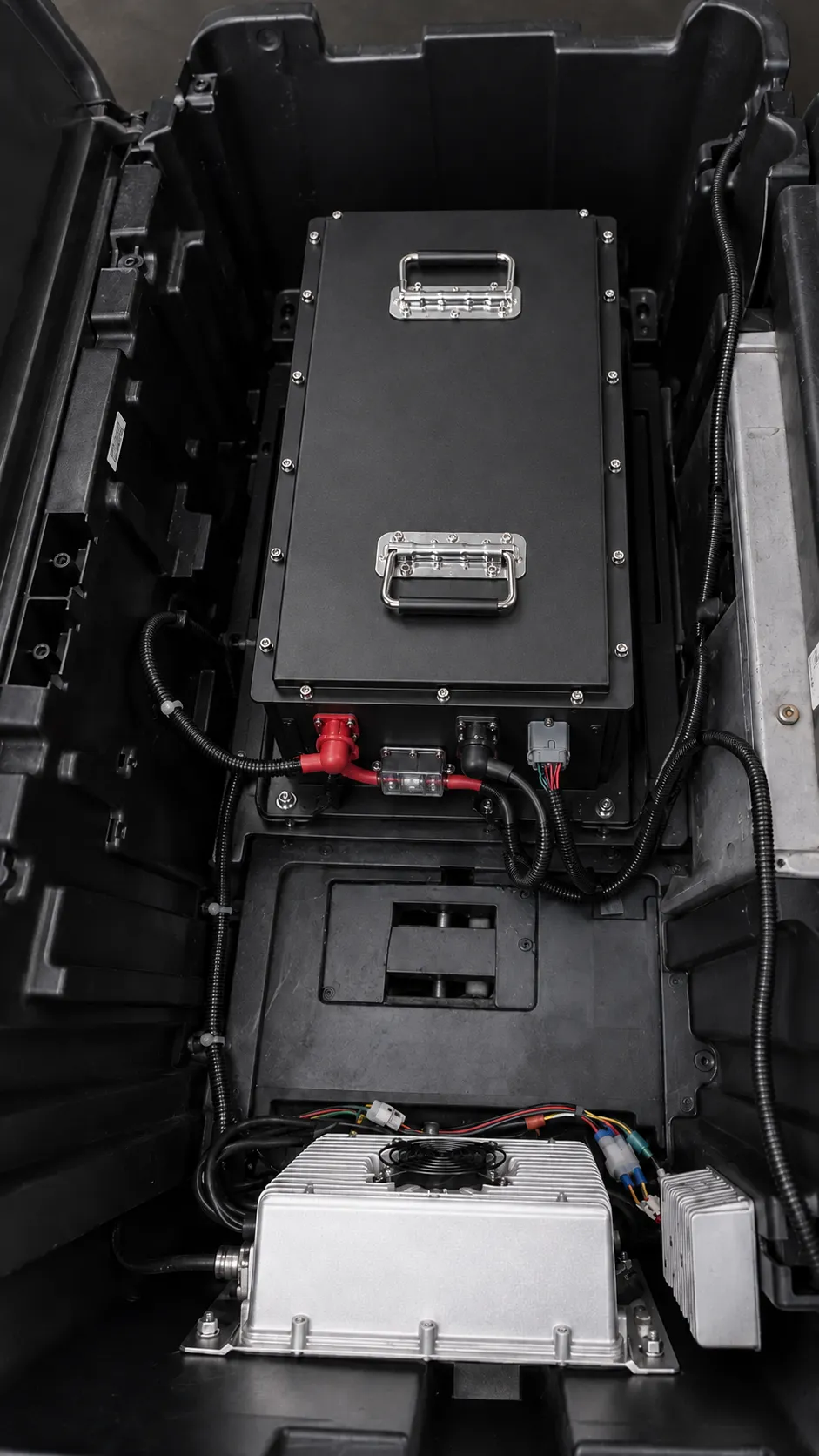
The reference 51.2V battery supports 100A continuously, up to 200A for two minutes and up to 600A for one second. These current limits must be compared with the controller’s battery-current demand rather than only its phase-current rating.
A 5kW motor does not continuously draw exactly 5kW in normal driving. Current changes with acceleration, vehicle weight, speed, gradient, tire pressure and controller efficiency.
Before approving a 48V configuration, confirm:
Driving range cannot be calculated accurately from battery capacity alone. It also depends on vehicle energy consumption per mile.
Estimated Range = Usable Battery Energy ÷ Average Vehicle Energy Consumption
| Reference System | Nominal Energy | Published Reference Range | Approximate Energy Use |
|---|---|---|---|
| 38.4V 100Ah | 3840Wh | Up to 35 miles | About 110Wh per mile |
| 51.2V 100Ah | 5120Wh | Approximately 40–50 miles | About 102–128Wh per mile |
These figures are planning references derived from published battery energy and range claims. They are not measured results from the vehicles shown on this page.
Actual range depends on:
A matched LiFePO4 charger is recommended for a lead-acid-to-lithium conversion. The charging voltage and current must follow the approved battery specification.
Estimated charging time is calculated by dividing battery capacity by charger current. Actual time may be longer because of charger efficiency, battery temperature, connected loads and charge-current tapering.
The battery enclosure, mounting brackets, cable outlets and connector positions should be configured around the vehicle’s existing battery compartment.
Before production, confirm:
The battery must remain secure during acceleration, braking and operation on uneven terrain. Power cables should be supported and protected from sharp edges, heat and moving vehicle components.
See the 48V Golf Cart LiFePO4 Retrofit for Limited Space Case Study →
The BMS is selected according to the battery voltage, capacity, controller current, motor load, charging system and operating temperature.
Available options can include:
Bluetooth, CAN and RS485 are available options rather than standard features on every battery. Compatibility must be confirmed against the selected BMS, display, controller and communication protocol.
A sample battery should be tested against the approved vehicle and electrical specification before volume production.
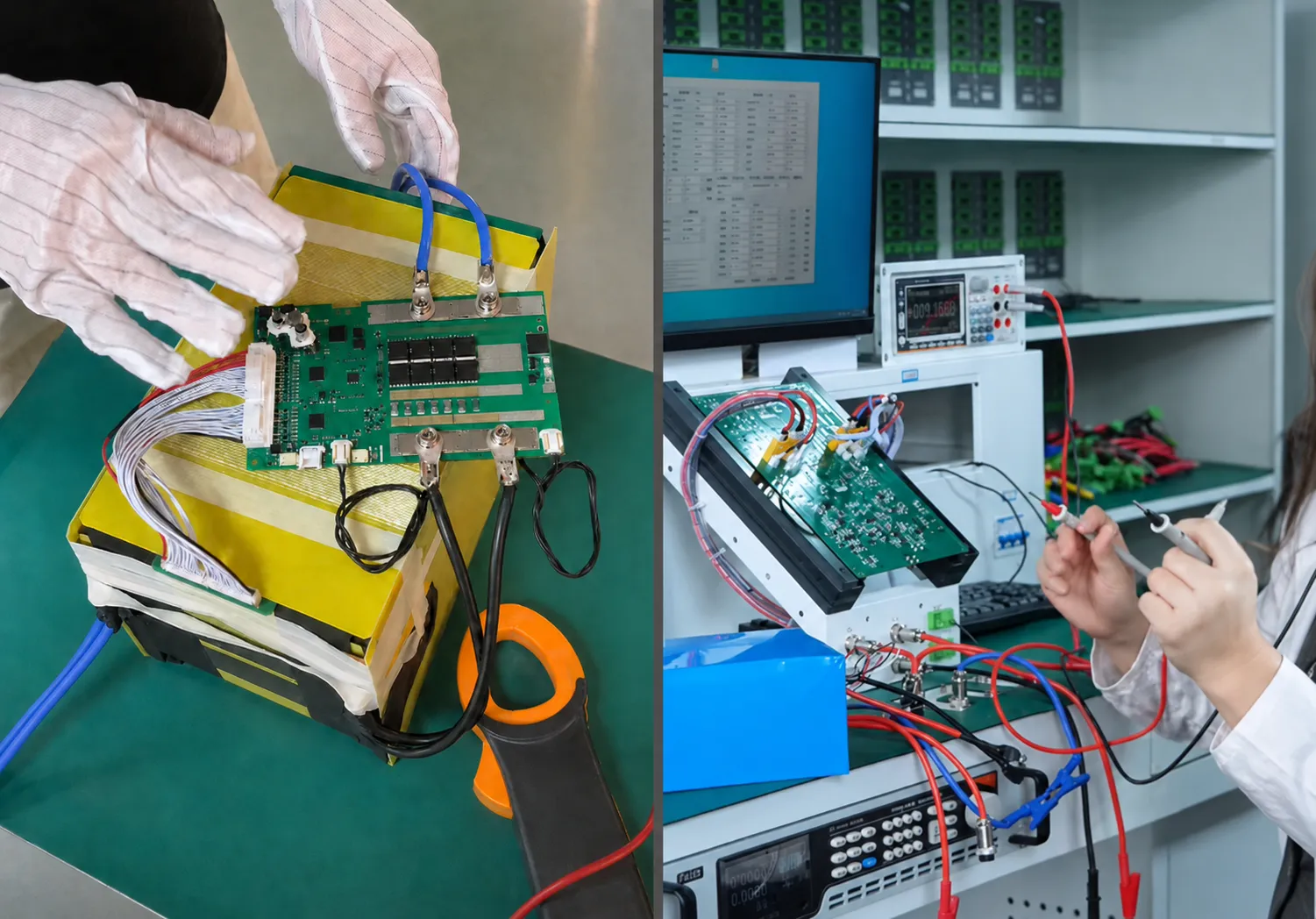
View LiFePO4 Battery Testing & Validation →
View LiFePO4 Battery Manufacturing & Quality Control →
We support golf cart manufacturers, vehicle converters, distributors and fleet operators with custom LiFePO4 battery development and production.
OEM and ODM options include:
View OEM & ODM Battery Development →
Continue from golf cart project planning to the verified technical resources most relevant to battery selection, BMS current, controller demand, regenerative braking, charging compatibility, testing and lead-acid replacement.
Yes. The vehicle voltage, motor, controller, charger, cables, connectors, battery tray and state-of-charge display must be checked before conversion.
The replacement battery must match the vehicle electrical system. A 36V vehicle normally uses a 38.4V LiFePO4 battery, while a 48V vehicle normally uses a 51.2V LiFePO4 battery.
A 100Ah battery is suitable for many golf carts, but the required capacity depends on driving range, motor power, vehicle load, terrain, speed and available installation space.
It may support a 5kW motor when the controller’s continuous, short-duration and peak battery currents remain within the approved battery and BMS limits. The complete vehicle specification must be checked before approval.
Published reference figures are approximately 35 miles for a 38.4V 100Ah configuration and approximately 40–50 miles for a 51.2V 100Ah configuration. Actual range varies with the vehicle and operating conditions.
Only when its voltage, current and charging profile are confirmed as compatible. A matched LiFePO4 charger is generally recommended.
Yes. Enclosure dimensions, mounting brackets, terminals, cables, connectors and charging interfaces can be developed for qualified OEM projects.
Review vehicle-specific conversion considerations for battery voltage, controller current, charger compatibility, wiring and available installation space. Final compatibility must be confirmed for the specific vehicle model and year.
Send us the golf cart model, original lead-acid battery configuration, system voltage, required capacity, motor power, controller continuous and peak current, battery-compartment dimensions, charger information, required driving range and estimated order quantity.
Our engineering team will review the vehicle requirements and recommend a suitable 36V or 48V golf cart LiFePO4 battery configuration.
Request a Golf Cart Battery Project Quote →