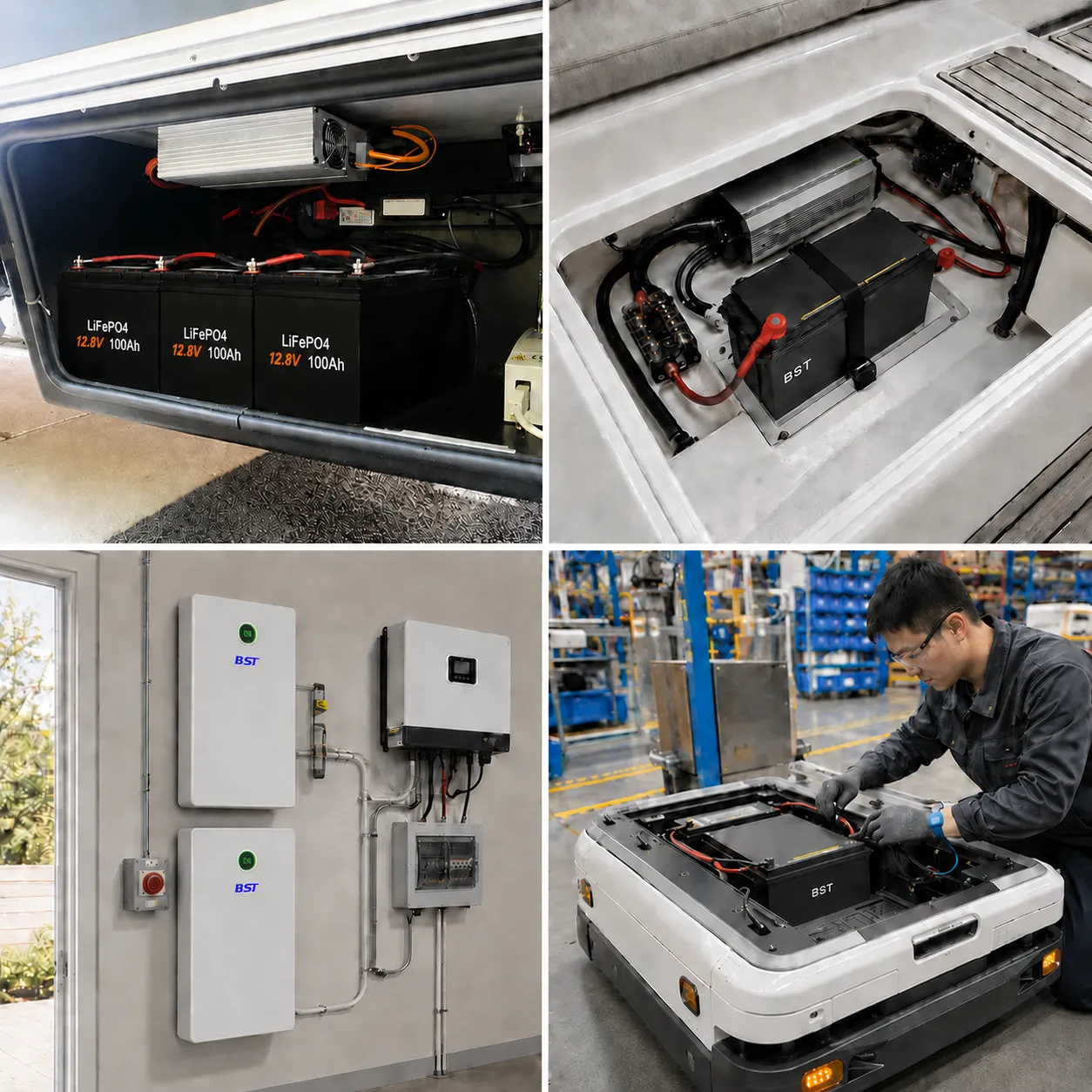
RV · Marine · Energy Storage · Industrial Applications

LiFePO4 Battery Application Guides

Find the right LiFePO4 battery configuration for your equipment, available installation space and power requirements.

These guides cover lead-acid replacement, voltage and capacity selection, discharge current, charging compatibility, Smart BMS options and custom OEM battery development.

LiFePO4 battery configurations for RV marine golf cart energy storage and industrial equipment
LiFePO4 battery configurations for mobile, marine, energy storage and industrial equipment.

RV LiFePO4 Battery Guide

Select an RV LiFePO4 battery according to the electrical-system voltage, daily energy use, inverter power, charging sources and required off-grid runtime.

Important selection factors include:

  • 12V and 24V RV battery configurations
  • Lead-acid to LiFePO4 battery replacement
  • Battery capacity and off-grid runtime
  • Continuous and peak inverter current
  • AC charger and solar-controller compatibility
  • Alternator and DC-DC charging
  • Low-temperature charging protection
  • Optional self-heating and Bluetooth monitoring
RV LiFePO4 battery system with inverter solar charging and circuit protection
RV LiFePO4 battery installation with charging and circuit-protection equipment.

View RV Battery Solutions →


Marine LiFePO4 Battery Guide

Marine batteries must be selected for their intended use. House-power systems, trolling motors and engine-starting applications have different current, charging and installation requirements.

Important selection factors include:

  • 12V, 24V, 36V and 48V marine battery systems
  • Marine lead-acid to LiFePO4 conversion
  • Sailboat and motor-yacht house batteries
  • Trolling motor battery selection
  • Verified CCA or MCA ratings for starting applications
  • Alternator, shore charger and solar integration
  • Marine terminals, cables and circuit protection
  • Battery mounting and compartment dimensions
Marine LiFePO4 battery electrical system with inverter charger fuse and busbars
Marine LiFePO4 battery integration with onboard charging and electrical equipment.

View Marine Battery Solutions →


Golf Cart Lithium Battery Guide

Select a golf cart lithium battery according to the vehicle voltage, motor power, controller current, passenger or cargo load, terrain and required driving range.

Important selection factors include:

  • 24V, 36V and 48V battery configurations
  • Golf cart lead-acid to lithium conversion
  • Motor and controller compatibility
  • Continuous and peak discharge current
  • Driving-range and capacity calculations
  • High-current Smart BMS selection
  • Charger, connector and cable compatibility
  • Bluetooth, CAN and RS485 options
  • Custom enclosures and mounting brackets
48V golf cart lead-acid to LiFePO4 lithium battery conversion
48V LiFePO4 battery installation for a golf cart and low-speed vehicle.

View Golf Cart Battery Solutions →


Industrial LiFePO4 Battery Guide

Industrial LiFePO4 batteries are configured around the equipment voltage, operating current, peak load, required runtime, charging system and available battery compartment.

Applications and engineering options include:

  • AGV and AMR battery systems
  • Floor scrubber and cleaning machine batteries
  • Mobility scooter and wheelchair batteries
  • Agricultural equipment batteries
  • Solar tracker battery systems
  • Custom voltage, capacity and discharge current
  • Smart BMS, CAN and RS485 integration
  • Custom enclosures, connectors and wiring harnesses
Industrial LiFePO4 batteries for AGVs cleaning machines and mobility equipment
Custom LiFePO4 batteries for industrial automation and mobility equipment.

View Industrial Battery Solutions →

Agricultural Equipment Batteries

LiFePO4 battery systems can be developed for automated feeding systems, egg-collection equipment, farm control systems and agricultural backup power.

Battery voltage, capacity, enclosure, charging method and BMS protection are selected according to the equipment and operating environment.

LiFePO4 battery for automated poultry farm and agricultural equipment
LiFePO4 battery configuration for automated poultry-farm equipment.

View Agricultural Battery Project →

Solar Tracker Battery Systems

Solar tracker batteries must support controller loads, motor startup current and the required backup time during periods of limited solar generation.

Selection factors include system voltage, peak current, charging configuration, outdoor enclosure, operating temperature and remote-monitoring requirements.

LiFePO4 battery and control cabinet for a solar tracking system
LiFePO4 battery integrated with a solar tracker control system.

View Solar Tracker Battery Solutions →


Home Energy Storage Battery Guide

Plan a residential LiFePO4 battery system around daily electricity use, essential loads, required backup time, inverter power and available solar generation.

Important selection factors include:

  • 48V and 51.2V LiFePO4 battery systems
  • Residential solar self-consumption
  • Essential-load and home backup power
  • Wall-mounted, floor-standing and rack-mounted batteries
  • Hybrid inverter compatibility
  • CAN and RS485 communication
  • Parallel capacity expansion
  • Installation and circuit protection
Residential solar LiFePO4 home battery energy storage system
Residential LiFePO4 battery system for solar storage and backup power.

View Residential Energy Storage Solutions →

How to Select a LiFePO4 Battery

  1. Identify the equipment and battery application.
  2. Confirm the required system voltage and capacity.
  3. Calculate the continuous and peak discharge current.
  4. Measure the available installation space.
  5. Confirm the charger, inverter, motor or controller model.
  6. Identify Bluetooth, CAN or RS485 requirements.
  7. Review low-temperature charging conditions.
  8. Confirm the estimated sample and production quantities.

For a lead-acid replacement project, also provide the original battery model, battery dimensions, terminal arrangement and charging method.

OEM Battery Selection and Engineering Support

We support equipment manufacturers, battery brands, distributors and system integrators with custom LiFePO4 battery development, sample testing and volume production.

Available OEM options include:

  • Custom voltage, capacity and discharge current
  • Smart BMS protection settings
  • Bluetooth, CAN and RS485 options
  • Custom battery enclosures and mounting points
  • Custom terminals, cables and connectors
  • Low-temperature charging protection
  • Optional self-heating
  • Private labels and packaging
  • Prototype testing and production quality control
LiFePO4 battery charge discharge Smart BMS and communication testing
Charge-discharge, Smart BMS and communication testing before OEM production.

View OEM & ODM Battery Services →

LiFePO4 Battery Selection FAQ

What information is required to select a LiFePO4 battery?

Provide the application, system voltage, required capacity, continuous and peak current, installation dimensions, charging equipment and estimated order quantity.

Can LiFePO4 batteries replace lead-acid batteries?

Yes, in many applications. The charger, inverter, controller, alternator, cables, fuses, battery dimensions and operating temperature must be checked before replacement.

How is the required battery capacity calculated?

Capacity is based on the connected load, daily operating time, required backup time, available charging energy and the reserve required by the application.

Are Bluetooth, CAN and RS485 available?

Selected battery systems support Bluetooth, CAN or RS485. Availability depends on the battery model, Smart BMS and connected equipment.

Can the battery enclosure and connectors be customized?

Yes. Battery dimensions, mounting points, terminals, cables and connectors can be reviewed for qualified OEM projects.

Discuss Your Battery Project

Send us the equipment type, required voltage and capacity, continuous and peak current, installation dimensions, charging equipment, communication requirements and estimated order quantity.

Our engineering team will review the information and recommend a suitable LiFePO4 battery configuration.

Request a Quote →

Contact Technical Support →