Golf cart lithium battery problems are not always caused by a bad battery.
A cart that shuts down under load, loses power uphill,
cuts out during regenerative braking, will not wake after storage
or refuses to charge may have a problem involving the
BMS, motor controller, charger, cell voltage,
wiring or system configuration
.
This golf cart lithium battery troubleshooting guide helps identify
common symptoms and shows what should be checked before replacing
the battery, controller or charger.
Golf cart lithium battery shutdown can occur when current demand,
BMS limits, cell voltage or system resistance are not correctly matched.
Start With the Golf Cart Battery Symptom
The operating condition where the problem occurs is often the first useful clue.
Uphill shutdown, downhill regenerative cutoff and a battery that will not wake
after storage require different checks.
Golf Cart Shuts Down Uphill or During Hard Acceleration
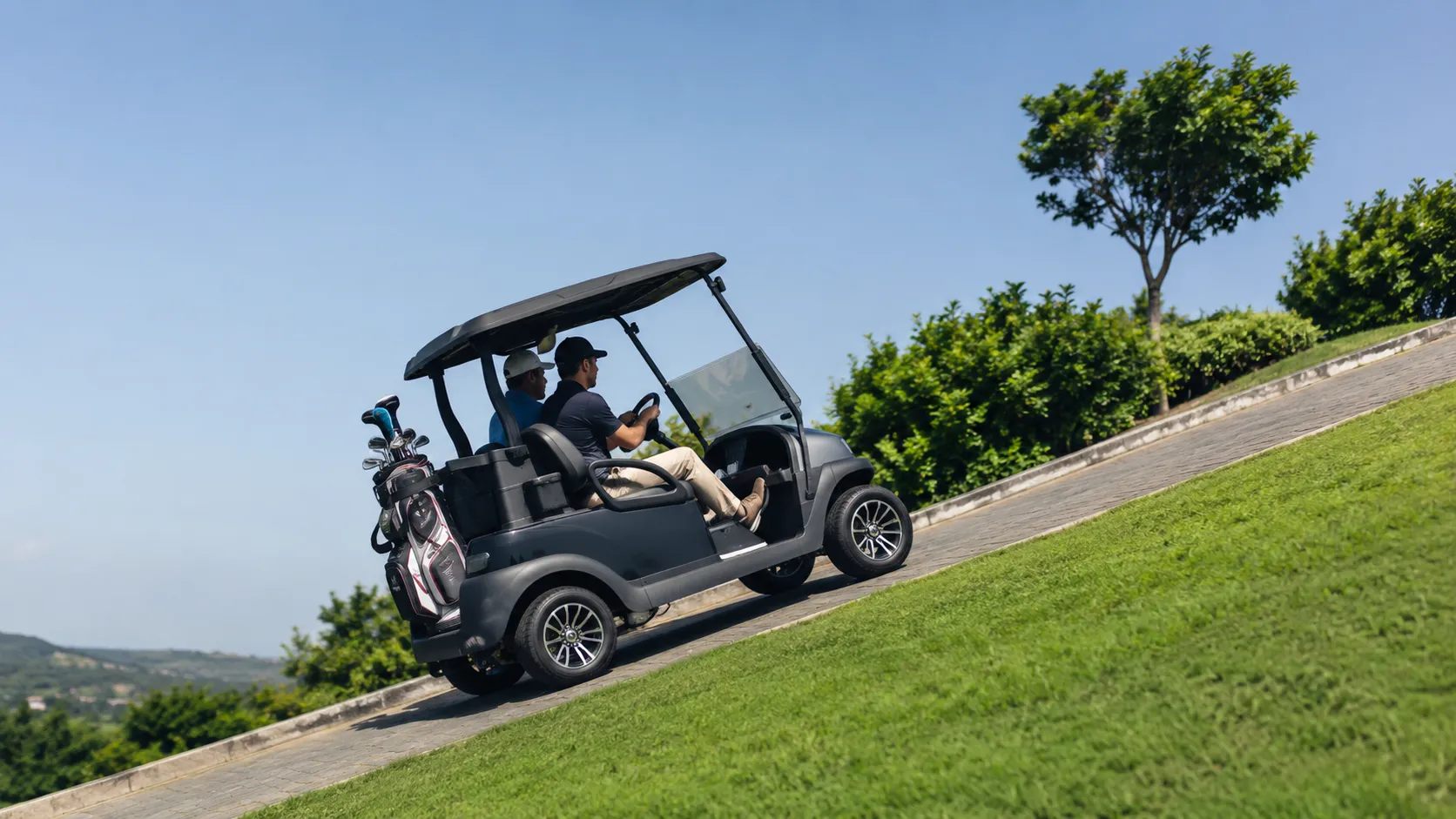
If the cart drives normally on flat ground but loses power while climbing,
carrying a heavier load or accelerating hard, check continuous and peak
discharge current, BMS protection limits, controller demand,
cell voltage and voltage sag under load.
Golf Cart Cuts Out During Regenerative Braking or Downhill Driving
Regenerative braking sends energy back toward the lithium battery.
If the battery is near full SOC, regen current exceeds the BMS charge limit,
or one cell reaches high-voltage protection,
the BMS may activate protection.
Golf Cart Lithium Battery Won’t Wake Up After Storage
If the cart worked before storage but now has no battery output,
check BMS sleep mode, low-voltage protection, parasitic drain,
battery-terminal voltage, charger detection, fuses and disconnect
switches before replacing the battery.
Different symptoms can have similar causes. Before replacing components,
identify exactly when the fault occurs and review the complete
battery and vehicle system.
Golf cart shuts down during hill climbing
Battery cuts out during hard acceleration
BMS enters over-current protection
Battery voltage drops sharply under load
One LiFePO4 cell reaches low-voltage protection first
Golf cart cuts out during regenerative braking
BMS enters high-voltage or charge over-current protection
Battery will not wake after storage or deep discharge
Battery will not charge correctly
Existing lead-acid charger is not compatible with LiFePO4
Golf cart range is shorter than expected
Battery SOC display appears inaccurate
Battery, controller and motor current requirements do not match
Cables, terminals or connectors create excessive voltage drop
1. Check the BMS Current Capability
Battery capacity and battery power capability are not the same thing.
Amp-hours mainly affect stored energy and potential driving range,
while BMS continuous and peak current ratings
help determine how much current the battery can safely supply.
A golf cart battery can have enough capacity for the required range
but still shut down when the motor controller demands high current
during acceleration, hill climbing or heavy-load operation.
2. Check Golf Cart Battery Voltage Under Load
Measuring battery voltage while the golf cart is parked does not always reveal
what happens during a high-current event.
Monitor battery voltage while accelerating or climbing a hill where practical.
Excessive voltage sag can be related to high current demand, low SOC,
cell imbalance, internal resistance or high-resistance cables and connections.
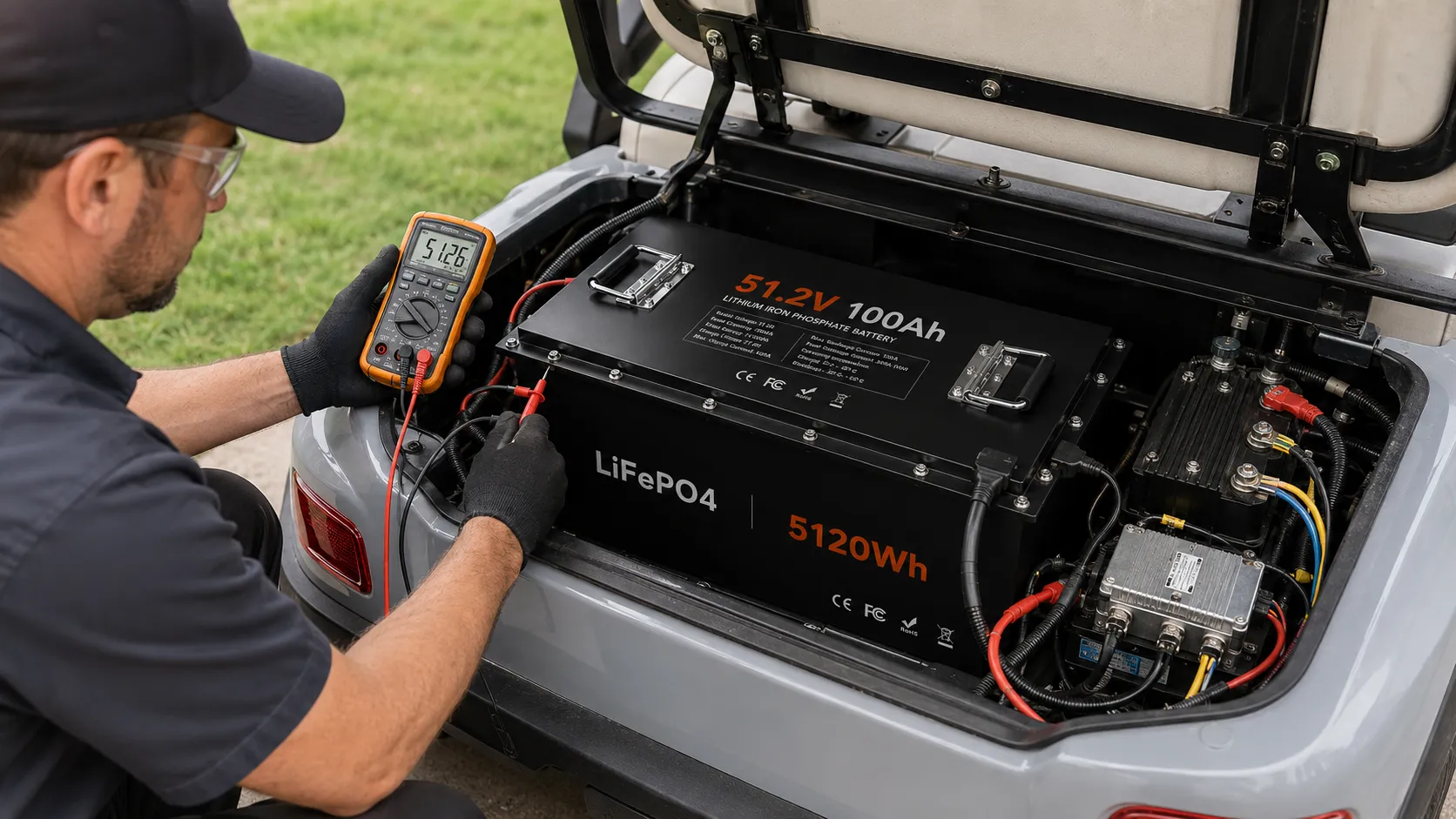
Checking golf cart lithium battery voltage,
high-current cables and electrical connections during troubleshooting.
3. Review Individual LiFePO4 Cell Voltage
Total pack voltage may look normal while one cell is weaker than the others.
Under heavy load, that cell can reach the BMS low-voltage threshold
before the rest of the battery.
Near full charge, the opposite can occur: one cell may reach the
high-voltage protection threshold first, especially when regenerative
braking sends energy back into the battery.
4. Compare the Golf Cart Controller With the Battery
The motor controller determines how much current is requested from the battery.
Controller demand can increase substantially during startup, acceleration,
steep hill climbing and heavier vehicle loads.
Compare the controller's
battery-current requirement
with the battery's continuous, short-duration
and peak discharge-current capability.
Do not select the battery from motor kW or Ah alone.
5. Check Regenerative Braking Requirements
Golf carts with regenerative braking require the battery
to handle current in two directions.
During acceleration:
Battery → Controller → Motor
During regenerative braking:
Motor → Controller → Battery
This means the battery must be selected for both
discharge-current capability and regenerative charge-current capability.
Validate the System Before OEM or Fleet Production
Testing the intended battery with the actual controller,
charger and representative operating conditions can help identify
current, charging, BMS and integration issues before the final
battery specification is approved.
Planning a Lead-Acid to Lithium Golf Cart Conversion?
Review system voltage, motor, controller current, charger,
battery compartment, cables and regenerative-braking requirements
before selecting the replacement battery.
Send the golf cart model, system voltage, motor and controller information,
battery specification, BMS rating, charger and the operating condition
where the problem occurs for a system-level review.