
Technical Knowledge
BMS, charging, CAN/RS485, parallel batteries and troubleshooting.
Technical Knowledge Center →Selecting a LiFePO4 battery involves more than matching voltage and Ah capacity.
For reliable system integration, the LiFePO4 battery, Smart BMS, charger, inverter, CAN/RS485 communication, wiring, protection devices and application load must work together as one complete system.
Nominal voltage and battery capacity are only the starting point. Reliable lithium battery integration requires electrical, charging and communication compatibility across the complete system.
For detailed guidance on Smart BMS protection, charging, CAN/RS485 communication, series and parallel batteries, SOC behavior and LiFePO4 troubleshooting, explore our LiFePO4 Battery Technical Knowledge Center →
A LiFePO4 battery operates as part of a larger electrical system. A battery can have the correct voltage and sufficient capacity but still develop charging problems, communication faults, unexpected BMS shutdowns or limited performance if surrounding equipment is not properly matched.
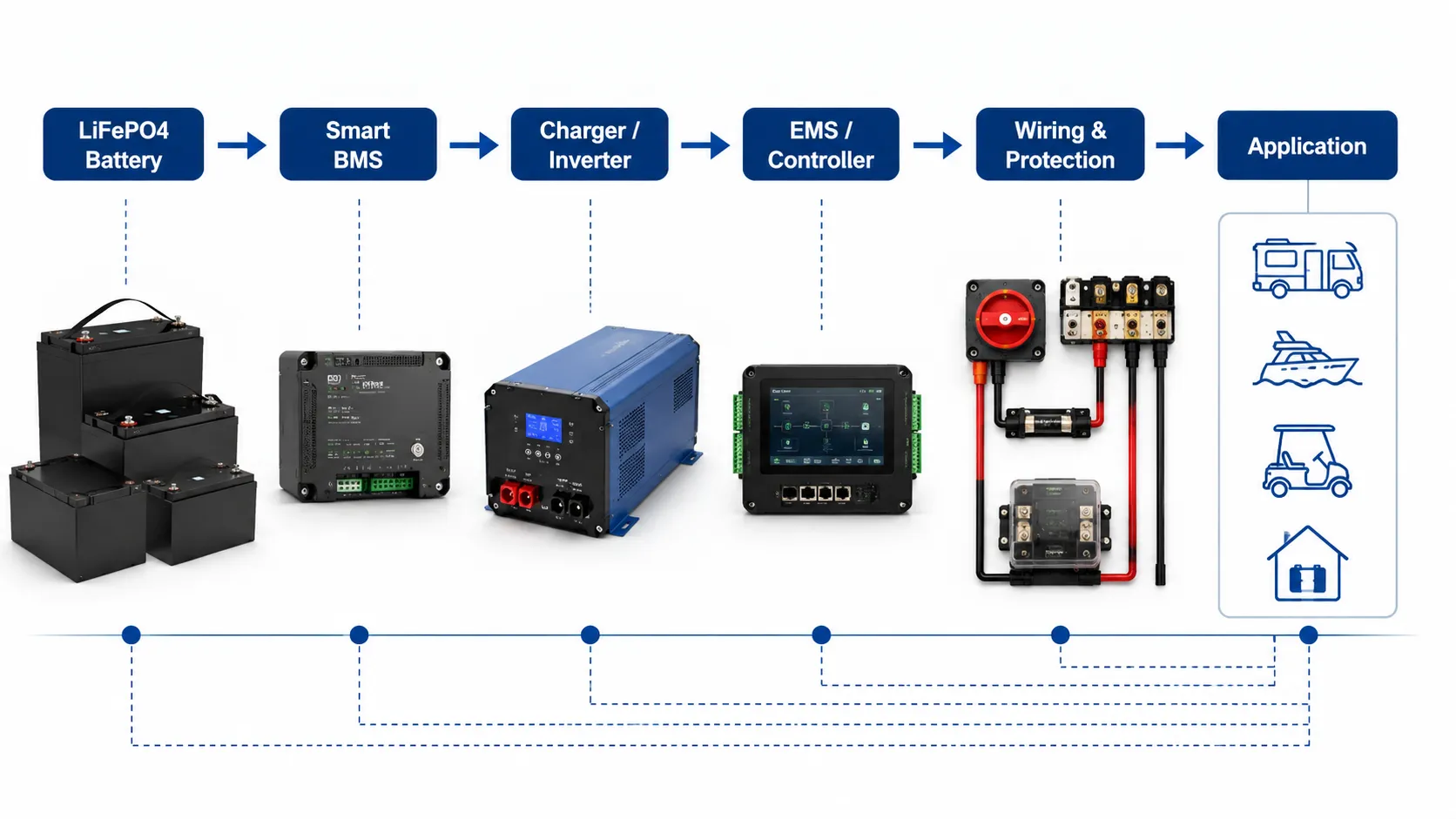
A mismatch at any point in this chain can affect charging, discharge performance, SOC reporting, protection behavior or system communication.
The BMS determines how much current the battery can safely accept and deliver, while protecting individual cells against abnormal voltage, current and temperature conditions.
Important BMS specifications include:
A battery may have enough Ah capacity but still shut down if the application requires more current than the BMS can safely deliver. Cell-level conditions can also cause early protection even when total pack voltage appears normal.
Seeing CAN or RS485 on both the lithium battery and inverter specification does not automatically mean the two devices can communicate with each other.
Communication compatibility may depend on:
If the battery has normal voltage but the inverter reports a CAN, BMS or communication fault, review the Lithium Battery CAN Communication Diagnostic Guide →
The charger should be matched to both the LiFePO4 chemistry and the specific battery BMS requirements.
Check:
A charger can be operating normally while the BMS prevents charging because of temperature, cell voltage, current or another protection condition.
For alternator-based RV charging systems, review RV LiFePO4 DC-DC Charger Compatibility →
Inverter compatibility involves more than selecting the same nominal voltage.
The complete system should consider:
A high-power inverter may require significantly more battery current than expected, especially during startup or surge loads.
The inverter or charger operates using configured voltage and current settings without dynamic communication from the battery BMS.
The BMS communicates battery SOC, voltage, temperature, charge-current limits, discharge-current limits, charge-voltage limits and alarms to the inverter or controller.
Closed-loop communication can improve system coordination, but only when the battery and inverter communication implementation has been properly validated.
Adding batteries in parallel requires more than connecting multiple batteries to the same DC bus.
Confirm:
Batteries connected to the same bus can show similar voltage while still carrying different currents or reporting different SOC values. See the Parallel Lithium Batteries SOC Imbalance Diagnostic Case →
The final battery specification should reflect how the battery will actually be used. Different applications can place very different demands on the same nominal battery voltage and capacity.
Select voltage, capacity and system requirements by application.
Application Guides →Charging, DC-DC, inverter, BMS and wiring diagnostics.
RV Troubleshooting →High-current loads, charging, wiring and BMS protection.
Marine Troubleshooting →Controller current, climbing load, regen and charging.
Golf Cart Troubleshooting →Step 1: Confirm the application and nominal system voltage.
Step 2: Confirm the required usable battery capacity.
Step 3: Determine maximum continuous and peak discharge current.
Step 4: Determine maximum charging current from all charging sources.
Step 5: Compare these requirements with battery BMS charge and discharge limits.
Step 6: Confirm charger voltage and LiFePO4 charging profile.
Step 7: Confirm inverter, motor-controller or load requirements.
Step 8: If communication is required, confirm CAN / RS485 protocol, pinout, addressing and firmware compatibility.
Step 9: Confirm cable size, fuse ratings, breakers and voltage drop.
Step 10: Review temperature, installation environment, parallel configuration and application-specific requirements before final battery selection.
Matching voltage, connector shape or seeing “CAN compatible” on two product specifications does not prove complete system compatibility. Confirm electrical limits, communication protocol, pinout and operating requirements before integration.
To review a lithium battery application more accurately, provide as much of the following information as possible:
Battery-to-inverter communication problem? Lithium Battery CAN Communication Problem →
Parallel batteries showing different SOC or current? Parallel Lithium Batteries Show Different SOC →
RV lithium battery not charging correctly from the alternator? RV LiFePO4 DC-DC Charger Compatibility →
Explore additional BMS, charging, motor-load and battery system problems: View All Lithium Battery Troubleshooting Cases →
Continue from compatibility review to battery selection, technical integration, testing and real-world diagnostics.
BMS, charging, CAN/RS485, parallel batteries and troubleshooting.
Technical Knowledge Center →Battery selection for RV, marine, golf cart, industrial and ESS.
Battery Application Guides →Real-world BMS, charging, CAN, SOC and high-current problems.
Battery Troubleshooting Cases →Verify battery, cell, BMS and load behavior using real measurements.
Battery Testing & Validation →Send us your battery voltage and capacity requirements, inverter or controller model, charger specification, maximum current requirements and CAN / RS485 information. Our team can review the battery, BMS, charging and communication requirements before integration.