Choosing a golf cart lithium battery involves more than matching voltage and Ah.
Vehicle voltage, motor and controller current, driving range, terrain, charger compatibility,
regenerative braking, Smart BMS limits, cables and installation space can all affect whether
a LiFePO4 battery works correctly in the vehicle.
The questions below cover common issues that appear during golf cart lithium selection,
lead-acid conversion, charging, storage, installation and troubleshooting.
Battery voltage, current capability, charger, controller, cables and installation should be reviewed as one vehicle system.
Golf Cart Battery Voltage, Capacity & Range
Start with the vehicle electrical system, then determine current capability and required energy.
1. Should I choose a 36V or 48V lithium battery for my golf cart?
Start with the voltage the golf cart is designed to use. A compatible 36V-class vehicle normally
uses a 36V-class lithium system, while a compatible 48V vehicle uses a 48V-class system.
Changing system voltage may require changes to the controller, motor, charger and other electrical components.
For a detailed comparison, see
36V vs 48V Golf Cart Battery →
2. Why is a 36V LiFePO4 golf cart battery often rated at 38.4V?
A LiFePO4 cell has a nominal voltage of approximately 3.2V.
A typical 12-cell series battery therefore has a nominal voltage of about 38.4V
and can be used in compatible 36V-class systems.
Nominal voltage alone does not confirm vehicle compatibility.
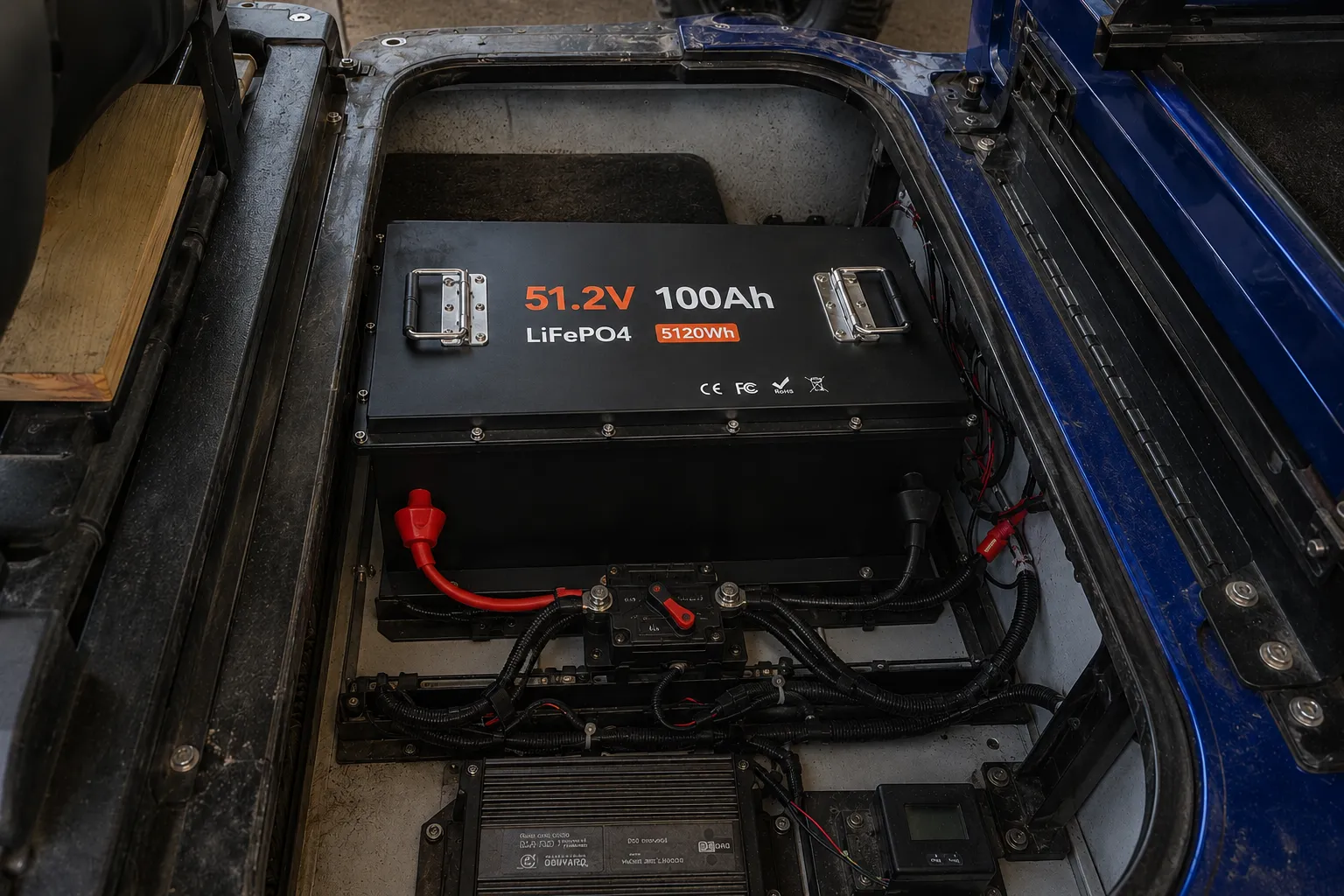
3. Why is a 48V LiFePO4 battery usually rated at 51.2V?
A typical 16-cell LiFePO4 configuration has a nominal voltage of approximately 51.2V.
It is commonly used in compatible 48V-class lithium systems.
The controller maximum voltage, charger and other connected equipment still need to be checked.
4. How many Ah does a golf cart lithium battery need?
There is no single Ah rating that is correct for every cart.
Capacity should be based on daily driving distance, terrain, vehicle weight, passenger or cargo load,
speed, accessories and available charging time.
Ah mainly determines stored energy and runtime; it does not by itself determine whether
the battery can supply enough power to the controller.
For a planning estimate, use the
LiFePO4 Battery Calculator →
5. Does a 100Ah battery have more power than a smaller battery?
Not necessarily. Ah describes capacity, while power capability depends on the cells,
Smart BMS current limits, internal resistance, cables and overall battery design.
A 100Ah battery can still shut down if its BMS current capability is lower than the controller demand.
6. How far will a lithium golf cart battery go?
Range depends on usable battery energy and actual vehicle consumption.
Terrain, passenger load, speed, tire pressure, temperature, motor efficiency,
accessories and driving pattern can change real-world range significantly.
Compare battery energy in kWh rather than using Ah alone.
Lead-Acid to LiFePO4 Golf Cart Conversion
7. Can I replace my golf cart lead-acid batteries with one lithium battery?
In many compatible systems, yes.
A single integrated LiFePO4 battery can replace a multi-battery lead-acid bank,
but vehicle voltage, controller current, charger, cables, fuse, contactor, mounting
and battery-compartment dimensions should be reviewed before conversion.
Review
LiFePO4 Lead-Acid Replacement →
and see the
Golf Cart LiFePO4 Battery Projects →
8. Can I use several 12V LiFePO4 batteries in series for a golf cart?
Only when the battery manufacturer specifically approves the model for series connection
and the complete system is designed for it.
Batteries should be matched in model, capacity, age and state of charge.
A single integrated high-voltage battery can reduce inter-battery connections and BMS coordination issues.
9. Can I keep the original lead-acid charger after converting to lithium?
Do not assume the old charger is compatible because the connector fits.
Check maximum charging voltage, current, charging profile, termination behavior
and any equalization or desulfation functions.
Use the old charger only when its output is confirmed as suitable for the approved LiFePO4 battery.
10. Do I need to change the golf cart battery cables when converting to lithium?
Not always, but the cables and connectors must be rated for the actual continuous
and peak battery current. Check conductor size, cable length, terminal condition,
crimp quality, fuse rating and signs of heating or corrosion.
11. What happens to 12V lights and accessories after a 36V or 48V lithium conversion?
Low-voltage accessories should be supplied through a correctly sized DC-DC converter
or another approved low-voltage supply.
Avoid taking 12V from only part of a high-voltage battery system unless the battery design specifically provides that output.
Smart BMS, Controller Current & High-Load Performance
12. Why does the golf cart work on flat ground but shut down uphill?
13. Why does my golf cart shut down during hard acceleration?
Hard acceleration can create a short high-current demand.
Possible causes include an undersized BMS, controller demand above the battery rating,
voltage sag, a weak cell or resistance in cables and terminals.
Measure the system during the event rather than judging the battery only from its resting voltage.
14. How important is the BMS current rating in a golf cart battery?
It is critical. The BMS must support the controller's actual battery-current demand,
including continuous load and short high-current events during acceleration or hill climbing.
Ah alone does not tell you whether the battery can support the vehicle power demand.
15. Should I match the battery to the controller battery current or phase current?
Battery selection should focus on the controller's battery-side current demand.
Controller phase-current ratings are not the same as DC battery current.
Confirm continuous current, peak current and the duration of those peaks when selecting the battery and BMS.
16. Can I increase the BMS current limit if the cart keeps shutting down?
Do not increase protection settings simply to stop a shutdown.
Higher limits are only appropriate when the cells, BMS, cables, connectors, fuse,
contactor and complete battery design are approved for the additional current.
Do not bypass the BMS.
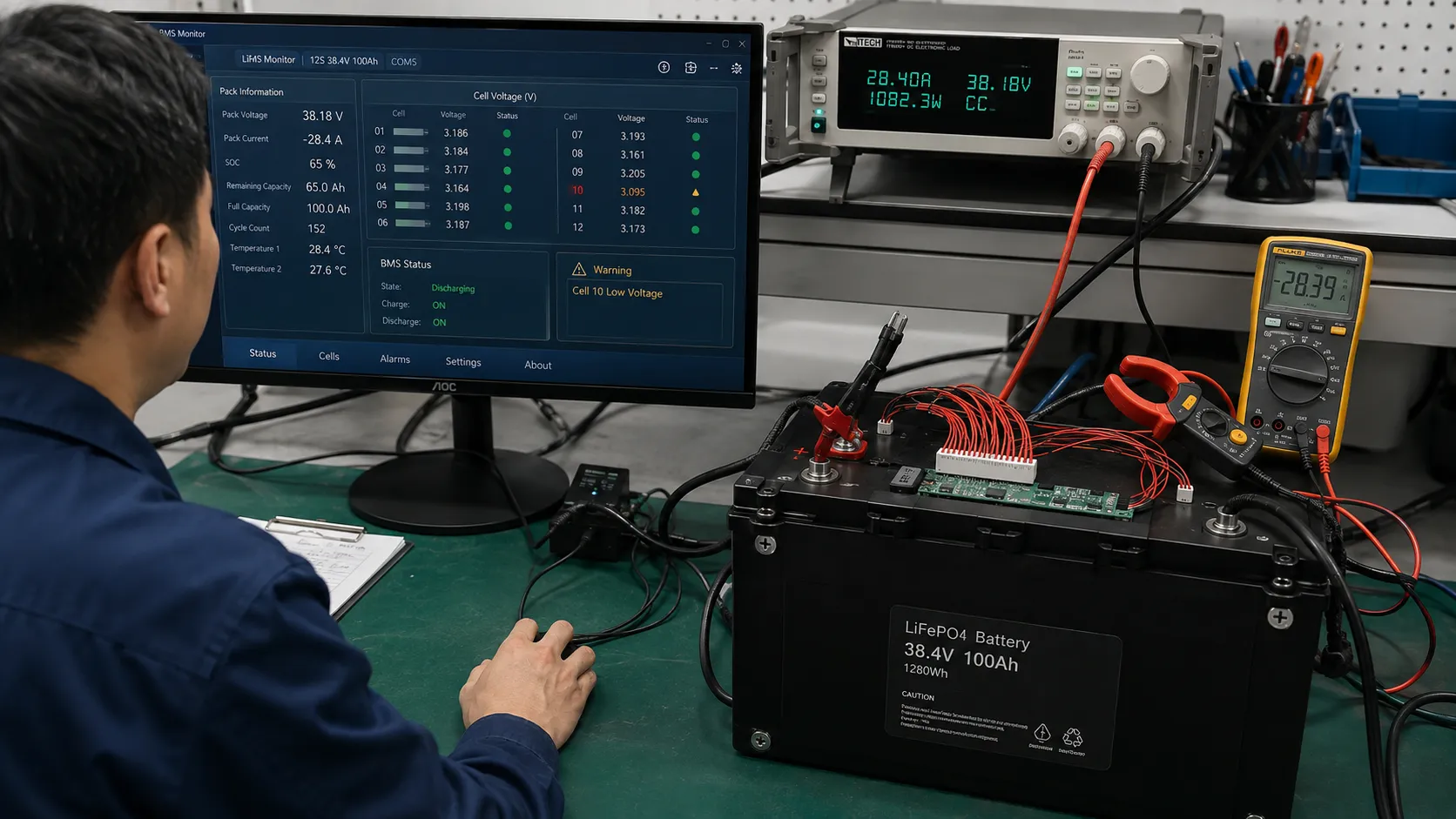
BMS current, pack voltage and individual cell voltage can help diagnose high-load shutdown problems.
Charging, Regenerative Braking & Battery Communication
17. Why does a lithium golf cart battery shut down during regenerative braking?
During regenerative braking, the motor controller can return current to the battery.
If the battery is near full charge, regen current exceeds the BMS charge limit,
or one cell reaches the high-voltage threshold, the BMS may disconnect charging.
See
Golf Cart Regen BMS Cutoff →
18. Why can regenerative braking be more problematic at 100% SOC?
A fully charged battery has less voltage headroom available to accept regenerative energy.
Regen can push one or more cells toward the BMS high-voltage protection threshold.
Battery charge limits and controller regen settings should be reviewed together.
19. Does a golf cart lithium battery need CAN or RS485?
Not every golf cart requires battery communication.
CAN or RS485 may be useful when the vehicle controller, dashboard, charger or monitoring system
requires battery data or control information.
The interface and protocol must both be compatible with the connected equipment.
For CAN/RS485 faults and controller integration, review
Lithium Battery CAN Communication Problems →
and
Battery System Compatibility →
20. Can Bluetooth SOC be used as the only way to judge battery condition?
Bluetooth monitoring is useful, but SOC is an estimate and can drift if calibration or current tracking is inaccurate.
When diagnosing a shutdown, also review pack voltage, individual cell voltage,
BMS fault records and current during the event.
Common Golf Cart Lithium Battery Problems
21. Why does the battery show 50–70% SOC but the golf cart suddenly shuts down?
Displayed SOC does not guarantee that every cell is healthy or that the battery can support a high-current load.
Possible causes include SOC calibration error, a weak or imbalanced cell, voltage sag,
BMS overcurrent protection or high-resistance connections.
If pack voltage still appears acceptable but one cell reaches the protection threshold first,
review the
LiFePO4 Cell Imbalance & Early BMS Cutoff
diagnostic case.
22. Why does the charger say full but the golf cart still will not move?
A charger indication does not prove that the vehicle drive circuit is ready.
Check actual battery voltage, BMS output status, contactor or solenoid operation,
fuse and disconnect devices, charger interlock behavior and controller fault codes.
The battery is only one part of the vehicle electrical system.
Golf Cart Lithium Battery Storage & BMS Wake-Up
Long storage can expose parasitic-drain, low-voltage protection and charger-detection problems.
23. Why won’t my golf cart lithium battery turn on after storage?
A golf cart lithium battery may enter BMS sleep or low-voltage protection during long storage,
especially if small parasitic loads remain connected.
Check battery-terminal voltage, BMS status, disconnect switches, fuses,
charger detection and any accessory loads before replacing the battery.
For the full BMS sleep and deep-discharge diagnostic process, see
LiFePO4 BMS Wake-Up & Deep-Discharge Guide →
24. Can a golf cart charger wake a sleeping lithium battery?
Sometimes, but it depends on the charger and battery BMS.
Some chargers require a minimum battery voltage before charging can begin,
so they may not detect a battery that has entered deep low-voltage protection.
Use the battery manufacturer's approved wake-up procedure.
For detailed BMS wake-up troubleshooting, see
LiFePO4 Battery Won’t Wake Up →
25. Can parasitic loads drain a golf cart lithium battery during storage?
Yes. The motor controller, DC converter, GPS device, alarm,
lighting accessories or other connected electronics can continue drawing small amounts of power
while the cart is parked.
Over a long storage period, this can discharge the battery deeply enough to trigger BMS low-voltage protection.
Follow the battery manufacturer's storage procedure and disconnect unnecessary loads when appropriate.
26. Why does the battery voltage look normal at rest but collapse under load?
Resting voltage does not show how the system behaves at high current.
Excessive voltage sag can come from a weak cell, low SOC, high internal resistance,
loose terminals, undersized cables or controller demand above the battery capability.
27. Can a BMS shutdown affect how the golf cart behaves or brakes?
Depending on the vehicle and controller design, sudden loss of battery output can place the drive system
into a fault or safety state and may change vehicle behavior.
For this reason, controller requirements, regenerative braking and BMS protection behavior
should be treated as system-integration issues rather than battery specifications alone.
28. What should I check before replacing a lithium battery that keeps shutting down?
Check the fault before assuming the battery has failed:
29. What information is needed to select a battery for a golf cart fleet or OEM project?
Provide the vehicle model, system voltage, motor power, controller model,
continuous and peak battery current, required driving range, passenger or cargo load,
terrain, battery-compartment dimensions, charger information,
regenerative-braking requirements, communication requirements and estimated quantity.
For custom development, see
OEM & ODM LiFePO4 Battery Services →
and the real
48V Golf Cart LiFePO4 Retrofit for Limited Space →
30. Should an OEM golf cart lithium battery be tested with the actual vehicle before production?
Continue from the FAQ to golf cart battery selection, troubleshooting, real projects,
system compatibility, testing and broader LiFePO4 technical guidance.
Need Help Matching a Lithium Battery to a Golf Cart?
Send the vehicle voltage, motor and controller information, required driving range,
battery-compartment dimensions, charger specification, terrain,
regenerative-braking requirements and estimated quantity for system review.
Golf cart lithium battery problems can have multiple causes.
Confirm the battery, BMS, controller, charger, wiring and vehicle requirements
before replacing components or changing protection settings.