Replacing a GC2 lead-acid battery bank with LiFePO4 can reduce battery-to-battery connections, simplify routine maintenance and provide a more integrated power system for a compatible golf cart. The conversion, however, should not be based on battery size, voltage or amp-hour rating alone.
A proper GC2 lithium battery replacement starts with the golf cart electrical system. Vehicle voltage, motor-controller current, acceleration demand, charger profile, battery-compartment dimensions, cable size, circuit protection and mounting all need to work with the new LiFePO4 battery.
This guide explains what dealers, fleet operators, installers and vehicle manufacturers should check when planning a GC2 lead-acid to lithium golf cart conversion. For complete 36V and 48V battery selection, see our Golf Cart LiFePO4 Battery Solutions.
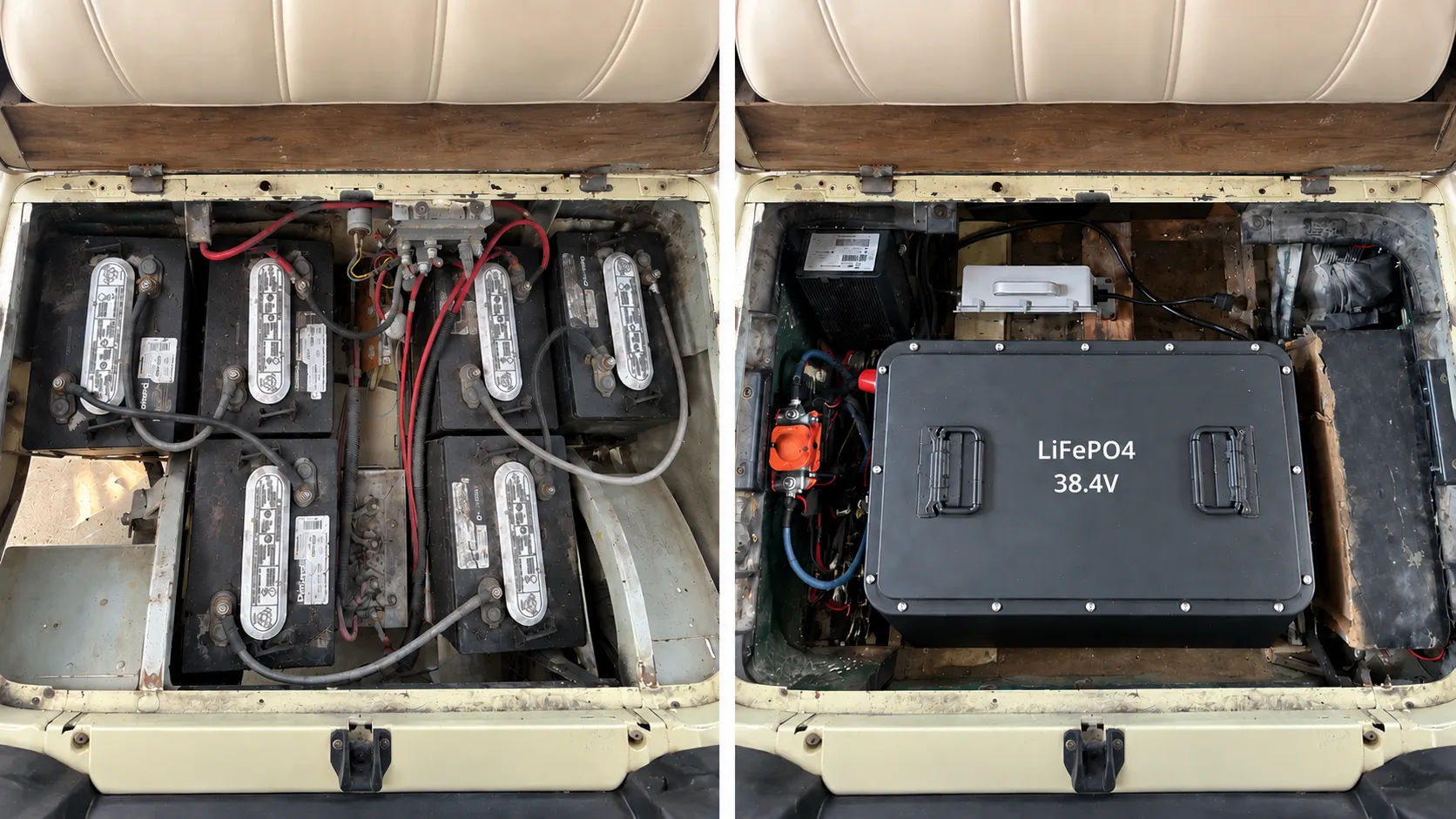
Confirm these items before selecting a replacement battery:
GC2 is a common deep-cycle battery case format used in golf carts, utility vehicles and other electric equipment. Traditional golf carts often use multiple flooded lead-acid GC2 batteries connected in series to create the required vehicle voltage.
A 36V golf cart, for example, may use six 6V lead-acid batteries connected in series. A 48V system may use a different battery count and voltage arrangement. For this reason, the term GC2 battery describes the physical battery format but does not by itself identify the complete electrical system.
When selecting a GC2 lithium golf cart battery, check both the available battery space and the complete electrical requirements of the vehicle.
A conventional golf cart battery bank usually combines several lower-voltage lead-acid batteries in series. The series connection increases total system voltage while keeping the amp-hour rating of the individual batteries unchanged.
| System | Common Lead-Acid Arrangement | LiFePO4 Class |
|---|---|---|
| 36V Golf Cart | Often 6 × 6V batteries in series | Typically 38.4V nominal LiFePO4 |
| 48V Golf Cart | Battery arrangement varies by vehicle | Typically 51.2V nominal LiFePO4 |
These are system references, not universal replacement rules. Always verify the original battery bank and the vehicle specification before converting from lead-acid to lithium.
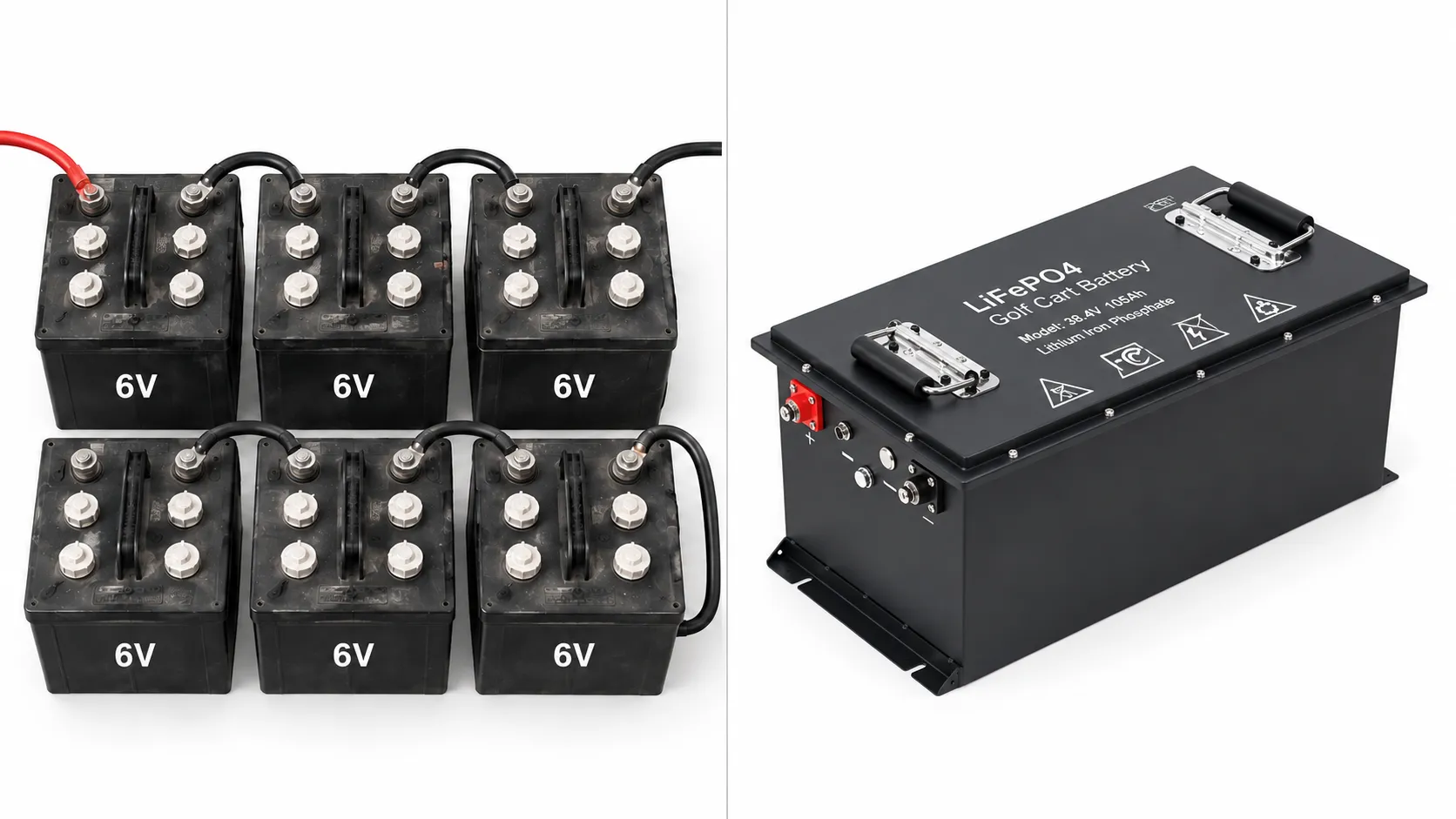
A properly engineered LiFePO4 conversion can replace a multi-battery lead-acid bank with a more integrated battery system. The practical benefit is not simply changing battery chemistry. It can also change how the battery bank is installed, charged, monitored and serviced.
| Item | Traditional Lead-Acid Bank | LiFePO4 Conversion |
|---|---|---|
| Battery connections | Multiple inter-battery cables | Can use fewer battery-to-battery connections |
| Routine maintenance | Flooded batteries require regular inspection | No electrolyte watering |
| Battery management | No integrated lithium BMS | Smart BMS can monitor and protect the battery |
| Monitoring | Depends on vehicle equipment | Bluetooth or communication options may be available |
| Charging | Lead-acid charging profile | Requires a compatible LiFePO4 charging profile |
Start with the vehicle, not the replacement battery. A compatible 36V golf cart normally requires a 36V-class lithium battery system, while a compatible 48V cart requires a 48V-class system.
LiFePO4 nominal voltage is different from the marketing voltage commonly used to describe a golf cart. A 12-cell LiFePO4 battery is approximately 38.4V nominal and is commonly used in compatible 36V-class applications. A 16-cell configuration is approximately 51.2V nominal and is commonly used in compatible 48V-class applications.
If you are deciding between the two systems, read 36V vs 48V Golf Cart Battery: Which Is Right for You?.
Amp-hour capacity and discharge capability are not the same thing. A battery may contain enough stored energy for the required driving range but still be unsuitable if its BMS cannot support the current demanded by the motor controller.
Golf carts can draw substantially more current during acceleration, hill climbing or heavy-load operation than during steady driving. The battery therefore needs enough continuous and short-duration current capability for the actual vehicle.
Before choosing a lithium battery for a golf cart lead-acid conversion, check controller continuous current, peak current, motor power and expected operating conditions. If a cart shuts down under load, see our Golf Cart Lithium Battery Troubleshooting Guide.
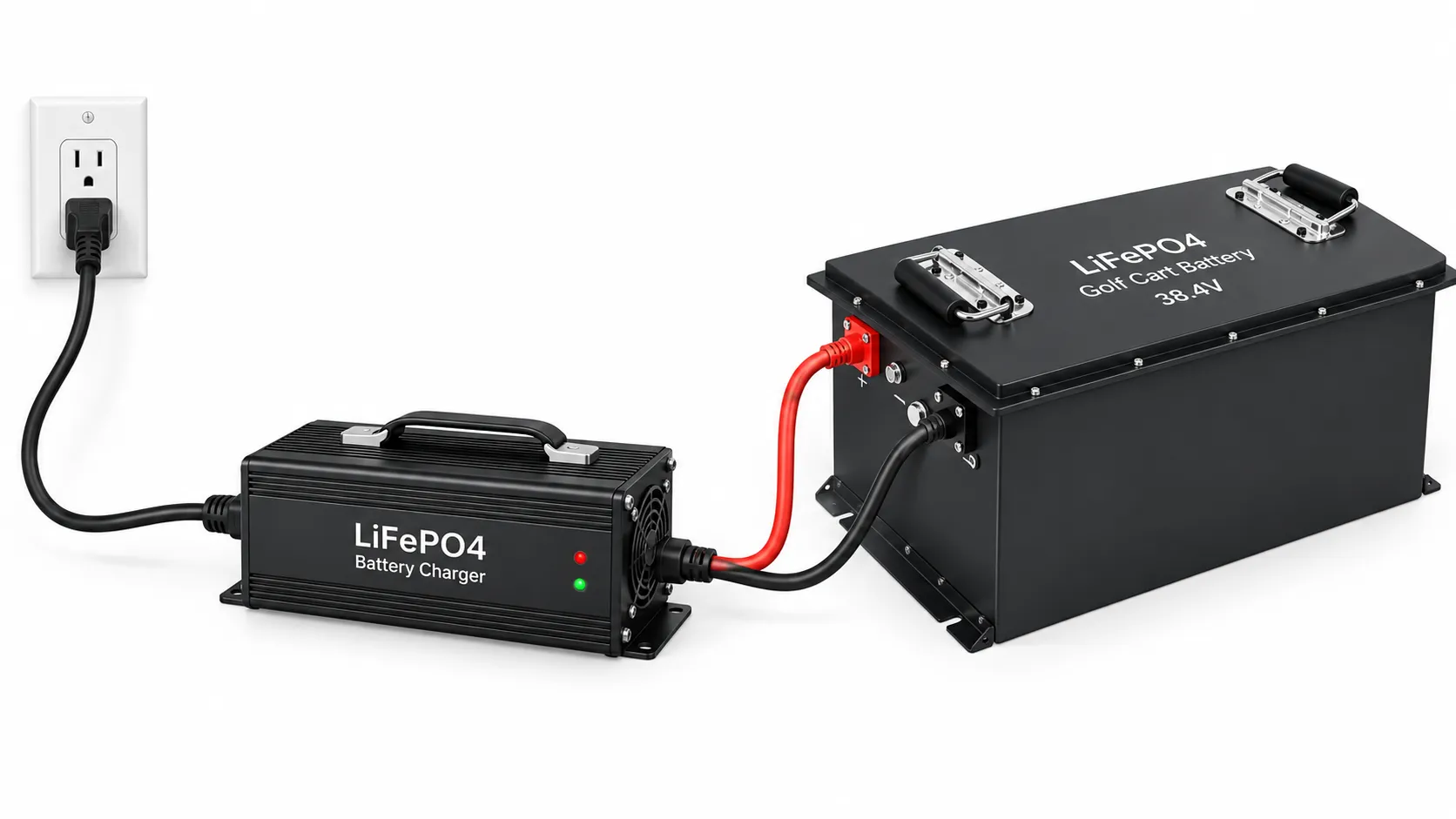
Do not assume that a lead-acid golf cart charger can be reused after a lithium conversion. The charger output voltage, charging profile, current and termination behavior must be compatible with the approved LiFePO4 battery.
Some existing charging equipment may be suitable after technical review, while other installations require a dedicated LiFePO4 charger. Charger compatibility should be confirmed before the new battery is connected.
For fleet, dealer and OEM projects, battery and charger specifications can be reviewed together as part of the conversion.
A GC2 lithium battery replacement must fit the available space without interfering with cables, terminals, seat structures or vehicle components. Measure the battery tray and usable height, width and length rather than relying only on the original battery label.
Also check terminal position, cable routing, service access and the mounting method. A lithium battery should be securely restrained against movement during acceleration, braking and operation over uneven ground.
For vehicles with limited installation space, see this 48V Golf Cart LiFePO4 Retrofit and Custom Battery Fitment Case.
Removing a lead-acid battery bank changes the battery-compartment layout, but it does not remove the need for correctly sized power cables and circuit protection.
A typical conversion review should include:
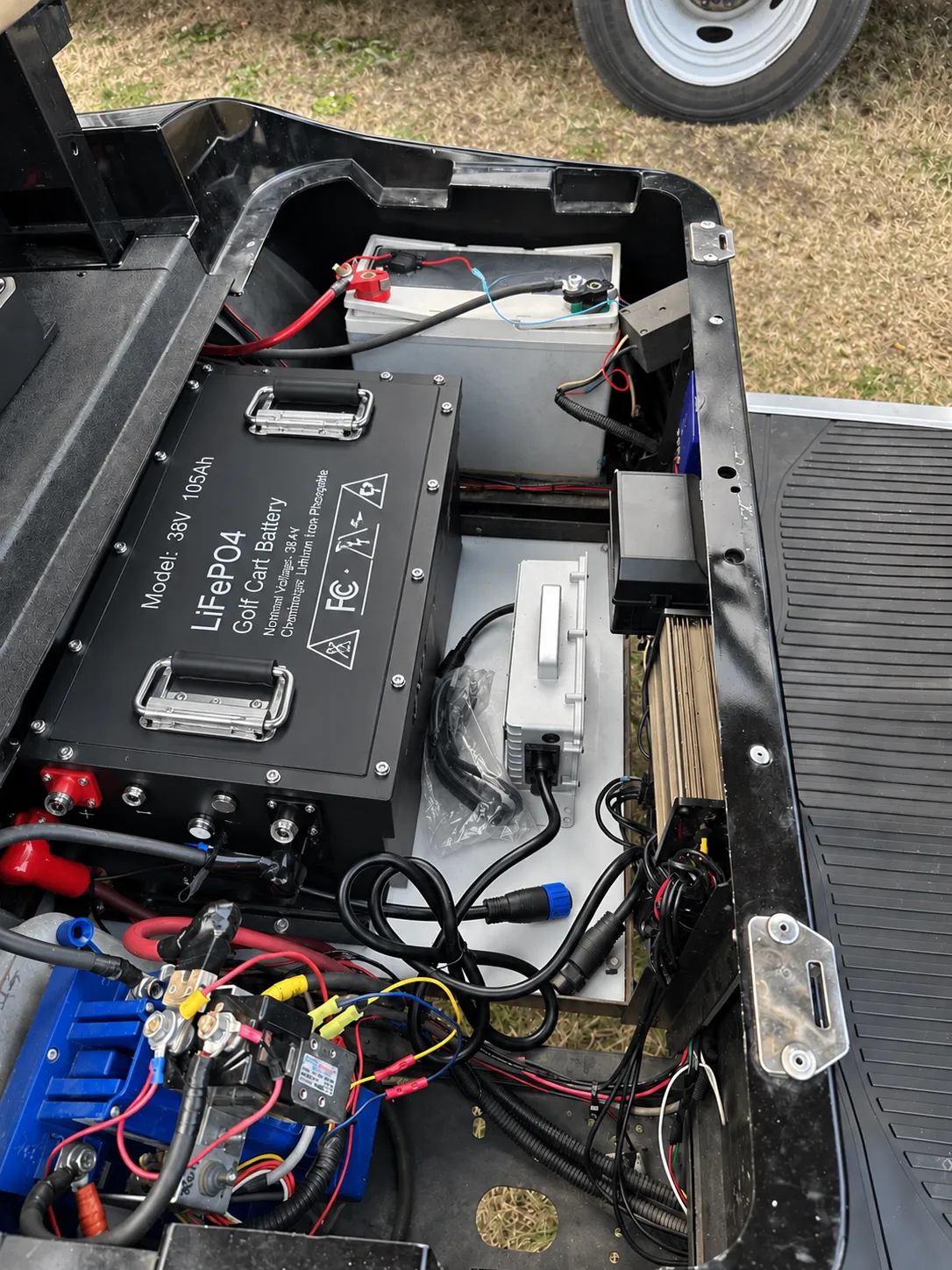
Do not choose the replacement battery by copying the Ah rating printed on the old GC2 battery. Battery capacity should be selected from the required daily energy, driving distance, vehicle weight, terrain, accessories and charging schedule.
A golf course fleet operating on relatively flat routes has different requirements from a utility cart carrying passengers or equipment on hills. Commercial operators should also consider how many hours each vehicle runs between charging opportunities.
For more answers about capacity, range, voltage and charging, see the Golf Cart Lithium Battery FAQ.
For compatible 36V golf carts, 38.4V LiFePO4 battery configurations are available for different battery compartments, energy requirements and controller-current demands. The correct option should be selected from the complete vehicle system rather than capacity alone.
The compact 38.4V 45Ah model uses a GC2-size enclosure and is designed for compatible 36V golf carts where battery-space efficiency is important. The current product configuration includes Bluetooth monitoring, a Smart BMS and low-temperature charging protection.
View 36V 45Ah GC2 Golf Cart Battery →
For applications requiring more stored energy, the 38.4V 100Ah model uses a Group 8D-size enclosure rather than a GC2 case. It provides 3,840Wh of nominal energy and a 100A BMS in the current configuration. Vehicle current demand, available space, mounting and charger compatibility should be confirmed before selection.
| Check | What to Confirm |
|---|---|
| System voltage | Original battery-bank voltage and vehicle electrical system |
| Motor | Rated power and expected operating load |
| Controller | Continuous, peak and regenerative current where applicable |
| BMS | Continuous and peak discharge capability matched to controller demand |
| Charger | Output voltage, current, charging profile and connector |
| Battery space | Tray dimensions, available height and secure mounting points |
| Cables | Conductor size, terminal type, routing and condition |
| Protection | Main fuse or circuit breaker, disconnect and terminal protection |
| Range | Daily distance, terrain, load and charging opportunities |
For detailed engineering examples, see our Golf Cart LiFePO4 Battery Projects and Conversion Guide.
A standard battery does not fit every golf cart platform. Golf cart manufacturers, distributors, fleet suppliers and conversion specialists may require different enclosure dimensions, current capability, mounting points, connectors or communication functions.
OEM and private-label projects can be reviewed for:
Learn more about OEM & ODM LiFePO4 Battery Manufacturing or contact our LiFePO4 Battery Technical Support team for an application review.
Yes, a compatible golf cart lead-acid battery bank can often be replaced with a properly specified LiFePO4 system. Before conversion, confirm system voltage, motor-controller current, battery space, charger compatibility, main cables, circuit protection and mounting.
In a compatible 36V golf cart, a correctly specified 36V-class LiFePO4 battery may replace a six-battery 6V lead-acid bank. The replacement must still meet the vehicle's voltage, current, capacity, charger and installation requirements.
A 12-series LiFePO4 battery has a nominal voltage of approximately 38.4V and is commonly used in compatible 36V-class golf cart systems. Compatibility should be confirmed against the controller, charger and other connected electrical equipment.
Do not assume the existing charger is compatible. Its output voltage, charging profile, current and termination behavior should be checked against the approved LiFePO4 battery specification. Use a compatible lithium charger when the existing charger does not meet those requirements.
Capacity depends on required driving distance, terrain, vehicle weight, passenger or cargo load, accessories and available charging time. BMS current capability should be checked separately because Ah alone does not determine whether the battery can support motor-controller demand.
Provide the golf cart model, original battery arrangement, system voltage, motor power, controller model and current limit, battery-compartment dimensions, charger specification, required range, operating conditions and estimated order quantity. These details allow the battery, BMS, charger and installation to be reviewed as one system.
Send us the golf cart model, existing battery configuration, system voltage, motor and controller information, battery-compartment dimensions, charger specification and estimated order quantity. Our engineering team can review the requirements before recommending a LiFePO4 battery configuration.
