A Club Car lithium battery conversion must be based on more than voltage
alone. The vehicle model, model year, motor controller, peak current,
battery-compartment dimensions and charging system should all be checked
before replacing a lead-acid battery bank with LiFePO4.
We supply 38.4V and 51.2V LiFePO4 battery systems for compatible golf cart
conversion, dealer, commercial fleet and OEM projects. Available options
include high-current BMS protection, Bluetooth monitoring, matched
chargers and project-specific enclosure or cable configurations.
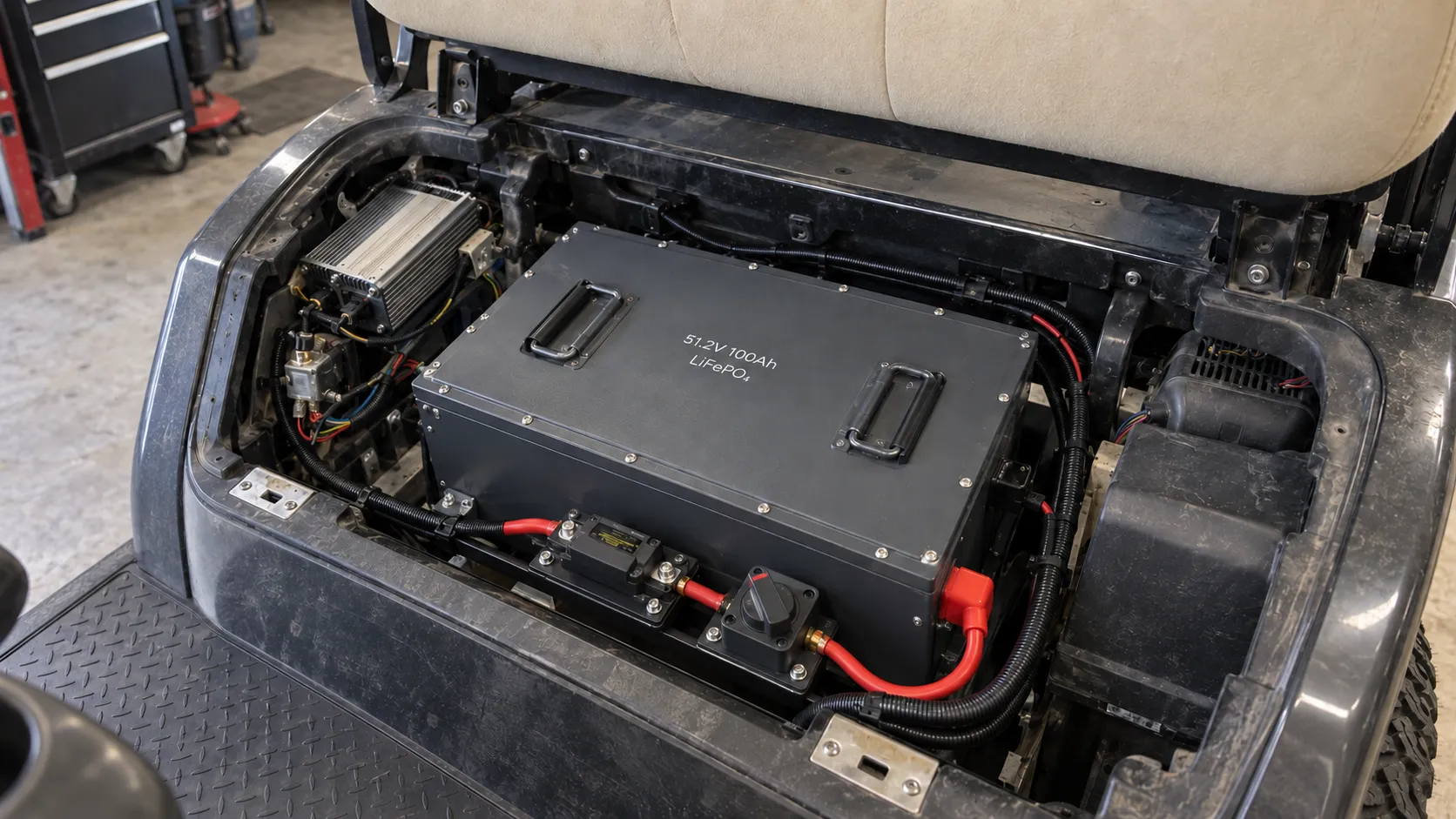
Club Car Lithium Battery Conversion Installation
A Club Car lithium battery conversion should be checked against controller current, charger compatibility and available battery-compartment space.
Choosing a Lithium Battery for a Club Car Golf Cart
Club Car golf carts have been produced with different electrical systems,
controllers and battery layouts. A battery suitable for one vehicle should
not be assumed to fit another cart simply because both are described as
36V or 48V.
Before selecting a lithium battery for a Club Car golf cart, confirm the
original system voltage, motor and controller current, short-duration
acceleration demand, charger output, compartment dimensions, terminal
position and accessory-voltage requirements.
Compatibility note:
References to Club Car DS, Precedent, Onward and other models describe
potential conversion applications only. Final compatibility depends on the
exact vehicle configuration and must be confirmed before installation.
36V or 48V Club Car Lithium Battery Conversion?
The correct replacement voltage is determined by the cart’s existing drive
system. A complete motor and controller redesign is outside the scope of a
normal lead-acid-to-lithium battery replacement.
Existing vehicle system
LiFePO4 platform to evaluate
Checks required before installation
Compatible 36V golf cart
38.4V LiFePO4 battery system
Controller current, peak load, charger profile, compartment size,
fuse, cables and accessory power
Compatible 48V golf cart
51.2V LiFePO4 battery system
Controller voltage range, regenerative current, peak load, charger,
mounting and wiring protection
Unknown or modified cart
Technical review required
Model, year, controller label, motor details, existing battery
arrangement and battery-compartment measurements
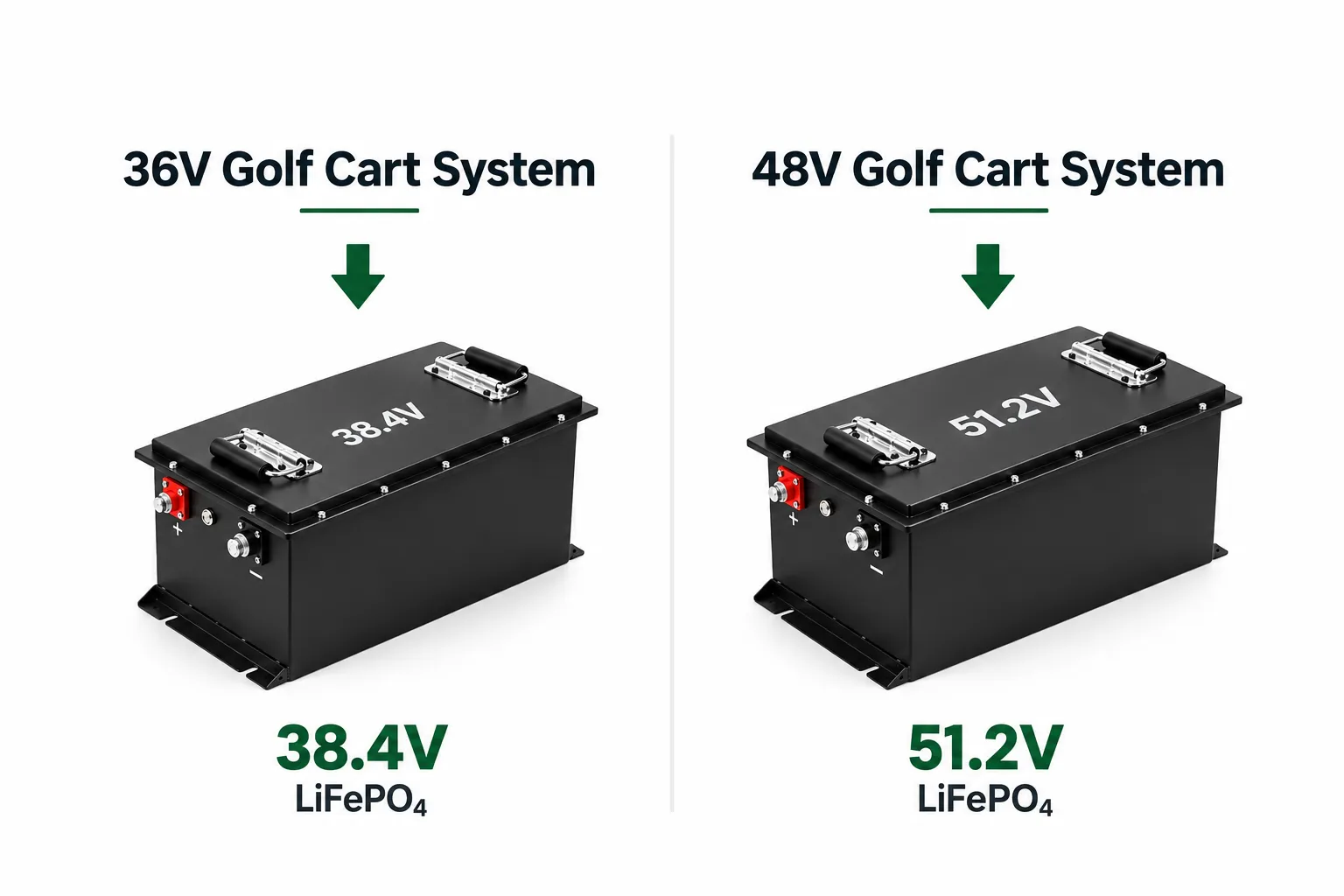
36V vs 48V Club Car Lithium Battery Selection
Compatible 36V golf carts typically use a 38.4V LiFePO4 platform, while compatible 48V carts typically use a 51.2V platform.
A Club Car Precedent lithium battery conversion, Onward conversion or
other 48V project requires confirmation of both electrical and
mechanical compatibility.
Controller operating-voltage range
Continuous and peak discharge demand
Regenerative-braking current, where applicable
Battery-compartment space and mounting
Charger voltage and charge termination
Accessory power and DC converter requirements
Main cable and circuit-protection ratings
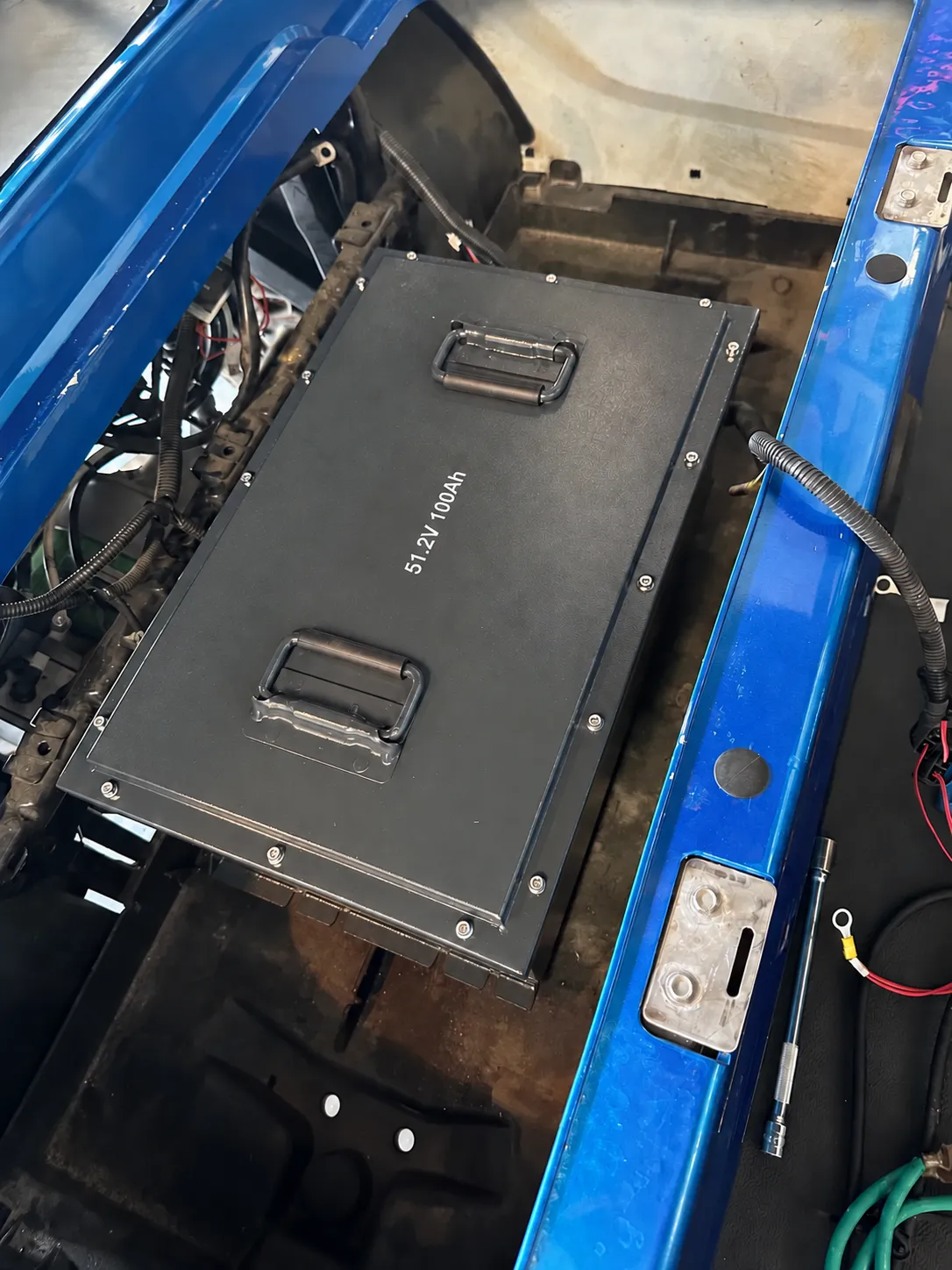
51.2V 100Ah Battery Installation for a 48V Club Car
For a 48V Club Car lithium conversion, verify controller voltage range, regenerative current, mounting and circuit protection.
What a Club Car Lead-Acid to Lithium Conversion Requires
Replacing several lead-acid batteries with one LiFePO4 battery can reduce
inter-battery cables and simplify routine battery inspection. The
conversion still requires correct mounting, circuit protection and charging
equipment.
LiFePO4 Battery → Main Fuse or DC Circuit Breaker →
Battery Disconnect → Golf Cart Controller
Verify system voltage.
Confirm whether the vehicle is built around a 36V or 48V drive system.
Check controller current.
The BMS must support continuous driving demand and short-duration current
during acceleration, hill climbing and loaded operation.
Measure the battery compartment.
Confirm length, width, height, mounting points, terminal clearance and
cable routing before ordering.
Review the charger.
Do not assume that an existing lead-acid charger is suitable for a
LiFePO4 battery.
Check circuit protection.
The main fuse or DC circuit breaker, disconnect, cables and terminals
must be selected for the actual current and installation.
Confirm accessory voltage.
Lights, audio systems and other 12V accessories may rely on a separate
DC-DC converter.
Charger compatibility is one of the most important parts of a golf cart
lithium conversion kit. The charger must use the correct output voltage,
charging profile and termination behavior for the selected battery.
Lead-acid equalization modes and incompatible charging profiles should not
be used with a LiFePO4 battery. Before installation, confirm the charger
output, connector, wiring polarity and whether charging is handled by an
onboard or off-board charger.
Matched charger options are available for selected 38.4V and 51.2V battery
configurations. Charger specifications should be confirmed together with
the battery and vehicle requirements.
Bluetooth Monitoring and High-Current BMS Selection
Bluetooth monitoring can provide convenient access to battery information
such as state of charge, voltage, current, temperature and operating
status. This is useful for owners, technicians and fleet operators who need
to check battery status without opening the compartment.
The BMS should be selected around the actual vehicle load. A higher amp-hour
rating does not automatically mean that a battery can support every motor
controller. Continuous discharge, peak current duration and regenerative
current should be reviewed separately.
Club Car Lithium Batteries for Dealers and Commercial Fleets
Golf cart dealers, conversion shops and fleet operators may require more
than a standard retail battery. Product selection can depend on the vehicle
mix, daily operating hours, passenger or cargo load, route conditions,
charging schedule and replacement-stock requirements.
We support qualified dealer, private-label and OEM golf cart battery
projects with options that may include:
38.4V and 51.2V LiFePO4 battery configurations
Project-specific BMS current settings
Bluetooth monitoring
Selected CAN or RS485 communication options
Matched chargers and charging connectors
Custom terminals, cables and wiring harnesses
Battery mounting and enclosure options
Private-label branding and packaging
Sample evaluation and production testing
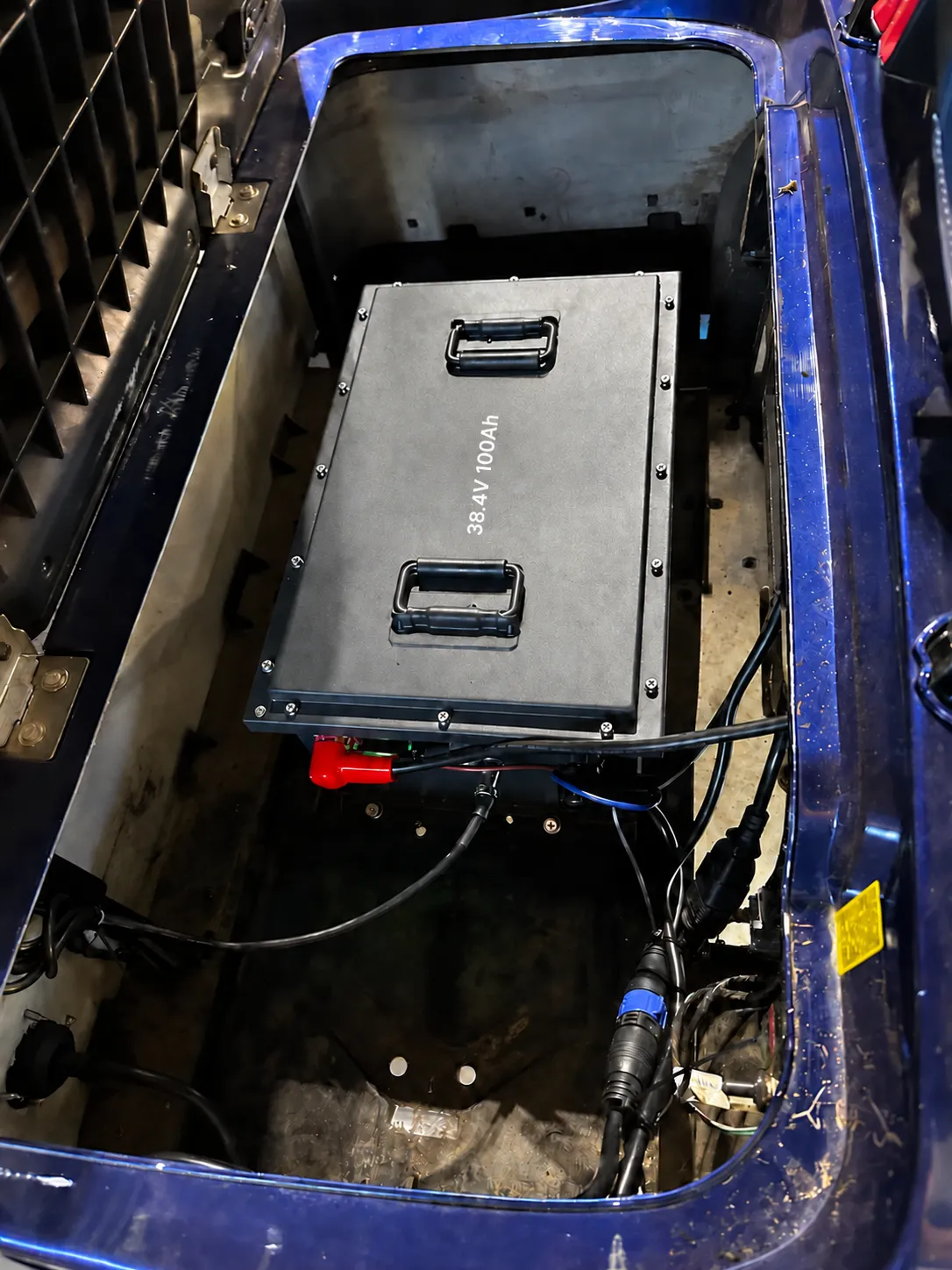
Lithium Golf Cart Batteries for Dealers and Fleets
Dealer and fleet battery configurations can be selected around vehicle mix, daily operating hours, charging schedules and replacement inventory.
Questions About Club Car Lithium Battery Conversion
Can I replace Club Car lead-acid batteries with one lithium battery?
A single LiFePO4 battery can replace a compatible multi-battery lead-acid
bank after the vehicle voltage, controller current, battery compartment,
charger, cables, fuse and accessory system have been checked.
Should I choose a 38.4V or 51.2V LiFePO4 battery?
A compatible 36V drive system normally requires evaluation of a 38.4V
LiFePO4 platform, while a compatible 48V system normally requires
evaluation of a 51.2V platform. Do not change system voltage without
reviewing the complete drive system.
Can I reuse the original Club Car lead-acid charger?
Only when its output voltage, charging profile and termination behavior
are compatible with the selected LiFePO4 battery. In many conversions, a
matched lithium charger is the safer and more predictable option.
Which measurements are needed before ordering a conversion battery?
Measure the usable compartment length, width and height, and record the
mounting points, terminal clearance and cable-entry locations. Also
provide the cart model, model year, original voltage and controller
information.
What BMS current is needed for a Club Car lithium conversion?
The BMS must support the controller’s continuous current and
short-duration demand during acceleration, loaded driving and hill
climbing. The required current cannot be selected from battery capacity
alone.
Do you supply lithium batteries for golf cart dealers and fleets?
Yes. We support qualified dealers, conversion shops, fleet operators,
battery brands and OEM projects. Available options depend on battery
specification, quantity, customization and destination market.
Confirm the Right Lithium System for Your Golf Cart
Send the cart model, model year, original system voltage, controller
details, battery-compartment dimensions, charger information and required
quantity. Our team can review a proposed 38.4V or 51.2V LiFePO4
configuration for a compatible Club Car lithium battery conversion.
Club Car, DS, Precedent and Onward are trademarks of their respective owner. ZXBATT is not affiliated with or endorsed by Club Car. Vehicle references are provided for compatibility guidance only. Final compatibility must be confirmed for the specific cart, controller, charger and installation.