Real Questions About Marine Lithium Battery Systems
Selecting a marine lithium battery involves more than matching voltage and Ah.
Trolling motors, bow thrusters, windlasses, inverters and engine-starting systems
can place very different demands on a LiFePO4 battery and its BMS.
The questions below focus on common real-world issues involving battery sizing,
high-current loads, charging, alternators, BMS protection, series and parallel banks,
communication and marine installation.
The key principle:
Ah tells you how much energy the battery stores.
It does not tell you whether the battery can safely support a trolling motor,
bow thruster, windlass or other high-current marine load.
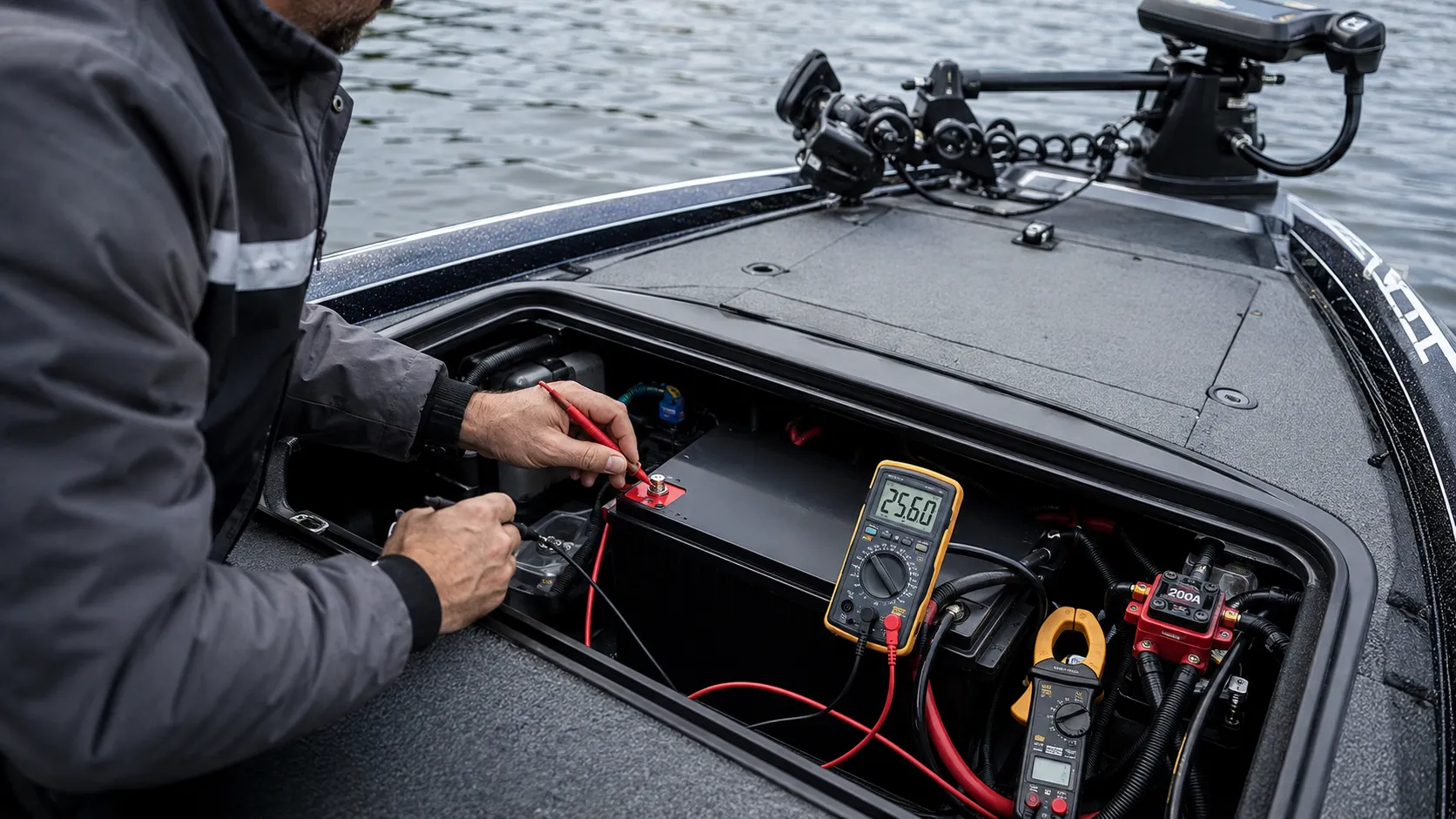
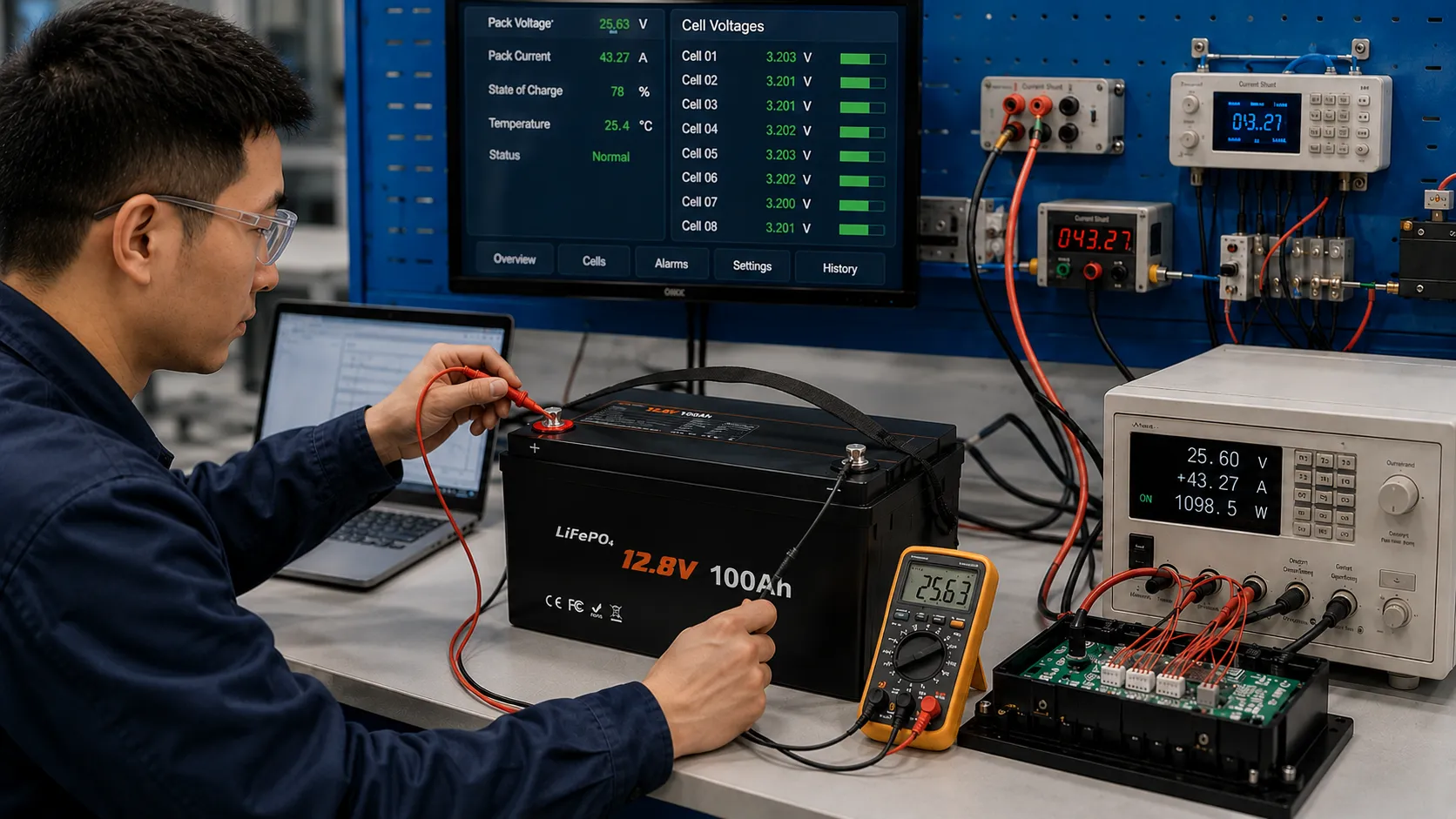
Marine battery current, voltage, BMS protection, wiring and connected loads should be checked as one complete system.
Marine Lithium Battery Selection & Bank Design
Start with the application, load current and charging system—not capacity alone.
1. How many Ah does a marine lithium battery need?
Capacity depends on daily energy use, trolling-motor runtime,
house loads, inverter consumption, charging availability and required reserve.
Calculate expected energy use first and then size the battery bank with suitable reserve.
Ah alone does not determine high-current capability.
For a planning estimate, use the
LiFePO4 Battery Calculator →
2. Should I use a 12V, 24V, 36V or 48V marine lithium battery system?
The battery-bank voltage should match the intended equipment.
Trolling motors commonly use 12V, 24V or 36V systems,
while larger marine electrical systems may use higher voltage.
Changing voltage requires checking motors, chargers, DC loads,
inverters and other connected equipment.
3. Can I replace a marine lead-acid battery directly with LiFePO4?
Not automatically.
Review charger voltage and profile, alternator charging,
battery BMS limits, cables, fuses, battery switches,
operating temperature and the current demand of connected equipment before conversion.
Review the
LiFePO4 Lead-Acid Replacement Guide →
4. Can a deep-cycle LiFePO4 battery also start a marine engine?
Only when the battery is specifically designed and rated for engine-starting current.
A deep-cycle battery with sufficient Ah does not automatically have the required cranking capability.
Check the battery's cranking specification and the engine manufacturer's starting-current requirements.
5. Can one lithium battery power both engine starting and house loads?
This depends on the battery design and vessel architecture.
Many marine systems keep starting and house banks separate for reliability.
A combined system should be specifically engineered for both cranking current
and deep-cycle energy use.
6. Is battery Ah the most important specification for a marine application?
No.
Capacity determines runtime, but high-current marine applications also require
sufficient continuous and peak current capability.
Cell design, BMS current limits, cable resistance and system voltage all matter.
Trolling Motor Lithium Battery Questions
7. Why does a trolling motor lithium battery shut down at high speed?
High trolling-motor settings increase current demand.
If the current exceeds the battery or BMS limit,
or if voltage drops too far under load, the BMS may disconnect the battery.
Possible causes include BMS overcurrent protection, voltage sag,
a weak cell or high-resistance connections.
See
Trolling Motor Lithium Battery Shutdown →
8. Why does the trolling motor work at low speed but cut out at full power?
Low-speed operation may remain below the battery's current limit,
while full power can push current above the BMS continuous or peak rating.
Measure battery current and voltage during the shutdown rather than testing only at rest.
9. How important is the BMS current rating for a trolling motor battery?
It is critical.
The battery and BMS must support the trolling motor's maximum battery-current demand
without repeatedly entering overcurrent protection.
A large Ah rating does not compensate for an undersized BMS.
10. How do I size a LiFePO4 battery for a trolling motor?
Confirm trolling-motor voltage and maximum amp draw first.
Then determine the required runtime and capacity.
The battery's continuous discharge rating should support the motor,
while capacity should provide the desired operating time.
For application selection and custom configurations, see
Marine LiFePO4 Battery Solutions →
11. Should I use one 24V or 36V lithium battery or several 12V batteries in series?
Both configurations may be possible when specifically approved.
A single integrated 24V or 36V battery can reduce inter-battery connections
and BMS coordination issues.
Multiple 12V batteries should only be connected in series when the battery model supports it.
12. What happens if one battery in a series trolling-motor bank trips its BMS?
If one battery disconnects, the series circuit can lose output
and the trolling motor may stop.
Differences in SOC, cell condition or protection behavior between batteries
can therefore affect the entire bank.
13. Why does a lithium battery trip when a bow thruster starts?
Bow thrusters can demand very high current.
A battery may have sufficient capacity but still trip its BMS
if the surge or sustained current exceeds the battery's approved discharge capability.
Cable voltage drop and terminal resistance can make the problem worse.
14. Can a normal deep-cycle lithium battery be used for a bow thruster?
Only when its cells, BMS and complete battery design are rated
for the thruster's current demand and duty cycle.
Do not select a bow-thruster battery based on Ah alone.
15. Why can a windlass cause BMS shutdown?
Windlasses can create substantial current,
particularly during heavy anchor retrieval or when mechanical load increases.
Check motor current, battery BMS limits, cable size,
cable length, connections and battery voltage under load.
16. Is peak current or continuous current more important for marine loads?
Both matter.
Continuous current determines what the battery can support over time,
while peak current determines whether it can tolerate short high-current events.
The duration of the peak is also important.
Marine Charging, Shore Power & Alternators
17. Can I use my existing marine lead-acid charger with LiFePO4?
Only when the charger's voltage, current, charge profile
and termination behavior are confirmed as suitable for the battery.
Avoid unsupported equalization or desulfation modes.
18. Can a marine LiFePO4 battery be charged directly from an alternator?
Do not assume direct alternator charging is suitable.
LiFePO4 batteries can accept substantial charging current,
so the alternator, regulator, wiring and battery BMS must be reviewed together.
Some systems use a DC-DC charger or external regulator to control charging.
19. Why can an alternator overheat after converting a boat to lithium?
A deeply discharged LiFePO4 bank can accept high current for an extended period.
An alternator designed around a lead-acid charging profile may operate near
high output for too long and overheat.
Alternator temperature, current limits and regulation should be considered during conversion.
20. Why does the charger show full but the lithium battery has no output?
Charger indication alone does not prove that the battery output is active.
Check BMS protection status, battery-terminal voltage,
battery switch, fuse, breaker and cable connections.
A BMS may disconnect output even when a charger is connected.
21. Can shore power, solar and alternator charging be used together?
Multiple charging sources can be integrated into a properly designed marine system,
but each charger must follow compatible battery limits.
Combined charging current should remain within the battery and BMS specification.
BMS Protection, SOC & Troubleshooting
22. Why will a marine LiFePO4 battery not wake up after deep discharge?
The BMS may have entered low-voltage protection or sleep mode.
Some chargers will not start if they cannot detect enough battery voltage.
Follow the approved wake-up procedure and identify the load that caused the deep discharge.
See
LiFePO4 Battery Won't Wake Up →
23. Why does SOC still show 50–70% but the battery suddenly shuts down?
Displayed SOC is an estimate and does not guarantee
that every cell can support the current demand.
Possible causes include SOC calibration error, a weak or imbalanced cell,
voltage sag, BMS overcurrent protection or high-resistance connections.
If pack voltage still appears acceptable but one cell reaches a protection threshold first,
review the
LiFePO4 Cell Imbalance & Early BMS Cutoff
diagnostic case.
24. Why do parallel marine lithium batteries show different SOC or current?
Parallel batteries share a common bus voltage,
but current sharing can differ because of cable resistance,
battery position, internal resistance, SOC,
BMS calibration or cell condition.
Balanced wiring and commissioning are important.
See
Parallel Lithium Batteries Show Different SOC →
25. What should I check before replacing a marine lithium battery that keeps shutting down?
Do not assume the battery itself has failed. Check:
26. Does a marine lithium battery need CAN or RS485?
Not every marine battery requires communication.
CAN or RS485 becomes useful when an inverter, charger,
monitoring system or vessel energy-management system
needs battery data or closed-loop operating limits.
Interface and protocol must both be compatible.
27. Does a battery with CAN automatically work with a Victron marine system?
28. What should be checked when installing a lithium battery in a marine environment?
Review battery mounting, ventilation requirements,
cable routing, fuse protection, battery switch,
terminal protection, moisture exposure and corrosion risk.
The required enclosure and ingress-protection level depend on the installation location.
29. What information is needed for a marine OEM or integration project?
Provide system voltage, required capacity,
continuous and peak current, connected loads,
trolling motor or thruster specifications,
charger and alternator information,
battery-compartment dimensions, operating environment,
communication requirements and estimated quantity.
For qualified custom projects, see
OEM & ODM LiFePO4 Battery Services →
30. Should an OEM marine battery be tested with the actual motor, charger or inverter?
Continue from the FAQ to marine battery selection, real projects, trolling-motor diagnostics,
system compatibility, testing and broader LiFePO4 technical guidance.
Send the system voltage, required capacity, trolling motor,
bow thruster or windlass specifications, charger, alternator,
installation dimensions, communication requirements and estimated quantity
for a system-level review.
Marine lithium battery symptoms can have multiple causes.
Confirm the battery, BMS, connected load, charger, alternator,
wiring and protection devices before replacing components or changing BMS settings.