
LiFePO4 Technical Knowledge
Charging, Smart BMS protection, CAN/RS485 communication, parallel batteries, SOC behavior and system troubleshooting.
LiFePO4 Battery Technical Knowledge Center →Marine lithium battery problems are not always caused by the battery itself.
Charging faults, BMS protection, alternator output, shore chargers, cable voltage drop, trolling motor current and incorrect system configuration can all cause a marine LiFePO4 battery to stop charging, shut down under load or show unstable voltage.
This marine lithium battery troubleshooting guide covers the most common LiFePO4 battery problems found in boats, yachts, trolling motor systems, house battery banks and lead-acid to lithium conversions.
View Marine LiFePO4 Battery Solutions →
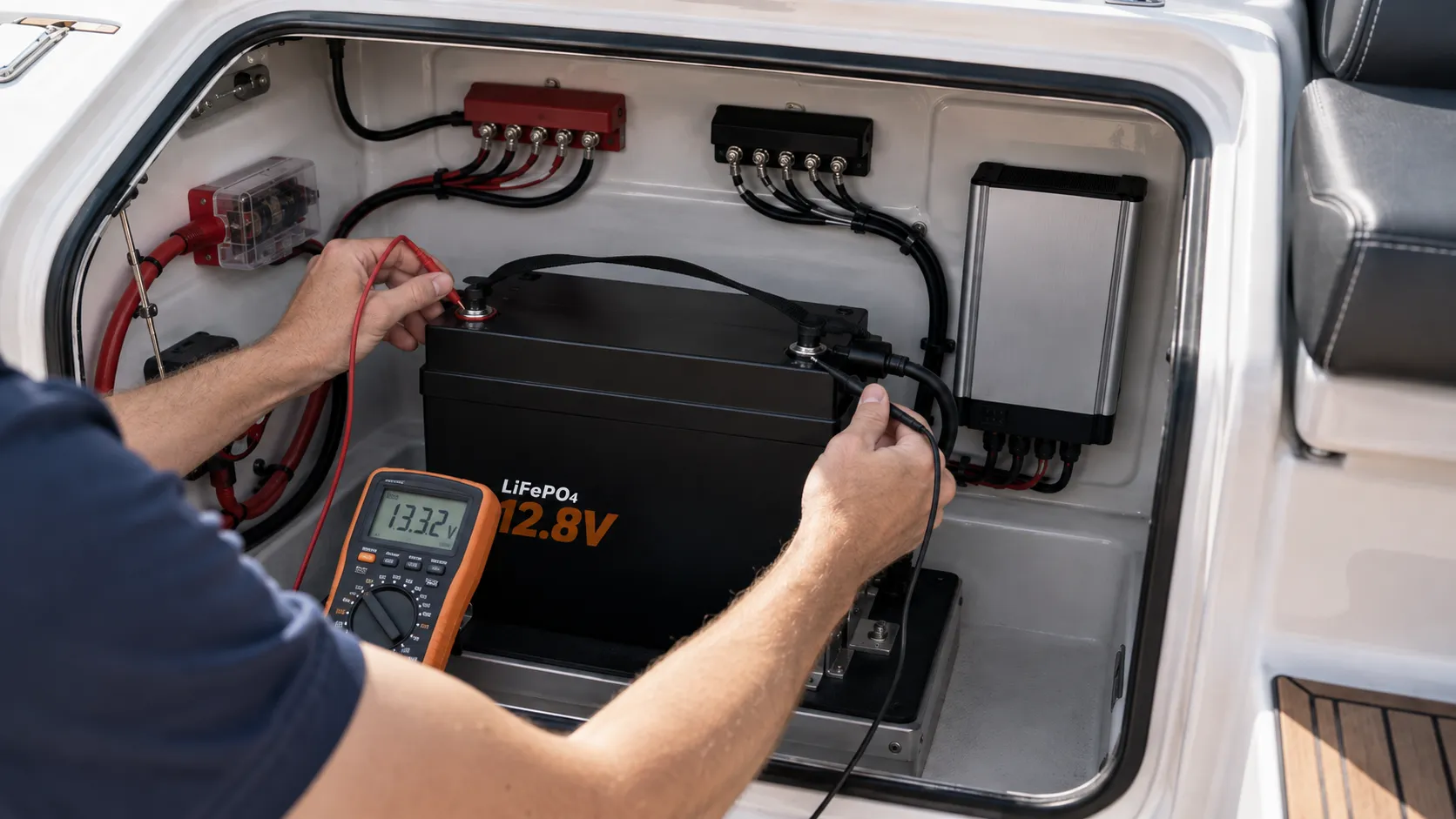
Before replacing a marine lithium battery, identify the exact symptom. Battery voltage measured directly at the terminals is usually a better starting point than relying only on a display, Bluetooth app or battery monitor.
| Symptom | Common Areas to Check |
|---|---|
| Marine lithium battery not charging | Charger voltage, fuse, disconnect switch, BMS protection, cable continuity and charger compatibility |
| Battery charges from solar but not shore power | Shore charger, AC supply, charging profile and battery-side protection |
| Battery not charging from alternator | Alternator voltage, DC-DC charger, current limit, cable size and BMS |
| Trolling motor battery shuts down | Motor current, BMS discharge limit, voltage sag, loose connections and weak cells |
| Inverter shuts down under load | Battery current capability, BMS limit, cables, busbars and low-voltage cutoff |
| Battery shows charge but SOC is incorrect | Battery monitor synchronization, BMS data, shunt configuration and full-charge calibration |
If a marine LiFePO4 battery is not charging, first measure voltage directly at the battery terminals. Then measure the charger output while the charger is operating.
Check:
If charging voltage is available at the charger but not at the battery, the fault is more likely to be in the cable, fuse, breaker or disconnect path.
If correct charging voltage reaches the battery but charging current remains near zero, check battery state of charge, BMS protection and temperature conditions.
Older marine shore-power chargers may have been designed around flooded, AGM or gel lead-acid charging profiles. A charger that worked with the original lead-acid bank should not automatically be assumed suitable for LiFePO4.
Check the shore charger for:
Also measure voltage at both the charger output and battery terminals. A meaningful difference between the two readings can indicate cable resistance, undersized wiring, loose terminals or protection-device losses.
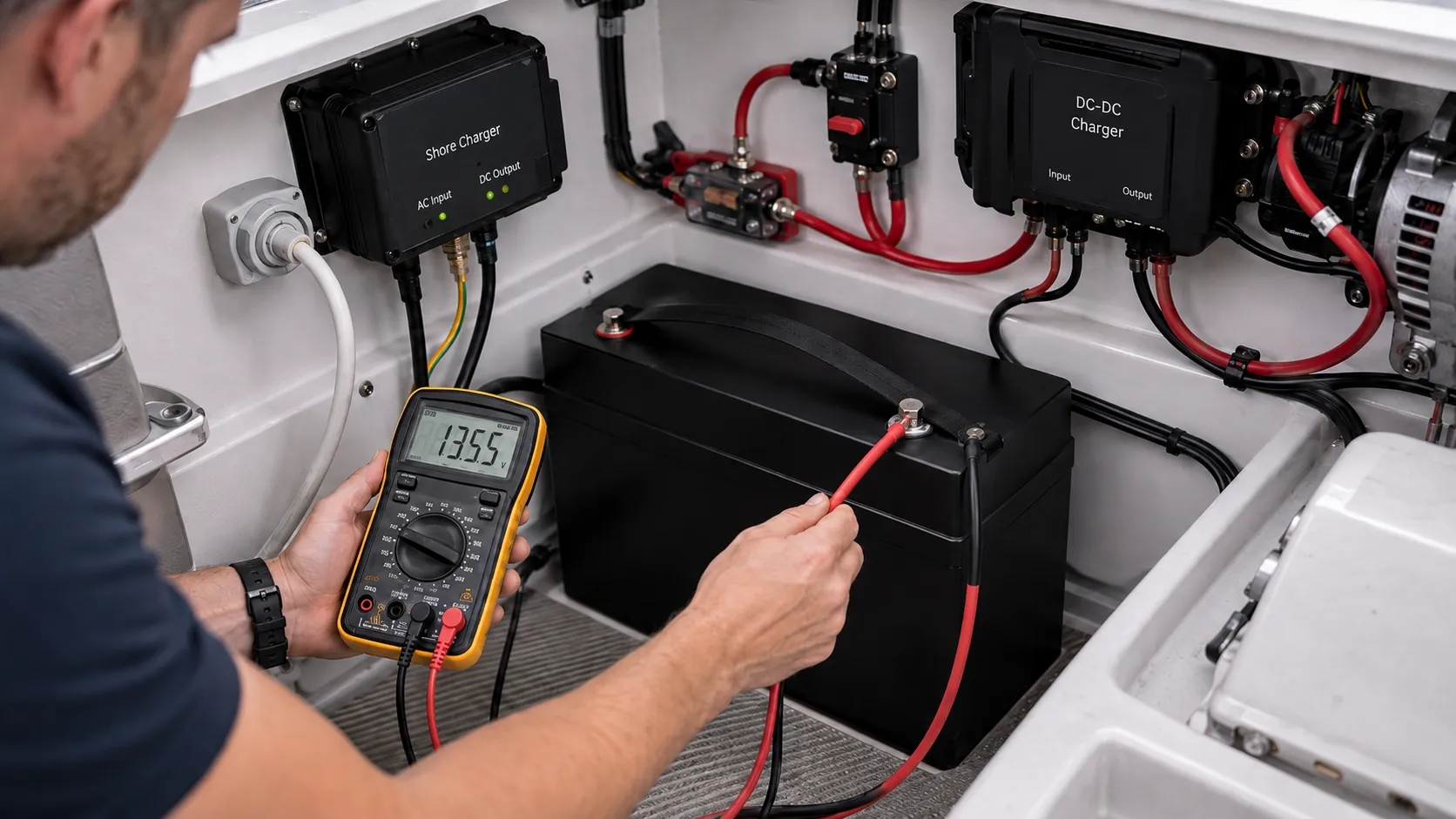
Alternator charging is one of the most important parts of a marine lead-acid to lithium conversion.
A LiFePO4 battery can accept high charging current for much longer than many lead-acid batteries. Connecting a large lithium bank directly to an alternator without reviewing the charging system can result in excessive alternator load or unstable charging behavior.
Check:
A DC-DC charger can control charging current and voltage between the alternator or engine battery and the LiFePO4 house battery bank.
If the marine lithium battery is not charging through a DC-DC charger, verify both the input and output sides.
Do not diagnose the battery only from the DC-DC charger display. Confirm voltage directly at the battery terminals.
The BMS protects the battery against operating conditions that could damage the cells or battery pack.
A marine lithium battery may disconnect because of:
A BMS shutdown should be treated as a symptom. Determine what caused the protection event before simply resetting or reconnecting the battery.
A battery that works normally with lights, electronics and small DC loads but shuts down when an inverter, windlass, bow thruster or other high-current equipment starts may be reaching the battery or BMS current limit.
Check:
Battery capacity in amp-hours tells you how much energy is available. It does not by itself tell you whether the battery can support a high-current load.
Trolling motor problems often appear at high speed because current demand increases and voltage drop becomes more significant.
A trolling motor lithium battery that runs normally at lower speed but shuts down at full power should be checked for BMS current limit, voltage sag, cable resistance and battery condition.
Trolling Motor Lithium Battery Shutdown: Full Troubleshooting Guide →
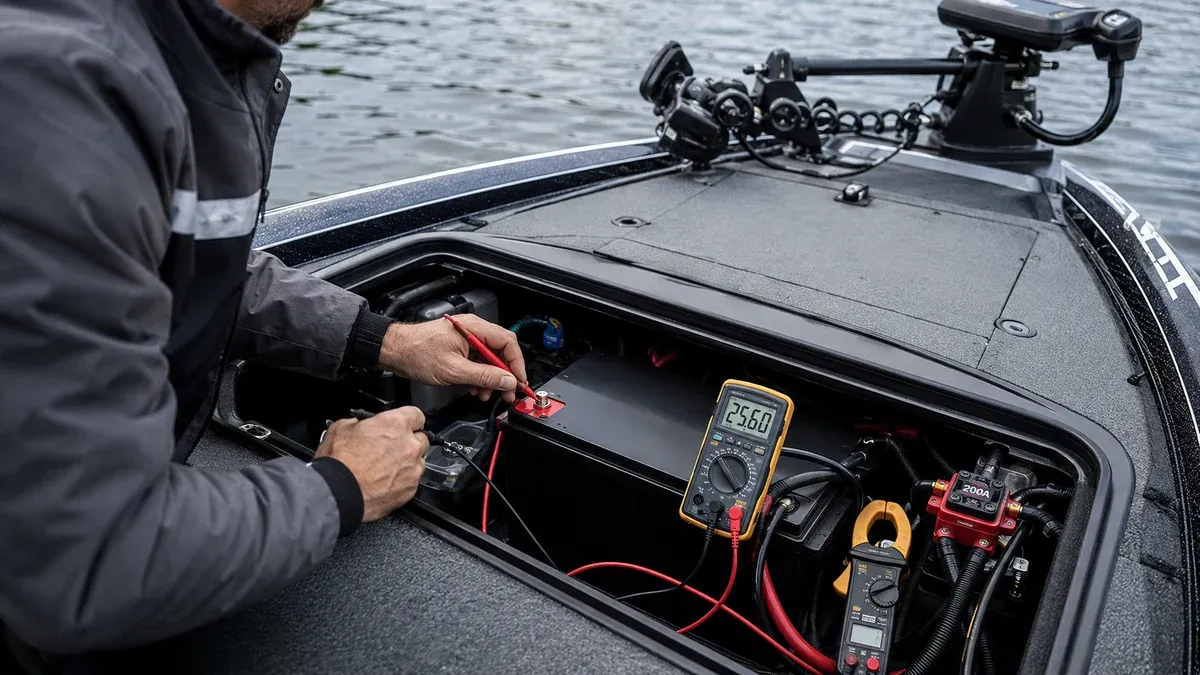
Voltage measured with no load can appear normal even when the electrical system has a cable or connection problem.
Measure voltage while the equipment is operating. Check voltage at the battery terminals first, then compare it with voltage at the connected load.
Inspect:
A connection can look mechanically secure but still develop significant resistance under high current.
If the inverter reports low battery voltage when the LiFePO4 battery still appears charged, measure battery voltage while the inverter is under load.
Possible causes include:
LiFePO4 batteries should not be charged below the battery manufacturer's permitted charging temperature.
Batteries with low-temperature charge protection may intentionally stop charging when cell temperature falls below the permitted limit.
Selected marine batteries use self-heating to warm the cells before charging. Heating operation depends on battery design, temperature and available charging power.
Check:
LiFePO4 voltage remains relatively flat through much of the discharge cycle, so estimating state of charge from voltage alone can be inaccurate.
If the BMS, Bluetooth app, battery monitor or onboard display shows an incorrect SOC, check:
Batteries connected in parallel should be installed with suitable cable lengths and connection geometry so current can be shared as evenly as possible.
Different state-of-charge readings can be caused by unequal cable resistance, batteries starting at different SOC, different battery ages or differences between individual packs.
Before connecting batteries in parallel:
For a detailed parallel-system diagnosis, see the Parallel Lithium Batteries SOC Imbalance Diagnostic Case →
Not every LiFePO4 battery is designed for engine starting.
Starting applications require high cranking current, suitable BMS protection and compatibility with the engine charging system.
Do not use a standard deep-cycle LiFePO4 house battery as a starting battery unless the battery is specifically designed and approved for that application.
Replacing an AGM, gel or flooded marine battery with LiFePO4 is more than matching nominal voltage and amp-hour capacity.
The complete marine electrical system should be reviewed:
Lead-Acid to LiFePO4 Battery Replacement Guide →
When diagnosing a marine lithium battery system, work through the system in a consistent order.
For additional guidance on LiFePO4 charging, BMS protection, high-current loads, battery communication and complete system integration, continue with the technical resources below.
Charging, Smart BMS protection, CAN/RS485 communication, parallel batteries, SOC behavior and system troubleshooting.
LiFePO4 Battery Technical Knowledge Center →Review battery BMS limits, chargers, inverters, CAN/RS485, current requirements and complete system integration.
LiFePO4 Battery System Compatibility →Explore LiFePO4 battery configurations for boats, yachts, trolling motors and onboard house-power systems.
Marine LiFePO4 Battery Solutions →Battery sizing, shore charging, alternators, trolling motors, starting batteries and lead-acid replacement.
Marine LiFePO4 Battery FAQ →Real-world BMS, charging, CAN, SOC, voltage-drop and high-current lithium battery problems.
LiFePO4 Battery Troubleshooting Cases →Get engineering support for battery voltage, BMS, charging equipment, communication and system integration.
LiFePO4 Battery Technical Support →Check charger output, battery-terminal voltage, fuses, disconnect switches, cable connections, battery temperature and BMS charge protection. Also confirm that the charger is suitable for the battery voltage and LiFePO4 charging requirements.
The load may be exceeding the battery BMS current limit, or voltage may be dropping because of battery condition, undersized cables or high-resistance connections.
Check trolling motor maximum current, BMS discharge-current rating, battery voltage under load, breaker size, cable gauge and terminal condition. For a detailed diagnosis, see the trolling motor lithium battery shutdown troubleshooting guide .
It depends on the charger. Confirm that the charging voltage, charging stages and operating behavior are suitable for the specific LiFePO4 battery. Avoid chargers that use automatic lead-acid equalization unless that function can be disabled.
The charging system should be reviewed before connecting a large LiFePO4 battery bank directly to an alternator. Alternator current, temperature, battery charge acceptance and BMS limits all need to be considered.
Check the battery monitor or shunt configuration, capacity setting, full-charge synchronization and BMS communication. LiFePO4 state of charge cannot be estimated accurately from voltage alone through much of its operating range.
In many systems, yes. The shore charger, alternator, DC-DC charger, solar controller, inverter, wiring, fuses and BMS limits should be reviewed before conversion. See our lead-acid to LiFePO4 replacement guide .
View All Marine LiFePO4 Battery FAQs →
For marine OEM, installer or system-integration projects, send the battery voltage, required capacity, maximum load current, charger model, alternator information, inverter power, installation dimensions and communication requirements.
Our engineering team can review the battery, BMS, charging system and electrical integration requirements before sample development or volume production.