An RV lithium upgrade involves more than replacing a lead-acid battery with the same voltage and more Ah.
The LiFePO4 battery, Smart BMS, converter or AC charger, inverter, solar controller,
alternator, DC-DC charger, cables, fuses and low-temperature protection all need to work together.
The questions below focus on common real-world problems seen during RV,
motorhome and camper-van lithium battery selection, conversion, charging and system integration.
The key principle:
Battery voltage and Ah are only the beginning.
Charging sources, inverter load, BMS limits, wiring, temperature and communication
should be reviewed as one complete RV electrical system.
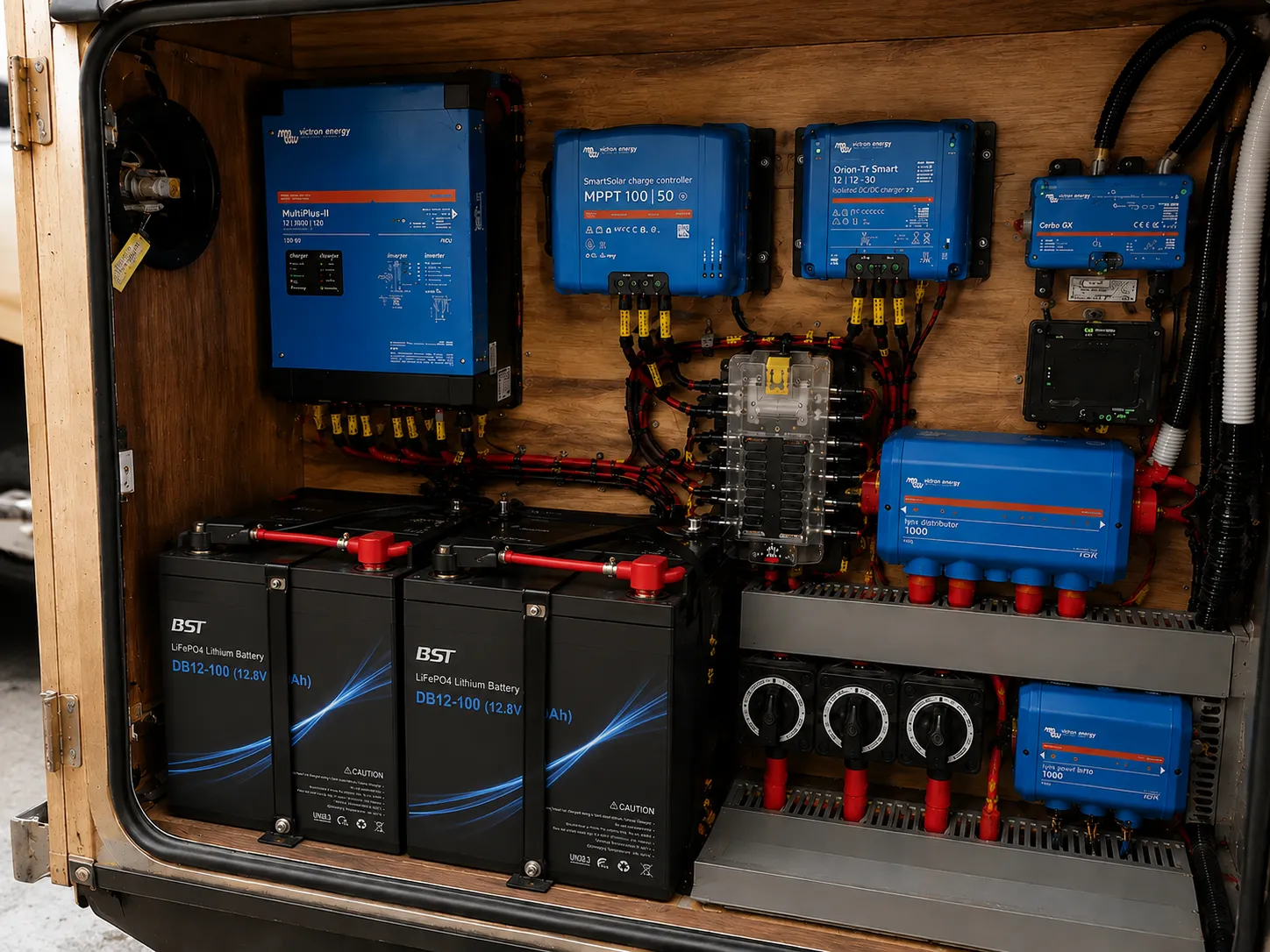
12V LiFePO4 house battery bank integrated with RV power and charging equipment.
RV Lithium Battery Sizing & Lead-Acid Conversion
Start with daily energy use, inverter demand, charging sources and installation space—not Ah alone.
1. How many Ah does an RV lithium battery need?
There is no single capacity that is correct for every RV.
Battery size should be based on daily energy consumption, inverter loads,
required off-grid runtime, solar production, alternator charging,
shore-power availability and installation space.
Comparing usable energy in kWh is often more useful than looking at Ah alone.
For a planning estimate, use the
LiFePO4 Battery Calculator →
2. Should an RV use a 12V, 24V or 48V LiFePO4 battery system?
12V systems are common in RV house-power installations, while 24V or 48V systems
can reduce current in higher-power applications.
The battery voltage must match the inverter, charging equipment and connected DC loads.
Changing system voltage normally requires a complete electrical-system review.
3. Is a Group 24, Group 27, Group 31 or 8D battery size enough to select an RV battery?
No. Group size mainly describes physical dimensions and terminal layout.
Two batteries in the same case size can have very different capacity,
continuous current, BMS limits and charging requirements.
Confirm both mechanical fit and electrical capability.
4. How do I size an RV lithium battery for an inverter?
Start with inverter power and expected simultaneous AC loads.
High-power inverters can draw substantial DC current from a 12V battery system.
Battery continuous and peak discharge capability, BMS rating, cable size,
fuse protection and voltage drop should all support the expected inverter load.
For battery, inverter and charger matching, review
Lithium Battery System Compatibility →
5. Can an RV lead-acid battery be directly replaced with LiFePO4?
Not automatically.
Battery dimensions, charger or converter profile, inverter current,
alternator charging, solar controller settings, fuse protection,
cable size and low-temperature charging should be checked before conversion.
See the
RV Lead-Acid to LiFePO4 Conversion Project →
6. Can the existing RV inverter remain after converting to lithium?
Often yes, provided the inverter input-voltage range, maximum current,
low-voltage settings, cables and circuit protection are suitable for the new battery.
The inverter should be reviewed against the complete battery configuration rather than capacity alone.
Shore Power, Converter, Solar & RV Charging
7. Why is the RV connected to shore power but the lithium battery is not charging?
Working AC appliances only prove that shore power is reaching the RV's AC system.
They do not prove that charging current is reaching the house battery.
Check converter output, battery-side fuses or breakers, battery disconnect,
cable continuity, ground connections, voltage at the battery terminals,
BMS protection status and charger compatibility.
See
RV Lithium Battery Not Charging on Shore Power →
8. Does an RV converter need a LiFePO4 charging profile?
The converter or charger output must be suitable for the approved battery specification.
Check charging voltage, current, charge stages, termination behavior
and whether the charger uses lead-acid equalization or desulfation functions.
Do not judge compatibility only from the nominal system voltage.
9. Why did replacing the converter not fix the RV battery charging problem?
The converter is only one part of the charging path.
If charging voltage is present at the converter but not at the battery,
the problem may be a fuse, breaker, battery disconnect, wiring,
ground connection or high-resistance connection.
The BMS may also be blocking charging because of voltage, temperature or another protection condition.
10. Can I use the old RV lead-acid charger with a LiFePO4 battery?
Only if its charging behavior is confirmed as compatible with the battery.
Connector fit and nominal voltage are not enough.
Review maximum voltage, charge current, charging stages and any equalization or recovery modes.
11. Can the existing RV solar panels be used after converting to lithium?
The solar panels themselves can often remain,
but the solar charge controller must support appropriate LiFePO4 charging settings.
Confirm charge voltage, current, temperature behavior and any communication requirements.
12. Can shore power, solar and alternator charging operate at the same time?
Multiple charging sources can be used in a properly designed RV system,
but each source should follow compatible charging limits.
The combined charging current must also remain within the battery and BMS charge-current capability.
Alternator & DC-DC Charger Compatibility
13. Can an RV LiFePO4 battery be charged directly from the alternator?
Do not assume direct alternator charging is suitable.
LiFePO4 batteries can accept high charging current,
and the alternator, regulator, wiring and battery BMS must all be considered.
Many RV conversions use a properly sized DC-DC charger to control the charging current and profile.
14. Do I need a DC-DC charger when converting an RV to lithium?
It depends on the vehicle charging architecture.
A DC-DC charger is commonly used to provide controlled alternator charging,
particularly in systems with smart alternators or where alternator current needs to be limited.
See
RV Lithium Battery DC-DC Charger Compatibility →
15. Why can a smart alternator cause RV lithium charging problems?
Smart alternators can vary their output voltage according to vehicle operating conditions.
A DC-DC charger may stop, reduce current or cycle if its input voltage or ignition-trigger requirements are not met.
Vehicle-side charging behavior should be reviewed before selecting the charger.
16. Why does my RV DC-DC charger repeatedly start and stop?
Possible causes include input-voltage drop, smart-alternator behavior,
ignition or D+ trigger configuration, high-resistance wiring,
charger thermal limits, BMS charging protection,
low battery temperature or an incorrect charging profile.
Measure both charger input and battery-side conditions during the fault.
17. Should an RV DC-DC charger be sized from battery Ah alone?
No.
Charger size should consider the alternator's available output,
battery charge-current limit, BMS capability, wiring,
expected charging time and other vehicle electrical loads.
A large battery does not automatically mean the alternator can safely support a larger charger.
BMS Protection, Deep Discharge & Cold Weather
18. Why will an RV LiFePO4 battery not wake up after deep discharge?
The BMS may have entered low-voltage protection or sleep mode.
Battery-terminal voltage may disappear even though the cells themselves are not at zero volts.
Follow the approved wake-up procedure and identify what caused the deep discharge.
See
LiFePO4 Battery Won't Wake Up After Deep Discharge →
19. Why does the charger say “No Battery” after a deep discharge?
Some smart chargers require a minimum detected battery voltage before they begin charging.
If the BMS has disconnected the battery output,
the charger may not detect enough voltage to start.
This can create a charger-detection loop where the battery remains asleep.
20. Can an RV LiFePO4 battery be charged below freezing?
Charging limits depend on the battery specification.
Many LiFePO4 batteries use low-temperature charging protection,
and selected configurations include self-heating.
Do not charge below the battery's approved temperature range.
Confirm the model's temperature limits and heating behavior before winter operation.
21. Why does the inverter report “Low Battery” when SOC still looks high?
SOC and voltage are different measurements.
High inverter load can cause battery voltage to sag even when the displayed SOC is still relatively high.
Check actual voltage at the battery and inverter under load,
individual cell voltage, cable voltage drop, BMS limits and inverter low-voltage settings.
If pack voltage still appears acceptable but one cell reaches a protection threshold first,
review the
LiFePO4 Cell Imbalance & Early BMS Cutoff
diagnostic case.
22. What should I check before replacing an RV lithium battery that keeps shutting down?
Do not assume the battery itself has failed. Check:
BMS protection, charge-discharge performance and system behavior should be verified during battery testing.
Parallel Batteries, CAN / RS485 & Victron Integration
23. Why do parallel RV lithium batteries show different SOC or current?
Parallel connection gives the batteries a common bus voltage,
but it does not guarantee identical current sharing or identical SOC readings.
Differences can come from initial SOC, cable resistance, battery layout,
BMS calibration, internal resistance or cell condition.
See
Parallel Lithium Batteries Show Different SOC →
24. Does an RV lithium battery need CAN or RS485 communication?
Not every RV battery system requires communication.
CAN or RS485 becomes important when an inverter, charger,
energy-management system or vehicle controller needs battery data
or closed-loop charge and discharge limits.
Both the communication interface and protocol must be compatible.
25. Does a battery with CAN automatically work with a Victron system?
No. A CAN connector alone does not confirm compatibility.
The battery BMS protocol, cable pinout, communication settings,
connected GX equipment, firmware and required charge/discharge data must be compatible.
The exact battery model, BMS protocol and connected equipment should be confirmed before installation.
Review
BMS, CAN, Charger & Inverter Compatibility →
26. If the inverter displays SOC, does that prove closed-loop BMS communication is working?
Not necessarily.
Receiving SOC, voltage or temperature data does not by itself prove that the inverter
is correctly following dynamic battery charge limits, discharge limits and alarms.
For communication problems, see
Lithium Battery CAN Communication Problem →
RV Battery Compatibility Is More Than Voltage and Ah
Review the battery, Smart BMS, inverter, converter,
solar controller, DC-DC charger, communication and electrical limits before integration.
27. Can lithium batteries be connected in series or parallel in an RV?
Only use series or parallel configurations approved for the specific battery model.
Batteries should be compatible in voltage, model, capacity, age and state of charge,
and the wiring layout should support balanced current sharing.
Follow the manufacturer's connection limits and commissioning instructions.
28. Should RV battery cables and fuses be changed during a lithium conversion?
They should at least be reviewed.
LiFePO4 batteries can support high current,
so cable size, cable length, fuse or breaker rating,
terminal connections, battery disconnect and inverter current
should be checked against the new battery system.
29. What information is needed for an RV OEM or conversion battery project?
Provide system voltage, required capacity, continuous and peak current,
battery-compartment dimensions, inverter model, AC charger or converter,
solar controller, alternator or DC-DC charger, operating temperature,
communication requirements and estimated quantity.
See the
Custom RV LiFePO4 Battery OEM Project →
For broader custom development options, see
OEM & ODM LiFePO4 Battery Services →
30. Should an OEM RV battery be tested with the actual inverter and charging equipment?
Send the RV system voltage, required capacity, inverter model,
AC charger or converter, solar controller, alternator or DC-DC charger,
installation dimensions, communication requirements and estimated quantity
for a system-level review.
RV lithium battery symptoms can have multiple causes.
Confirm the battery, Smart BMS, charging sources, inverter,
wiring, circuit protection and operating conditions before replacing components
or changing protection settings.