From Battery Specification to Verified Performance
Battery performance should be verified against the intended application—not assumed from voltage, capacity or BMS specifications alone.
Lithium battery testing and validation can cover cell consistency, charge and discharge performance,
Smart BMS protection, continuous and peak current, temperature protection, CAN or RS485 communication,
battery aging and final inspection according to the battery model and approved project requirements.
Typical Battery Validation Scope
Cell Consistency
Capacity
Charge / Discharge
BMS Protection
Continuous / Peak Current
CAN / RS485
Temperature Protection
Aging
Final Inspection
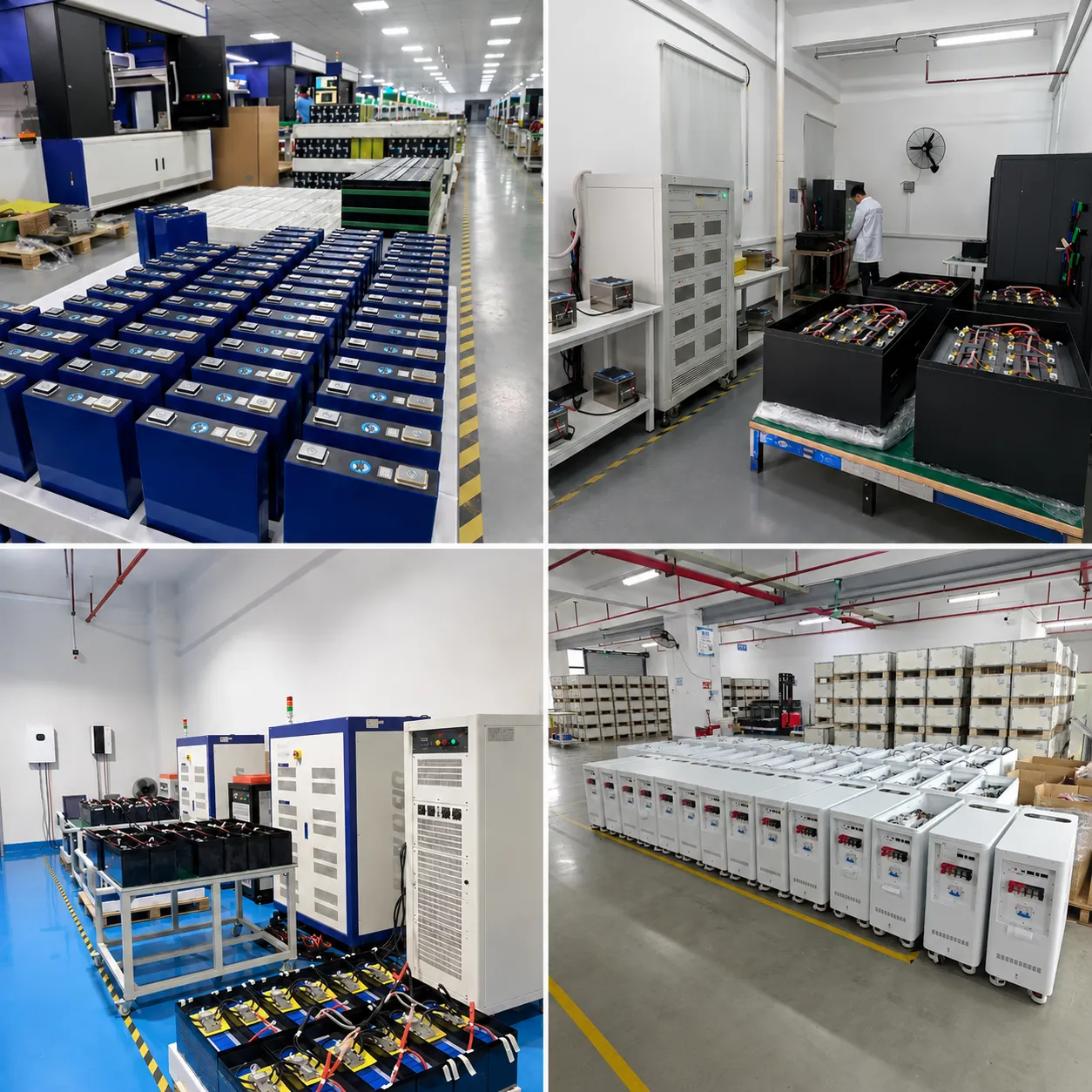
Battery assembly, inspection and production validation before final release.
Why Battery Testing Matters
Matching voltage and Ah is only the beginning of battery selection.
The connected load, charging equipment, BMS current limits, communication requirements,
operating temperature, wiring and installation conditions can all affect real-world performance.
Testing helps verify that the approved battery configuration performs according to the electrical,
mechanical and communication requirements defined for the application.
Specification defines the target.
Validation helps confirm the approved battery configuration against the project requirements before volume production.
Battery Validation Process
Cell & Battery Pack Validation
Battery consistency begins at the cell level. Cell characteristics, assembly condition
and completed battery performance should be reviewed against the approved battery configuration.
Cell Voltage
Cell voltage is reviewed as part of the consistency and inspection process.
Internal Resistance
Internal-resistance data can be used when reviewing cell consistency before pack assembly.
Capacity Verification
Battery capacity is checked according to the applicable battery or project test requirements.
Pack Inspection
Busbars, insulation, wiring, terminals, connectors and assembly condition are inspected.
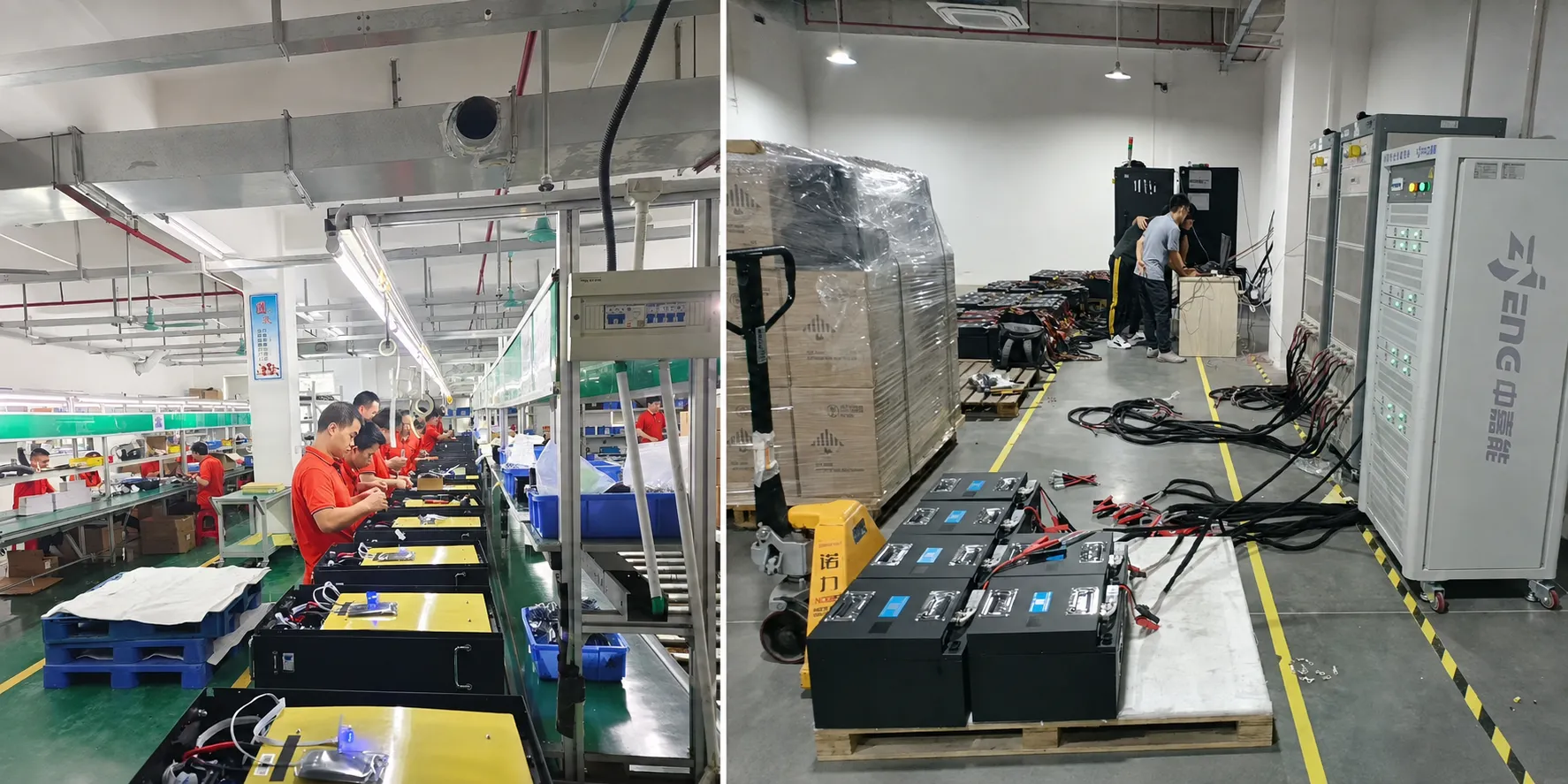
Battery pack assembly, Smart BMS installation and production inspection.
Smart BMS Functional Validation
The BMS is part of the battery protection and control system.
Required BMS functions should be verified according to the cells, current limits,
charging requirements and intended operating conditions.
- Overvoltage protection
- Undervoltage protection
- Overcurrent protection
- Short-circuit protection
- High- and low-temperature protection where required
- Cell-voltage monitoring
- Cell balancing functions
- Charge and discharge control
- Battery data monitoring where applicable
- Bluetooth monitoring on selected configurations
BMS settings and protection limits depend on the battery model, cell configuration,
current requirements and approved project specification.
Charge, Discharge & Current Testing
Battery capacity alone does not determine whether a battery can support an application.
Continuous current, peak current, charging requirements and voltage behavior under load must also be considered.
Charge Performance
Charging voltage, charging current and battery response are checked against the approved configuration.
Discharge Performance
Battery discharge behavior can be evaluated under the specified electrical load.
Continuous Current
Continuous-load capability is reviewed against the battery and BMS configuration.
Peak Current
Peak-current performance can be checked where motors, inverters or startup loads require it.
CAN / RS485 Communication Validation
Communication compatibility cannot be confirmed from a connector type alone.
When a battery communicates with an inverter, charger, controller or industrial equipment,
the communication requirements should be reviewed as part of the complete system.
CAN is the communication channel. The protocol is the language.
- Required communication protocol
- CAN or RS485 interface
- Message format
- Baud rate where applicable
- Connector and cable pinout
- Battery address or master/slave configuration where required
- Firmware requirements
- Connected inverter, charger or controller
- Required battery data and control functions
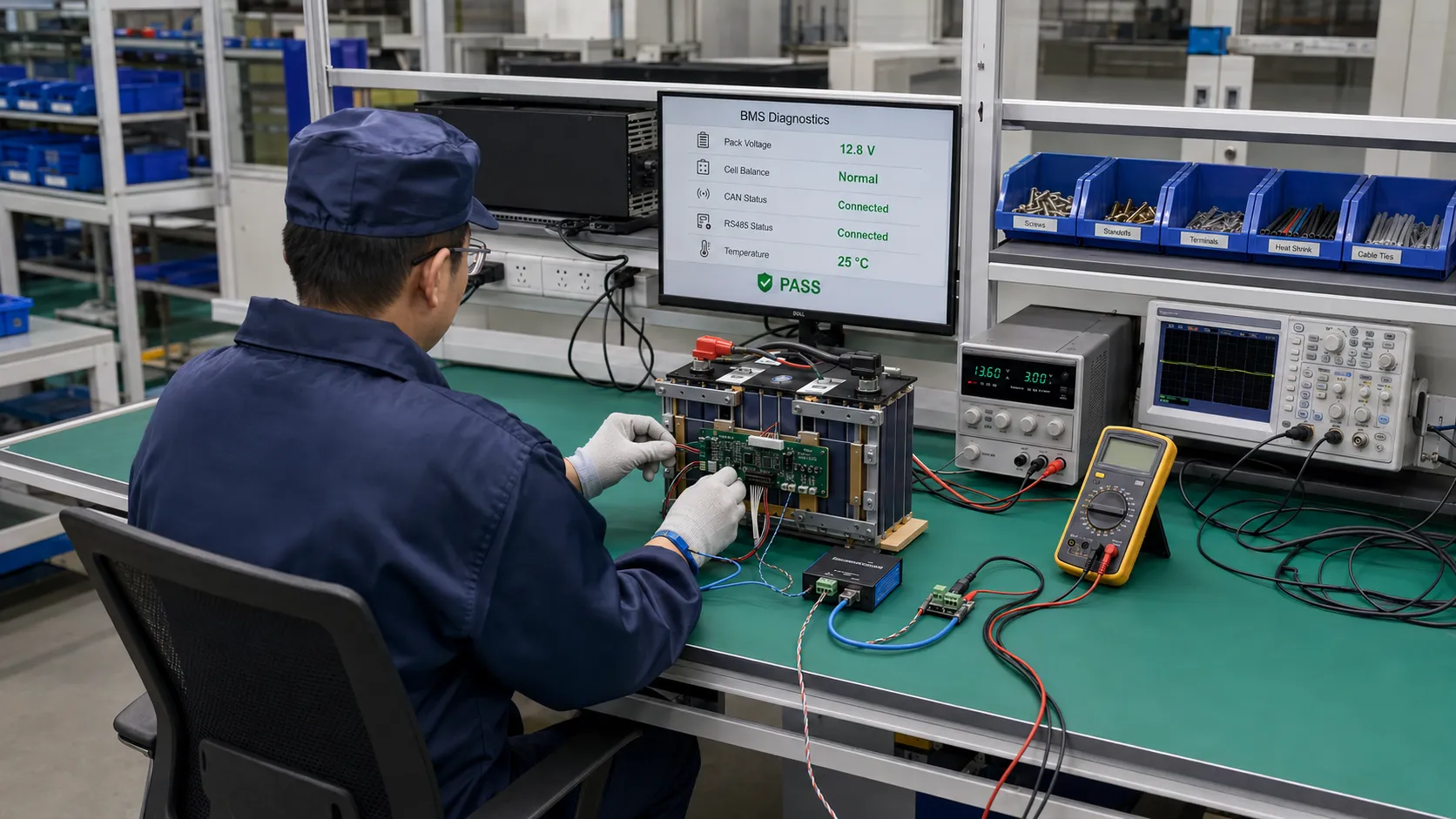
Smart BMS, CAN and RS485 communication review for compatible battery systems.
Communication Is More Than Seeing Battery Data
Receiving voltage, current or state-of-charge data does not by itself confirm that the complete system
is operating with the intended closed-loop control.
Where closed-loop integration is required, the connected equipment may also need to correctly interpret
battery charge limits, discharge limits, temperature status, alarms and other BMS information.
Temperature & Protection Checks
Temperature-related validation depends on the battery model, BMS configuration and intended operating environment.
Where required, testing can include temperature sensing and protection behavior.
- High-temperature protection
- Low-temperature charging protection
- Temperature sensor operation
- Self-heating operation where specified
- Application-specific temperature requirements
Environmental and temperature test requirements should be confirmed for the specific battery and application.
Battery Aging & Final Inspection
Testing does not end after the initial electrical checks.
Battery performance can be monitored during the specified aging process before final inspection and release.
Aging
Monitor battery performance during the specified aging process.
Functional Check
Confirm applicable electrical and BMS functions.
Physical Inspection
Inspect enclosure, terminals, connectors, cables and labels.
Final Release
Check identification, accessories and packaging before shipment.
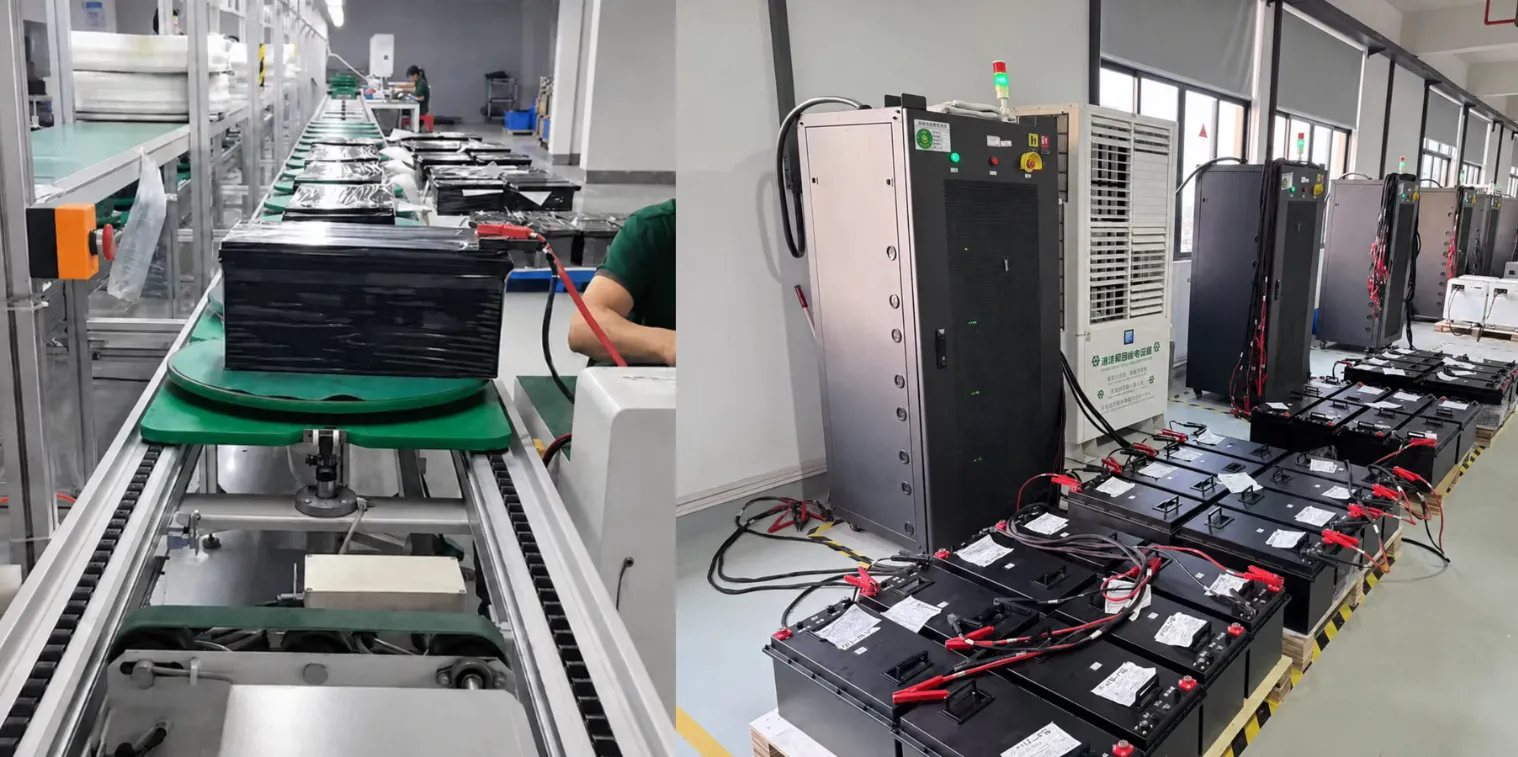
Battery aging, functional testing and final quality inspection before shipment.
OEM Sample Validation Before Volume Production
For qualified custom battery and OEM projects, sample validation provides an opportunity
to identify electrical, mechanical or communication issues before the final production specification is approved.
Requirement Review
→
Engineering
→
Sample
→
Testing
→
Review
→
Validation
→
Volume Production
Validation Depends on the Application
Different applications place different electrical and operating demands on a LiFePO4 battery.
The validation plan should focus on the requirements that matter to the final system.
RV & Van
Charger, inverter, alternator/DC-DC charging, current demand,
low-temperature operation and communication where required.
Marine
Continuous load, trolling-motor demand, charging equipment,
cable configuration, protection and onboard integration.
Golf Cart & Utility Vehicle
Acceleration current, controller demand, regenerative charging,
BMS current limits, charger matching and vehicle integration.
Industrial Equipment
Load profile, peak current, charger, enclosure, connectors,
communication and equipment-specific control requirements.
Test Records & Project Documentation
Available documentation depends on the exact battery model, configuration,
project requirements, shipping method and destination market.
- Battery datasheets and approved specifications
- Product-specific inspection or test information where available
- UN38.3 transport documentation for applicable models
- MSDS / SDS documentation where applicable
- CE or RoHS documentation for applicable models where available
- OEM drawings and technical information according to project scope
- BMS or communication information where applicable
View Battery Factory & Certifications →
Testing Scope Must Match the Battery and Project
Not every test, communication interface or protection function applies to every battery.
The required validation scope depends on the battery model, electrical specification,
application, connected equipment, customer requirements and approved project test plan.
Related Engineering & Manufacturing Resources
LiFePO4 Battery Manufacturing
Battery assembly, Smart BMS integration, aging and production quality control.
OEM & ODM Battery Services
Custom battery specifications, BMS, enclosure, communication and volume production.
Lithium Battery System Compatibility
Review BMS, CAN/RS485, charger, inverter and system compatibility before integration.
LiFePO4 Battery Technical Support
Battery selection, charging, BMS, communication and system-integration support.
Need to Validate a Lithium Battery for Your System?
Send your application, required voltage and capacity, continuous and peak current,
charging equipment, installation requirements, communication protocol and estimated quantity.
The battery configuration and applicable validation requirements can then be reviewed for the project.
Discuss Your Testing Requirements →
Validation procedures and available test records depend on the battery model,
application, project specification and required test scope.
Confirm the applicable validation plan before sample or volume production.