Liquid-Cooled vs Air-Cooled BESS

Liquid-Cooled vs Air-Cooled BESS

C&I BESS Thermal Management Guide

Compare liquid-cooled and air-cooled Battery Energy Storage Systems for commercial and industrial applications, including thermal performance, energy density, maintenance, installation, climate suitability and lifecycle considerations.
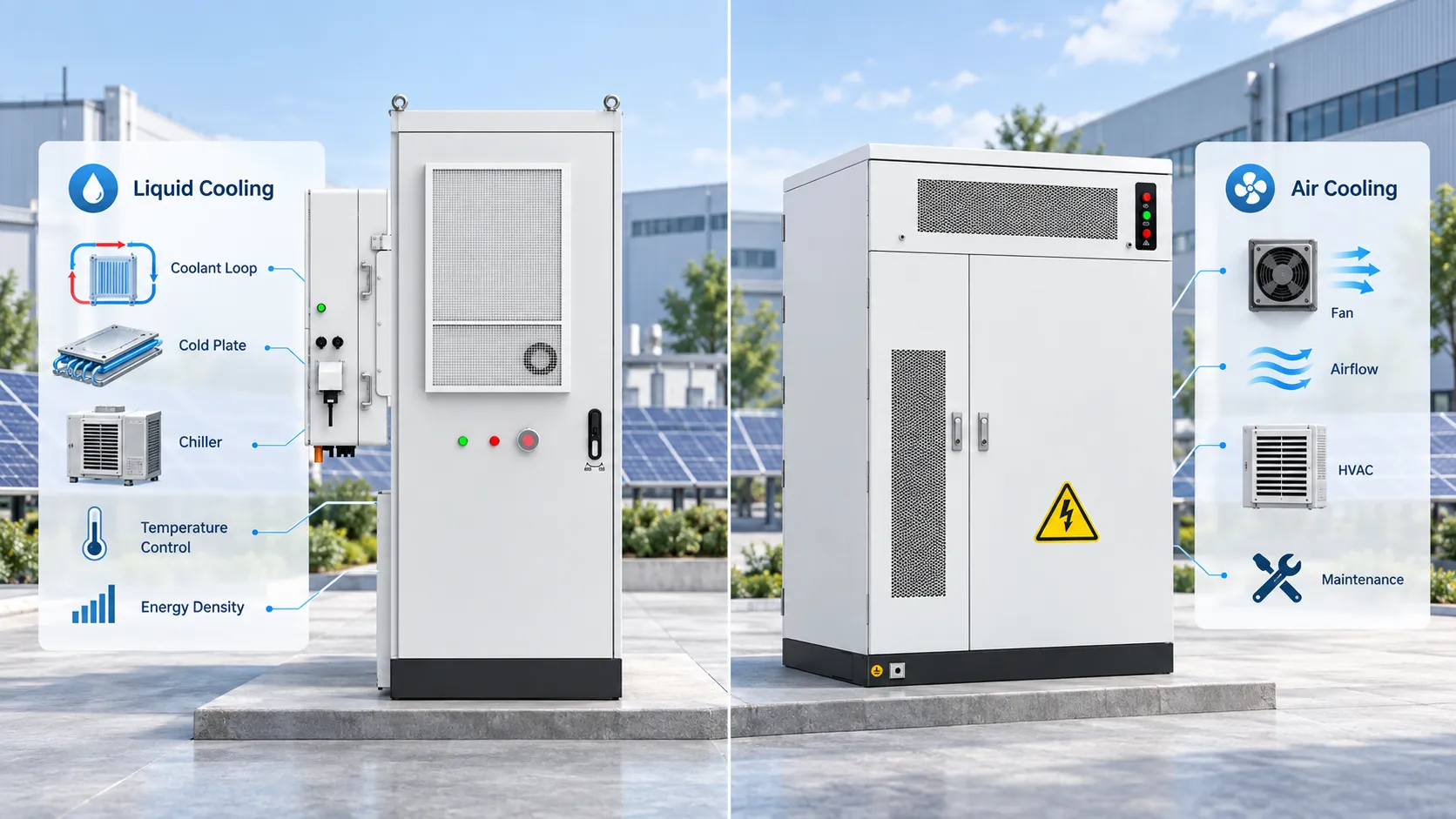
Liquid cooled vs air cooled C&I BESS comparison for commercial and industrial battery energy storage thermal management
Liquid-cooled vs air-cooled C&I BESS thermal management comparison for commercial and industrial battery energy storage systems, including cooling structure, energy density, maintenance and application suitability.
Liquid Cooling Air Cooling Thermal Management Energy Density C&I BESS Lifecycle & O&M

Why Thermal Management Matters in BESS

Battery cells generate heat during charging and discharging. The thermal-management system must keep cell temperatures within the specified operating range while minimizing temperature differences across modules and racks.

Cooling method affects cabinet layout, achievable power density, auxiliary energy consumption, installation complexity, maintenance requirements and long-term battery performance. The best choice depends on the actual project rather than on cooling technology alone.

Liquid-Cooled vs Air-Cooled BESS: Quick Comparison

Factor Liquid-Cooled BESS Air-Cooled BESS
Heat Transfer Coolant circulates through dedicated thermal paths close to battery modules. Fans and conditioned air remove heat from modules and cabinet spaces.
Temperature Uniformity Generally better suited to tightly controlled temperature distribution in high-density systems. Can be effective in lower-density systems when airflow paths are well engineered.
Energy Density Supports compact layouts and higher cabinet-level energy density. Often requires more airflow space and larger thermal clearances.
System Complexity Higher: pumps, coolant loops, heat exchangers, sensors and leak-control considerations. Lower: fans, filters, ducts and HVAC components are generally simpler to service.
Initial Cost Typically higher due to additional thermal components and integration. Typically lower for smaller or less thermally demanding installations.
Typical Fit Higher-energy cabinets, dense C&I systems, MWh-scale projects and demanding climates. Smaller C&I systems, moderate climates and projects prioritizing simplicity.

How Liquid-Cooled BESS Works

A liquid-cooled BESS circulates coolant through cold plates, cooling channels or other thermal interfaces positioned close to the battery modules. Heat is transferred from the cells into the coolant and then rejected through the system's heat exchanger or chiller loop.
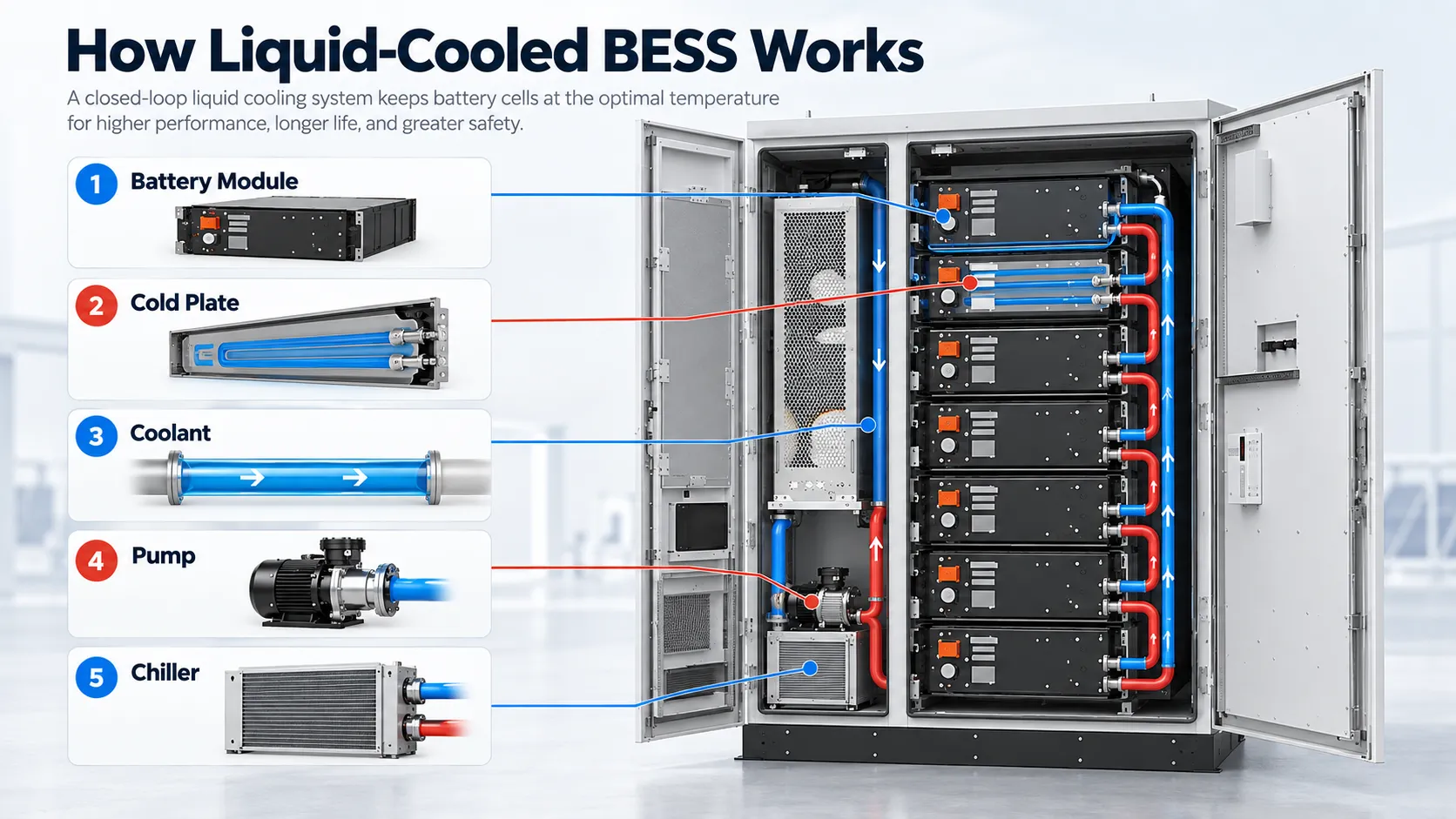
Liquid cooled BESS working principle with battery modules cold plates coolant loop pump heat exchanger and chiller
Liquid-cooled BESS working principle showing battery modules, cold plates, coolant circulation, pump and chiller for high-density commercial and industrial energy storage thermal management.
Battery Modules
Heat is generated during charging and discharging.
Cold Plate / Cooling Channel
Transfers heat from the module into the coolant loop.
Pump & Coolant Loop
Circulates coolant through the battery thermal circuit.
Heat Exchanger / Chiller
Rejects heat and controls coolant temperature.

How Air-Cooled BESS Works

An air-cooled BESS uses fans, ventilation paths and often HVAC to move conditioned air around battery modules and racks. Effective airflow design is critical because blocked ducts, dirty filters or uneven air distribution can create local hot spots.
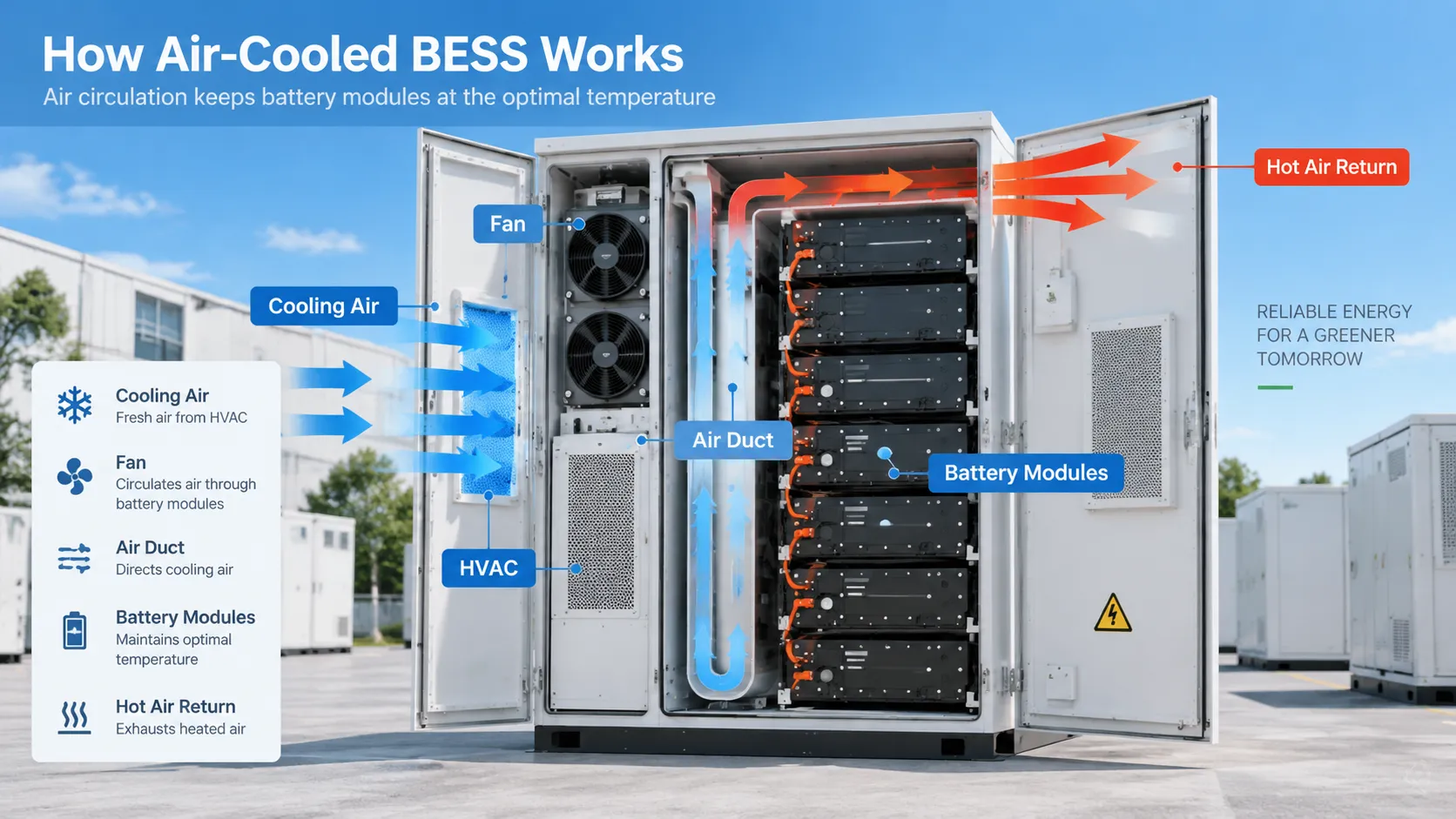
Air cooled BESS working principle with HVAC cooling air fans air ducts battery modules and hot air return
Air-cooled BESS working principle showing HVAC cooling air, fans, air ducts, battery modules and hot-air return for commercial and industrial battery energy storage systems.
Cooling Fans
Move air through battery racks and cabinet channels.
Air Ducts
Guide air to maintain predictable thermal flow paths.
HVAC / Air Conditioning
Controls incoming air temperature in enclosed systems.
Filters & Maintenance
Keep airflow components clean and operating within design limits.

Thermal Performance: What Actually Matters?

Cooling technology should be evaluated together with the cell, battery module, enclosure, control strategy and operating environment. Important engineering metrics include:
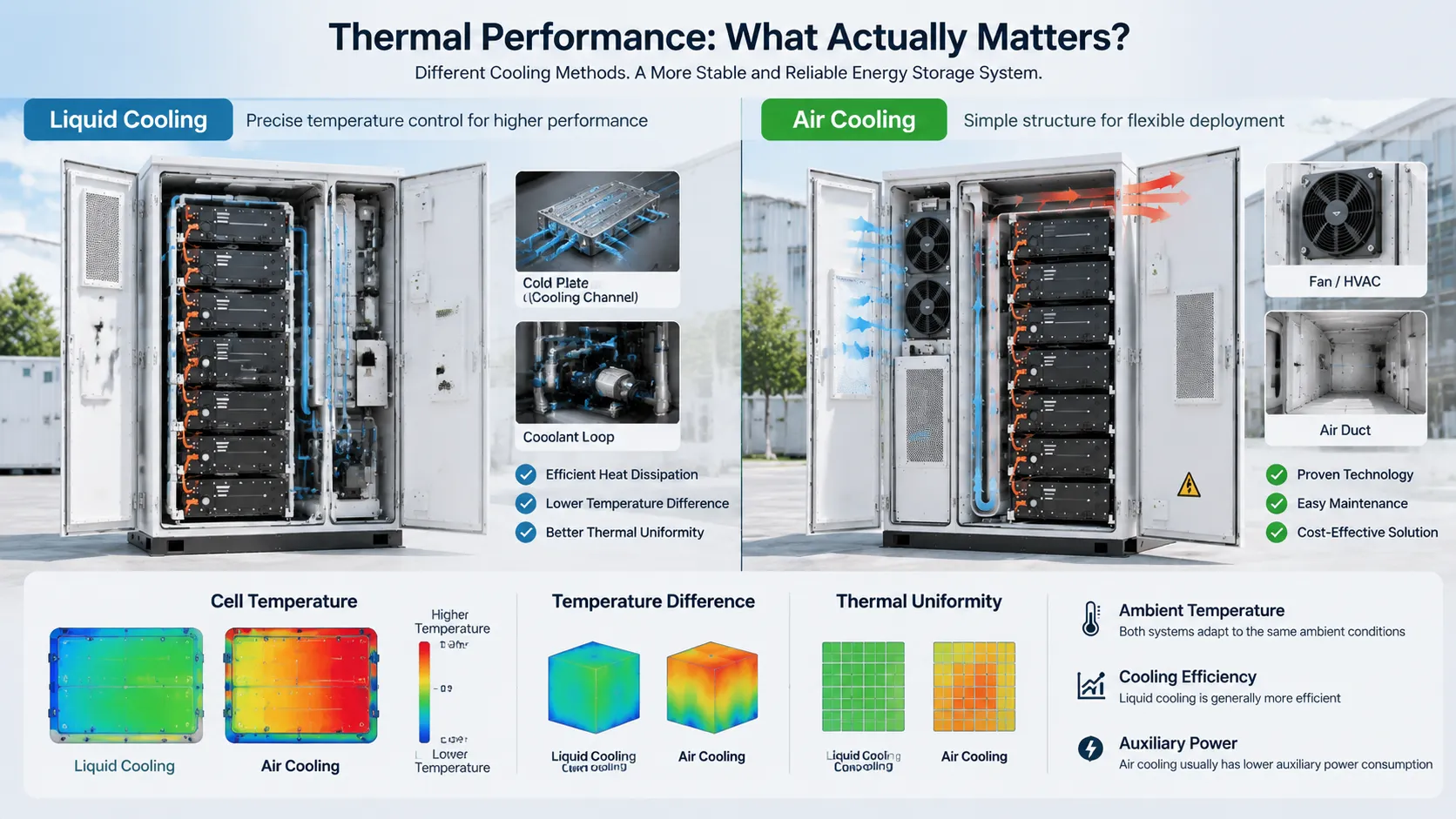
Liquid cooled vs air cooled BESS thermal performance comparison for cell temperature thermal uniformity cooling efficiency and auxiliary power
Liquid-cooled vs air-cooled BESS thermal performance comparison covering cell temperature, temperature difference, thermal uniformity, cooling efficiency and auxiliary power in C&I energy storage applications.
Maximum Cell Temperature
Must remain within the cell manufacturer's allowable range.
Temperature Difference
Lower spread across cells and modules supports more uniform operation.
Ambient Temperature
Hot and cold climates place different demands on HVAC and coolant systems.
Charge / Discharge Rate
Higher sustained power usually increases thermal load.
Auxiliary Power
Cooling systems consume energy and affect net system efficiency.
Fault Detection
Temperature, pressure, flow or fan monitoring supports early detection of abnormal conditions.

When Liquid Cooling Makes More Sense

High battery energy density is required within limited installation space.
The project operates at relatively high sustained charge or discharge power.
Ambient temperatures are high or vary significantly.
Tighter control of module temperature distribution is a design priority.
The project is cabinet-dense, MWh-scale or designed for frequent cycling.
Higher initial complexity is acceptable in exchange for compact thermal design.

When Air Cooling Makes More Sense

The BESS is relatively small and thermal load is moderate.
Installation space is available for airflow and HVAC components.
Simple maintenance and straightforward component replacement are priorities.
The site climate is moderate and system duty is not highly thermally demanding.
Lower initial system complexity is more important than maximum energy density.
The project does not require an especially compact cabinet footprint.

Cooling Method Is Only One Part of BESS Safety

Neither liquid cooling nor air cooling alone determines whether a BESS is safe. System safety also depends on cell quality, BMS protection, electrical protection, enclosure design, thermal runaway detection, fire protection, installation spacing, commissioning and operating procedures.

Cell + BMS + Thermal Management + Electrical Protection + Fire Protection + Controls + Installation

Lifecycle & Maintenance Considerations

Maintenance Item Liquid Cooling Air Cooling
Routine Inspection Coolant level, pumps, hoses, connectors, pressure/flow, heat exchanger and alarms. Fans, filters, ducts, HVAC operation, airflow and alarms.
Typical Wear Components Pumps, seals, valves and cooling-loop components. Fans, filters, blowers and HVAC components.
Failure Detection Flow, pressure, temperature and leak-related monitoring. Fan status, airflow, filter condition and temperature monitoring.

Which Cooling Method Should You Choose?

Instead of choosing by name alone, compare the project against the following engineering inputs:

  • Required BESS power in kW and usable energy in kWh
  • Expected charge/discharge C-rate and daily cycling profile
  • Maximum and minimum site ambient temperature
  • Available footprint and maximum cabinet density
  • Required IP rating and outdoor installation conditions
  • Auxiliary energy consumption target
  • Maintenance capability and spare-parts strategy
  • Expected project life and end-of-life performance target
  • Applicable safety, transport and grid-compliance requirements

Questions About Liquid-Cooled vs Air-Cooled BESS

Is liquid-cooled BESS always better than air-cooled BESS?

No. Liquid cooling is often advantageous for higher-density and more thermally demanding projects, while air cooling may be more practical for smaller systems or projects prioritizing simplicity and lower initial complexity.

Which cooling method is better for high ambient temperatures?

Liquid cooling can provide tighter thermal control in demanding climates, but final suitability depends on the complete thermal design, chiller or HVAC capacity, enclosure and operating profile.

Does liquid cooling improve battery life?

Better temperature control can help reduce thermal stress and temperature imbalance, but actual battery life also depends on cell chemistry, SOC window, C-rate, cycling, ambient conditions and BMS strategy.

Is air-cooled BESS easier to maintain?

Air-cooled systems are generally simpler because they avoid coolant loops, but fans, filters, ducts and HVAC still require routine inspection and maintenance.

What information is needed to choose the cooling method?

Typical inputs include BESS kW/kWh, C-rate, ambient temperature range, cycling profile, available footprint, installation environment, maintenance requirements and expected project life.

Need Help Selecting a BESS Cooling System?

Send us your required kW/kWh, site temperature range, charge/discharge profile, available footprint and installation conditions to evaluate whether liquid-cooled or air-cooled BESS is more appropriate for your project.

Request a BESS Thermal Design Review
