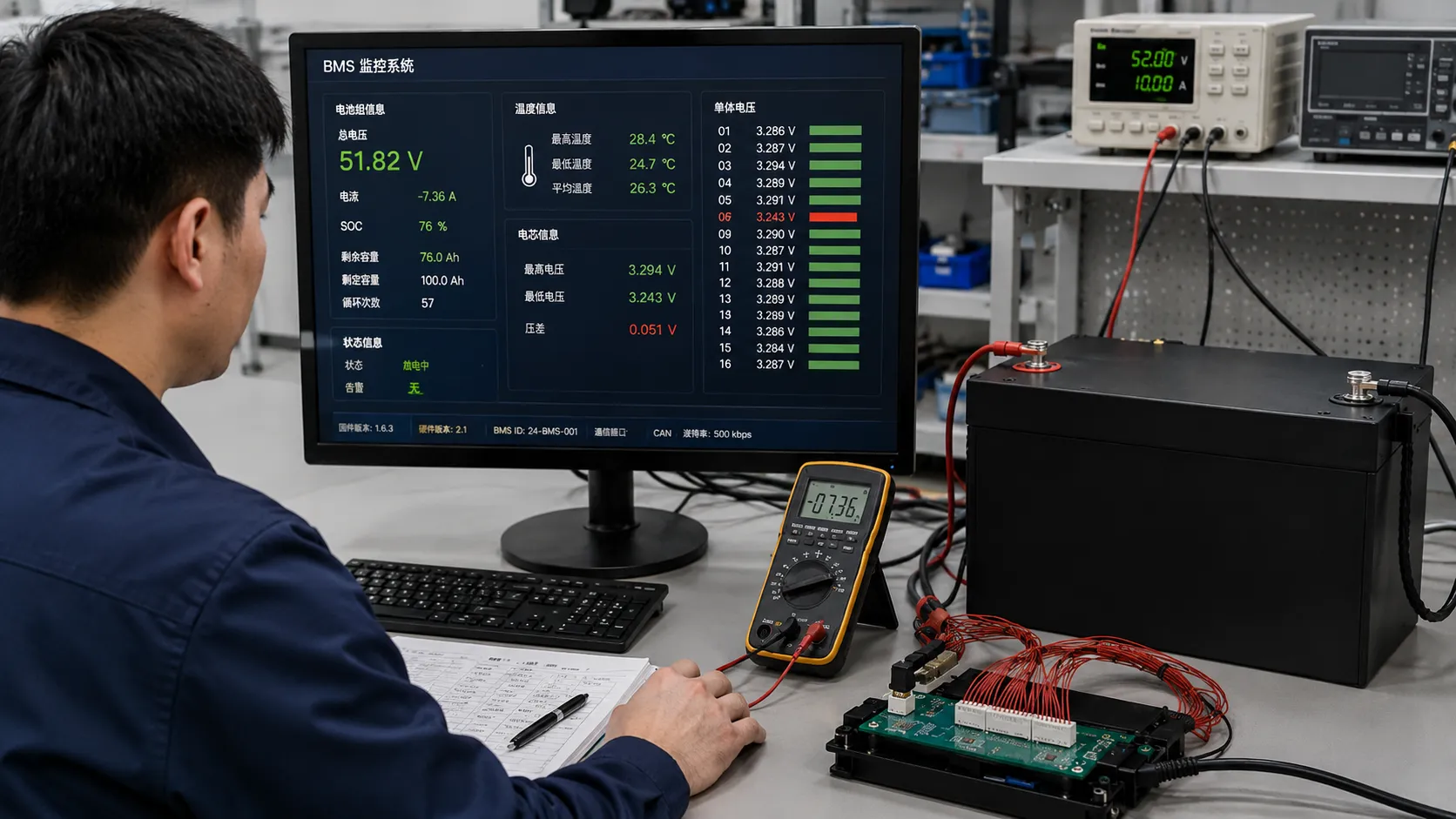
One Cell Reaches Cutoff Before the Rest
A LiFePO4 battery can appear to have usable capacity remaining and still shut down because one cell reaches a BMS protection limit before the rest of the pack.
During discharge, one cell may reach the low-voltage threshold first.
During charging, one cell may rise to the high-voltage threshold before the others.
The important question is whether the cause is cell imbalance,
a weak cell, load-related voltage sag, charging behavior,
temperature difference or another system condition.
LiFePO4 Cell Imbalance & BMS Diagnostic Testing
Pack voltage alone may look normal. Individual cell voltage, cell delta, current and BMS data provide a clearer picture of battery condition.
Key diagnostic point:
The BMS protects individual cells, not only total pack voltage.
One cell reaching its protection threshold can disconnect the entire battery
even when overall pack voltage or displayed SOC still looks acceptable.
Common Symptoms of LiFePO4 Cell Imbalance
- Battery shuts down earlier than expected
- SOC still shows remaining capacity when the BMS disconnects
- Total pack voltage appears normal at rest
- One cell voltage drops faster than the others under load
- One cell reaches high-voltage protection first during charging
- Battery repeatedly enters low-voltage or high-voltage protection
- Available capacity appears lower than expected
- Battery works at light load but shuts down at higher current
Possible Causes
1. Cell Imbalance Has Increased
Small voltage differences between LiFePO4 cells are normal.
The problem begins when the difference becomes large enough that one cell reaches a BMS limit significantly earlier than the others.
2. One Cell Has Higher Internal Resistance
A weaker cell may show a larger voltage drop as current increases.
The pack can therefore look normal at rest but trigger low-voltage protection during acceleration,
inverter load or another high-current event.
3. One Cell Reaches High Voltage First During Charging
Near full charge, a higher-SOC or lower-capacity cell may rise faster than the rest.
Once that cell reaches the BMS high-voltage threshold, charging may be reduced or disconnected
even though the other cells are not yet fully charged.
4. BMS Balancing Has Not Corrected the Difference
BMS balancing capability varies by battery design.
Balancing current, activation voltage and the amount of time spent near the balancing range
can affect how quickly cell-voltage differences are corrected.
5. Load or Charging Conditions Expose the Imbalance
High charge current, high discharge current, regenerative charging or large inverter loads
can make an existing cell difference much more visible than it appears during low-current operation.
6. Temperature Differences Affect Cell Behavior
Cells operating at different temperatures can show different voltage and resistance behavior.
Temperature data should therefore be reviewed alongside cell voltage when diagnosing an abnormal pack.
What Should You Check?
Do not judge the battery only by total pack voltage or displayed SOC. Review:
- Total pack voltage
- Highest individual cell voltage
- Lowest individual cell voltage
- Cell-voltage difference or delta
- Cell voltage during charging
- Cell voltage under load
- Charge and discharge current
- Battery SOC
- BMS high-voltage and low-voltage protection records
- Battery and cell temperature data
- Charger voltage and charging profile
- Connected load and peak-current demand
Practical Diagnostic Sequence
- Record pack voltage and individual cell voltages at rest.
- Check BMS fault history before resetting protection.
- Observe which cell reaches the limit first during charging or discharge.
- Compare the highest and lowest cell voltage.
- Repeat the measurement under the operating condition that causes the fault.
- Review charge or discharge current at the moment of protection.
- Check temperature differences and connection condition.
- Confirm charger settings and BMS protection limits.
- Determine whether the condition is persistent before concluding that a cell is defective.
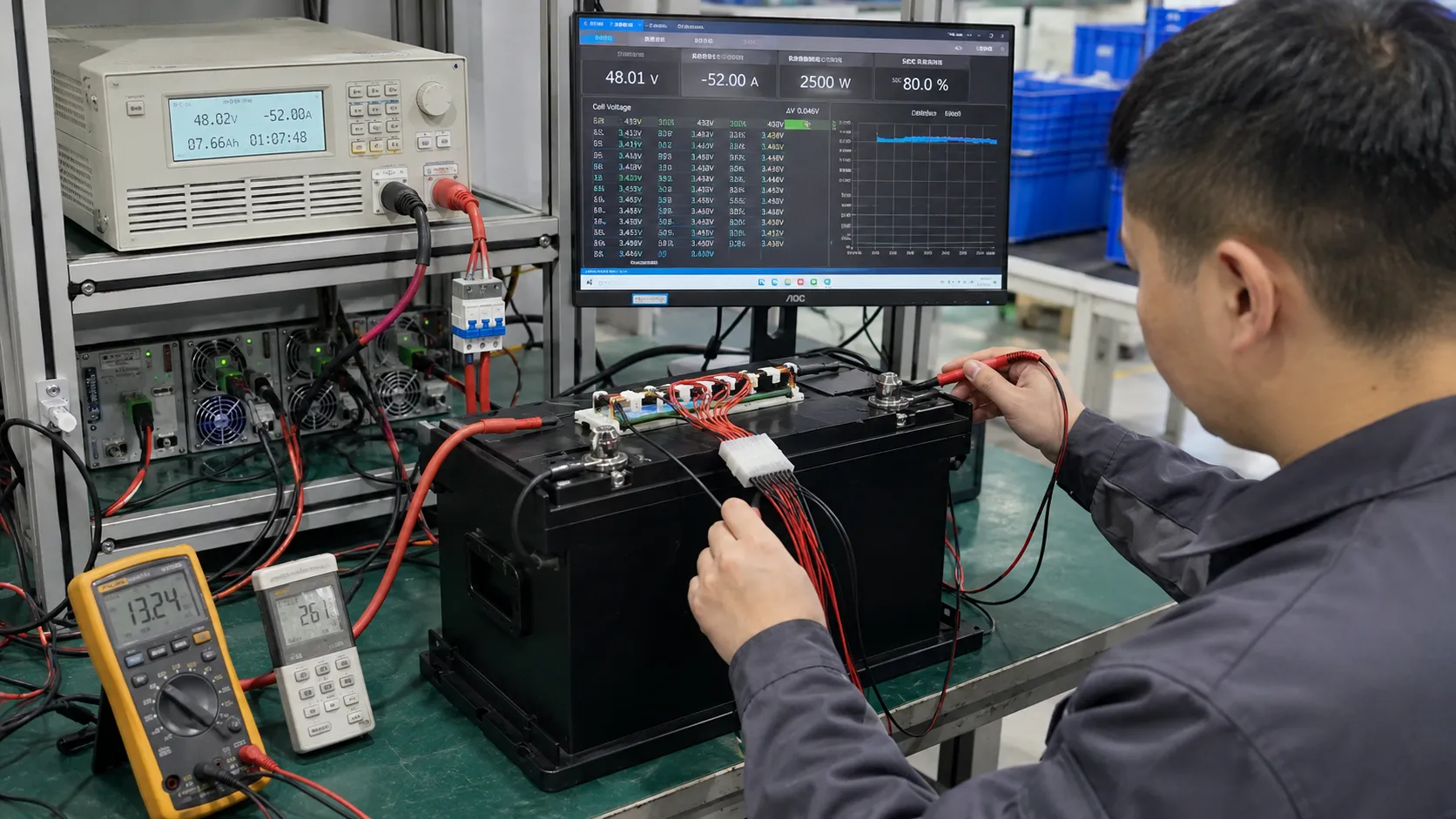
LiFePO4 Cell Voltage Load Test & Early BMS Cutoff Diagnosis
Monitoring individual cell voltage while the battery is under charge or discharge load can reveal differences that are not obvious from resting pack voltage alone.
Do Not Disable BMS Protection to Hide the Symptom
If one cell repeatedly reaches a high- or low-voltage threshold first,
increasing BMS protection limits is not a substitute for finding the cause.
Confirm cell condition, current, temperature, charger settings and system demand first.
Pack Voltage Can Look Normal While One Cell Is Not
This is one of the main reasons cell-level data is valuable during lithium battery troubleshooting.
A pack may still show apparently normal overall voltage while one cell has already moved close to a BMS protection threshold.
Resting pack voltage alone therefore cannot confirm cell health or available high-current capability.
Cell-Level Testing & Lithium Battery Validation
Charge-discharge testing, individual cell-voltage monitoring,
BMS protection records and current data can help determine whether the problem is temporary imbalance,
load-related voltage sag or a persistent weak-cell condition.
Lithium Battery Testing & Validation →
Review the Complete Lithium Battery System
Cell-voltage behavior can be affected by battery current, charger settings,
inverter or controller demand, regenerative charging, wiring and operating temperature.
Lithium Battery System Compatibility →
More Lithium Battery Troubleshooting Cases
Explore practical cases involving BMS shutdown, charging,
CAN communication, SOC imbalance and application-level LiFePO4 battery faults.
Classic Lithium Battery Cases →
Need Help Diagnosing LiFePO4 Cell Imbalance?
Provide pack voltage, highest and lowest cell voltage, SOC,
charge/discharge current, BMS fault information, charger settings
and the operating condition where cutoff occurs.
Get LiFePO4 Battery Technical Support →
Cell imbalance and early BMS cutoff can have several possible causes.
Confirm individual cell voltage, current, temperature, charging behavior and BMS fault data
before replacing cells or changing protection settings.