Real Battery Problems. Engineering Diagnosis. Practical Solutions.
Lithium battery problems are not always caused by the battery itself.
BMS settings, chargers, motor controllers, inverters, wiring,
communication protocols, temperature and system configuration
can all affect battery performance.
Explore common LiFePO4 battery troubleshooting cases
across golf carts, RVs, marine systems and energy storage applications
to understand what should be checked before replacing components.
Looking for Broader LiFePO4 Technical Guidance?
For battery sizing, charging, Smart BMS protection, CAN/RS485 communication,
series and parallel systems, application integration and troubleshooting,
visit the
LiFePO4 Battery Technical Knowledge Center →
A Battery Problem Is Often a System Problem
Battery
↔
BMS
↔
Charger / Inverter / Controller
↔
Wiring & Protection
↔
Application
Matching voltage and Ah is only the beginning.
Reliable lithium battery integration requires the battery, BMS,
charging system, cables, protection devices and load profile
to work together as one system.
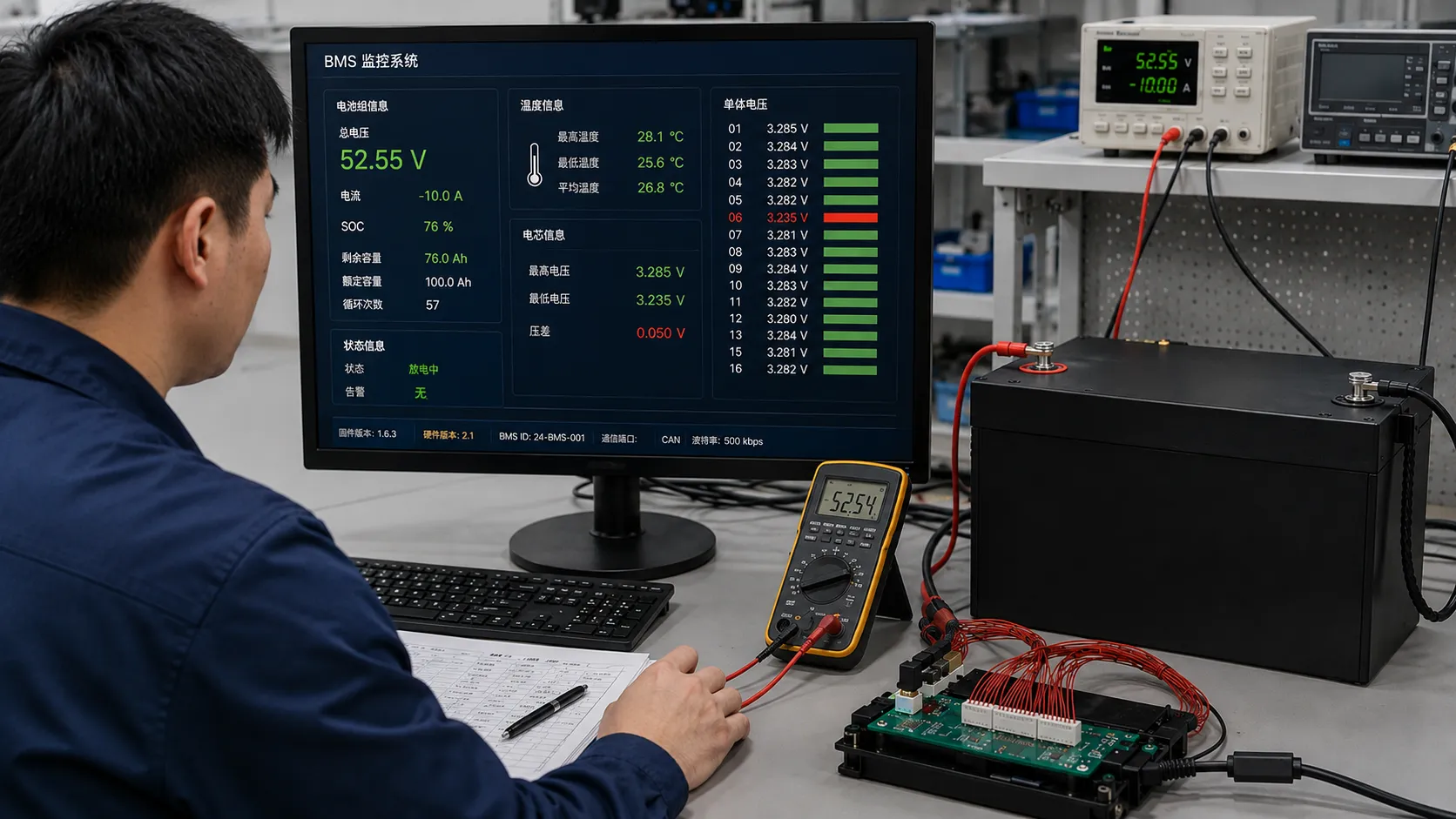
LiFePO4 Battery BMS & Cell Voltage Diagnostic Testing
Pack voltage alone does not always show what is happening inside a lithium battery.
Individual cell voltage, current, temperature and BMS data can help identify
cell imbalance and early BMS cutoff
before components are replaced.
Explore LiFePO4 Battery Problems by Application
Battery faults can appear differently depending on the vehicle, equipment,
charging system and load. Start with the application that matches your system.
Featured Lithium Battery Troubleshooting Cases
Select a diagnostic case below to review the symptoms, possible causes,
system checks and technical information that should be reviewed before replacing components.
GOLF CART
Golf Cart Lithium Battery Shuts Down Uphill
Cart runs normally on flat ground but loses power during uphill driving
or hard acceleration.
Check BMS current limits, controller demand, voltage sag,
cell imbalance and high-current wiring.
View Diagnostic Case →
GOLF CART
Golf Cart Lithium Battery Regen Triggers BMS Cutoff
Golf cart cuts out during downhill driving,
deceleration or regenerative braking.
Check battery SOC, regenerative current, BMS charge limits,
cell over-voltage and controller settings.
View Diagnostic Case →
RV
RV Lithium Battery Not Charging on Shore Power
Shore power is connected and AC appliances work,
but the RV house battery does not charge.
Check converter output, fuses, disconnect switches,
wiring, BMS status and LiFePO4 charger compatibility.
View Diagnostic Case →
LiFePO4 / BMS
LiFePO4 Battery Won't Wake Up After Deep Discharge
Battery shows extremely low voltage, no output
or cannot be detected by the charger.
Check BMS sleep, low-voltage protection, charger detection,
parasitic loads and individual cell voltage.
View Diagnostic Case →
LiFePO4 / BMS
LiFePO4 Cell Imbalance & Early BMS Cutoff
Battery still shows usable SOC or normal pack voltage,
but one cell reaches a protection limit before the rest.
Check highest and lowest cell voltage, cell delta under load,
BMS fault history, charging behavior, temperature and weak-cell symptoms.
View Cell Imbalance Case →
ESS / INVERTER
Lithium Battery CAN Communication Problem
Battery has normal voltage but the inverter reports
No BMS, CAN Fault or Communication Lost.
Check BMS protocol, CAN pinout, baud rate, termination,
firmware, addressing and inverter configuration.
View Diagnostic Case →
PARALLEL BATTERIES
Parallel Lithium Batteries Show Different SOC
Parallel batteries share the same DC bus
but show different SOC or carry different charge and discharge currents.
Check cable resistance, connection layout, BMS calibration,
cell balance, battery age and current sharing.
View Diagnostic Case →
MARINE
Trolling Motor Lithium Battery Shuts Down at High Speed
Trolling motor operates normally at lower speed
but shuts down under maximum thrust or heavy marine load.
Check BMS discharge current, voltage sag, weak cells,
cable resistance, SOC and motor demand.
View Diagnostic Case →
RV
RV Lithium Battery DC-DC Charger Compatibility
Lithium house battery charges slowly, intermittently
or not at all from the alternator while driving.
Check smart alternator behavior, DC-DC charger settings,
BMS charge limits, wiring and charging-system design.
View Diagnostic Case →
Diagnose Before Replacing Components
Similar battery symptoms can have very different causes.
A shutdown may result from BMS current protection, low cell voltage,
wiring resistance, controller demand, temperature
or another system condition.
If total battery voltage appears normal but one cell repeatedly reaches
a protection limit first, review the
LiFePO4 cell imbalance and BMS cutoff diagnostic case
.
A charging problem may come from the charger,
but it may also involve a fuse, disconnect relay,
BMS protection state, cable voltage drop
or an incompatible charging profile.
Measurements and system data should come before component replacement.
Continue With LiFePO4 Technical Resources
Use these resources to move from symptom diagnosis to battery selection,
testing, compatibility review and system integration.
Technical Knowledge Center
Explore LiFePO4 battery sizing, charging, Smart BMS,
CAN/RS485 communication, series and parallel systems
and application-level troubleshooting.
LiFePO4 Technical Knowledge →
Battery Application Guides
Review battery selection and system requirements by
RV, marine, golf cart, energy storage and other applications.
Explore Application Guides →
LiFePO4 Battery Calculators
Estimate battery capacity, energy and application requirements
before selecting or configuring a LiFePO4 battery system.
Use Battery Calculators →
Battery Testing & Validation
Charge-discharge testing, individual cell-voltage monitoring,
current measurement and BMS fault records can help separate
temporary imbalance from load-related voltage sag or weak-cell conditions.
Lithium Battery Testing & Validation →
LiFePO4 System Compatibility
Many lithium battery problems can be prevented before installation
by checking the battery, BMS, charger, inverter,
communication and electrical limits as one complete system.
BMS · CAN / RS485 · Charger · Inverter · Current Limits · Parallel Batteries
Lithium Battery System Compatibility →
Have a Similar Lithium Battery Problem?
To review a lithium battery application more accurately,
provide the battery specification, application or vehicle model,
charger or inverter model, controller information,
system voltage, expected current, fault messages
and any available BMS data.
✓ Battery voltage and Ah
✓ Application / vehicle model
✓ Motor / inverter / controller
✓ Charger model and output
✓ Continuous and peak current
✓ BMS fault or alarm information
✓ CAN / RS485 requirements
✓ Wiring or installation information
Need Help Diagnosing a Lithium Battery System?
Share your battery, BMS, charger, inverter or controller information
together with fault data and operating conditions for a more useful technical review.
Get Lithium Battery Technical Support →
Diagnostic Note:
These classic battery cases describe common real-world lithium battery symptoms
and engineering diagnostic considerations.
Similar symptoms can have multiple causes.
Confirm the actual fault using measurements,
BMS data and complete system information
before replacing components or changing protection settings.